The gross requirement is an anisotropic polarizability tensor, so that changing molecular orientation changes the induced response. A permanent electric dipole moment is not required; a homonuclear diatomic can therefore have a rotational Raman scattering spectrum.
For the inelastic lines of a linear rigid rotor, the detailed rule is , with . The contribution is unshifted Rayleigh scattering, not a rotational Stokes Raman scattering line. Stokes Raman scattering has because the molecule gains rotational energy.
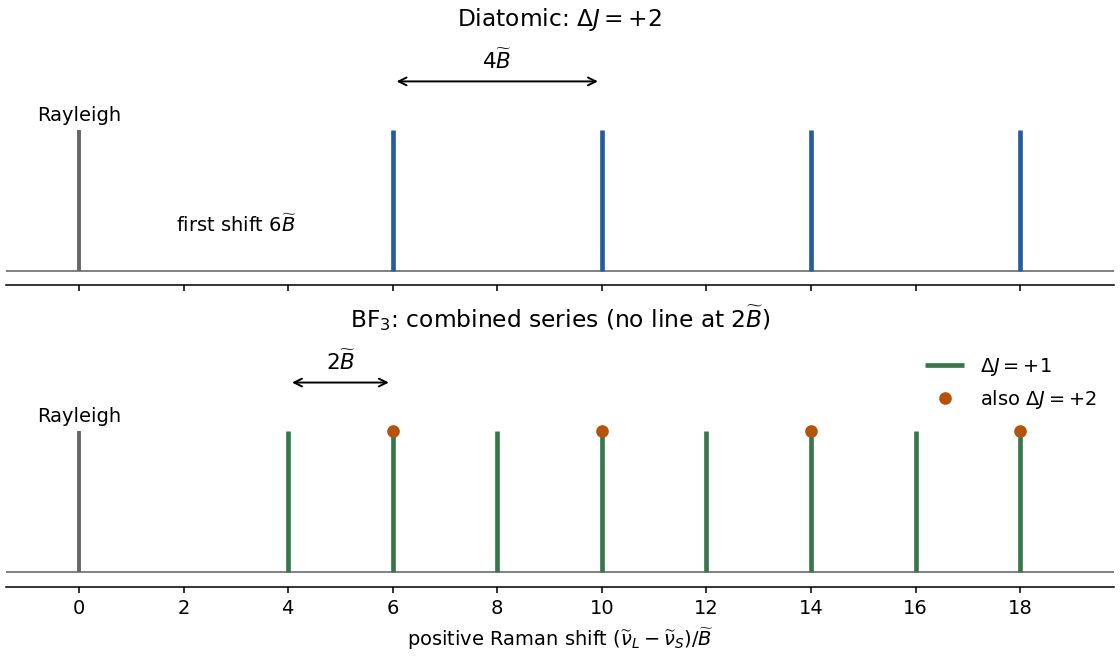
For a transition starting at and ending at , the molecule gainsEnergy conservation therefore gives the scattered-light wavenumbersThe first shifts below the laser are . Adjacent Stokes lines are separated by , while the first line is from the Rayleigh line. The figure uses positive Raman shift ; increasing shift means decreasing scattered-light wavenumber.

Articles by others on the same topic
There are currently no matching articles.