Number the enone carbonyl carbon C1, the adjacent alkene carbon C2 and the ethoxy-bearing alkene carbon C3. In the bromine-first pathway, the enol-ether-like unit attacks at C2, breaking the Br–Br bond. The intermediate has a new C2–Br bond and positive charge at C3, stabilized as an oxonium chemical resonance contributor by donation from the ethoxy oxygen.
triethylamine removes the remaining C2 hydrogen. Its C–H bonding pair reforms C2=C3 and neutralizes the oxonium system. The result is replacement of the vinylic C2–H by C2–Br, with the original enone and ethoxy group retained. If bromide first captures the cationic intermediate, the equivalent vicinal dibromide can eliminate HBr to reach the same product.
The ethoxy group makes this alkene sufficiently electron-rich for the electrophilic-addition description. It is important to place bromine at C2 and restore the double bond, rather than stop at a saturated addition product.
For an amine-first pathway, use triethylamine as a nucleophile in a reversible conjugate addition. Its lone pair attacks C3 of the enone; electron shifts through C2 and the carbonyl give a zwitterionic enolate with a C3– bond.
The C2 nucleophilic site of that enolate attacks , installing C2–Br and releasing bromide. Removal of C2–H by base then reforms C2=C3 while the C3–N bond breaks back to neutral triethylamine. This addition–bromination–elimination sequence gives the same C2-brominated enone and regenerates the nucleophilic amine, with another base equivalent accepting the eliminated proton.
These are alternative formal sequences requested by the question, not a kinetic determination that one must dominate under unspecified conditions. In particular, the amine-first sequence does not require triethylamine to generate a high concentration of a vinylic carbanion by direct deprotonation.
A is a fused five-/six-membered bicyclic diketone containing sulfur. To specify its structure unambiguously, retain the cyclohexanone numbering C1=O, C2 and C3 for the original alkene. Add the five-membered ringThe original C1 ketone remains, and the former methyl-ester carbonyl becomes the second ketone. The product is drawn in the first panel below.
methoxide first deprotonates the thiol. The soft thiolate attacks the beta carbon C3 in a Michael addition, shifting the enone electrons onto oxygen. The resulting enolate is nucleophilic at C2. It then attacks its tethered ester carbonyl intramolecularly, forming a five-membered ring through a tetrahedral intermediate. Collapse expels methoxide. proton transfers and work-up give the neutral bicyclic beta-diketone.
The initial 1,4 addition followed by intramolecular Claisen acylation explains the regiochemistry: it connects C3 to sulfur and C2 to the ester carbonyl, giving a favorable five-membered closure. Addition to the original ketone would not give this same enolate-and-ester arrangement. The net loss of methanol from the combined starting materials gives the observed formula.
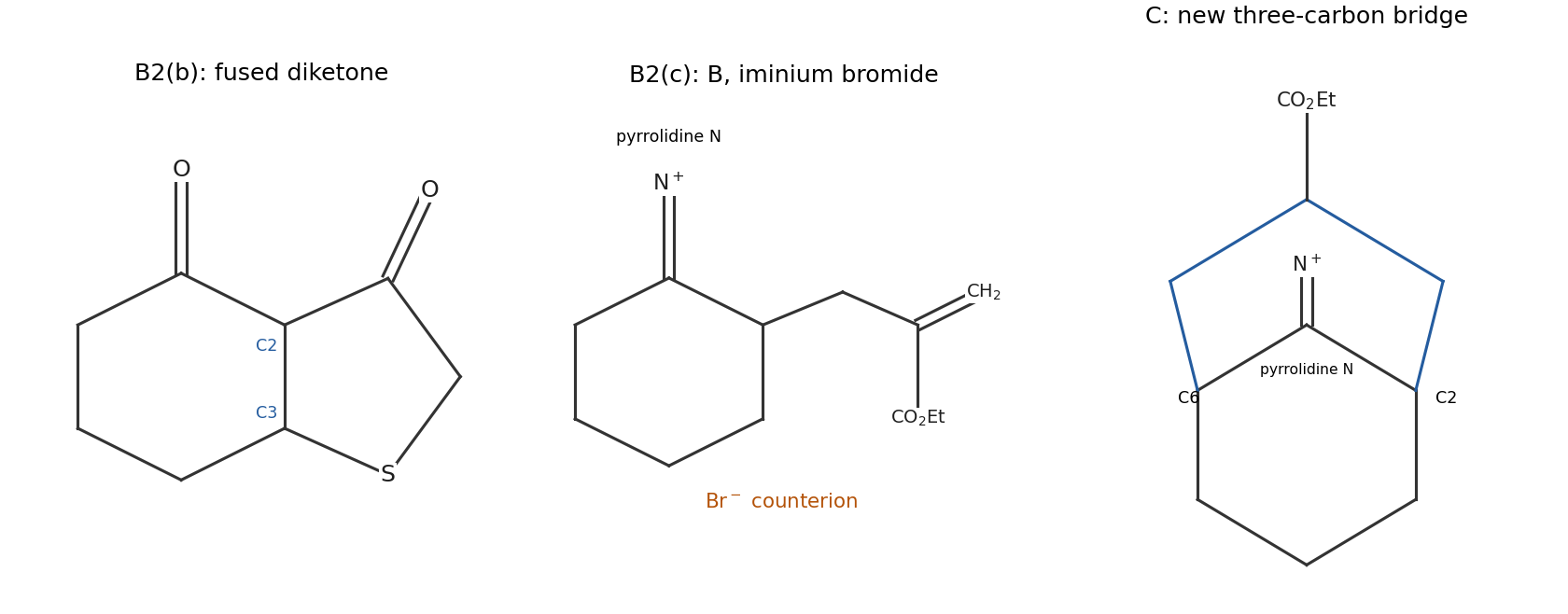
Label the enamine carbon bonded to nitrogen C1 and its alkene partner C2; C6 is the other carbon next to C1. B is the C-alkylated iminium ion bromide. Its new substituent at C2 is , while C1 is double-bonded to the pyrrolidine nitrogen, which bears positive charge. bromide is the counterion, accounting for Br in the empirical formula without requiring a retained C–Br bond.
The C2 end of the enamine attacks the bromomethyl carbon by displacement. Simultaneously, donation of the nitrogen lone pair creates the C1=N bond. This is ordinary enamine C-alkylation, not N-alkylation.
proton transfer removes an alpha proton at C6, converting the iminium ion into the enamine regioisomer C1=C6. That enamine attacks the terminal of the tethered acrylate in an intramolecular Michael addition. nitrogen donation restores the iminium ion, and protonation of the ester enolate completes the sequence.
The new bridge is . Together with the original ring and its C1 bridge this produces the bicyclononane iminium ion skeleton in C. It retains the pyrrolidine group and the ester; hydrolysis to a ketone is not part of the displayed reaction. The second panel of the original annulation figure shows the chemical atom connectivity and distinguishes ionic bromide in B from a covalent bromine substituent.
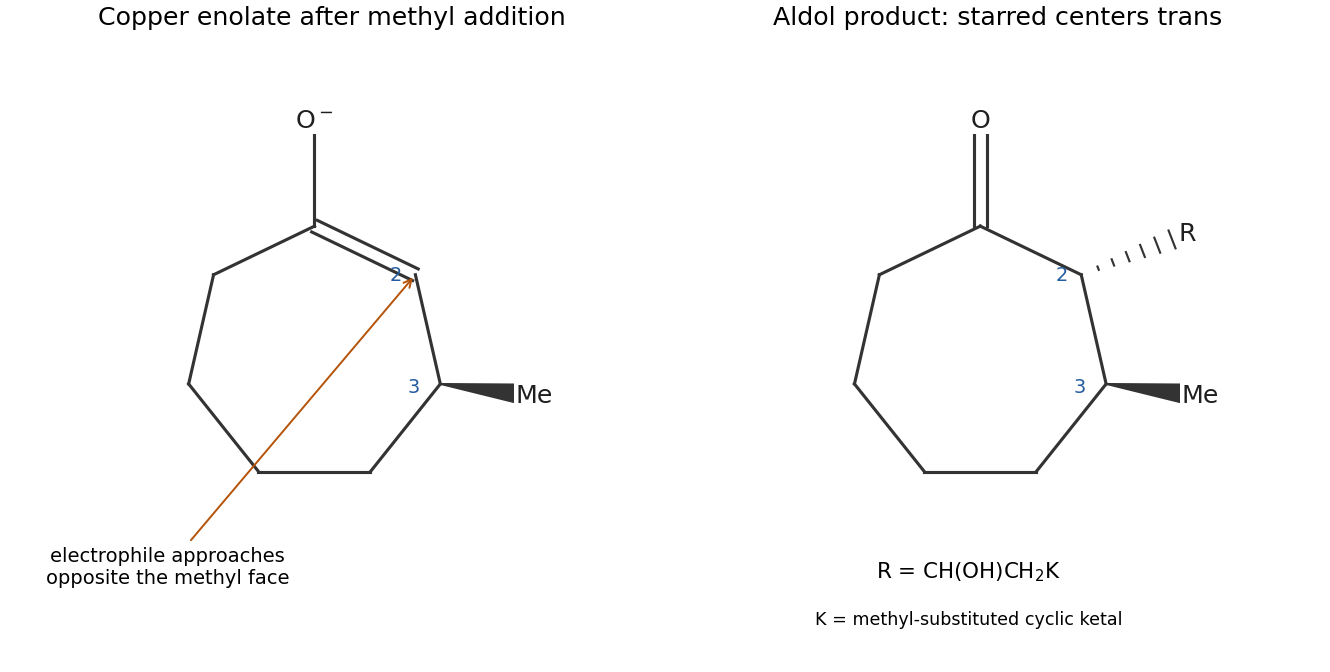
copper(I) converts the methyl grignard reagent into a softer organocopper nucleophile. Methyl undergoes 1,4 addition to the beta carbon of the cycloheptenone, giving a metal enolate rather than direct 1,2 addition to the ketone carbonyl.
The carbon nucleophilic site of this enolate, at the alpha carbon, attacks the aldehyde carbonyl in the second reagent. Its C=O electrons move to oxygen; protonation of the resulting alkoxide gives the beta-hydroxy ketone side chain. The cyclic acetal is a protected ketone and survives these nucleophilic conditions.
The beta methyl group shields one face of the cyclic enolate. Aldol bond formation from the less crowded opposite face places the new alpha side chain trans to the beta methyl group. Thus the two starred ring centers have an anti relationship; the two mirror-related products are possible from achiral starting materials and reagents. This argument does not assign the separate, unstarred alcohol center, for which the question gives no specified configuration.


Articles by others on the same topic
There are currently no matching articles.