Methane consumes hydroxyl radicals during its initial oxidation and therefore influences atmospheric oxidative capacity and the removal of other trace gases. Subsequent oxidation generates peroxy radicals. In the presence of sufficient nitrogen monoxide, these convert nitrogen monoxide to nitrogen dioxide without consuming ozone, allowing net photochemical ozone production. At low nitrogen monoxide, peroxide formation and ozone-destroying radical reactions compete. Methane oxidation ultimately produces carbon monoxide and carbon dioxide; the sign and rate of the associated ozone response depend on the radical/nitrogen oxides regime, not methane alone.
Methane reaching the stratosphere is oxidized and is an important source of stratospheric water vapor. That water can feed HOx radical family chemistry and alter radiative cooling and polar-cloud conditions. Methane also converts chlorine atoms into hydrogen chloride, opposing some chlorine-driven ozone loss. These effects compete: increasing methane does not have one universal ozone sign at every altitude and latitude.
Methane is an infrared-active greenhouse gas with absorption in the terrestrial thermal spectrum. Its direct forcing is supplemented by chemically induced changes in tropospheric ozone and stratospheric water vapor. Its finite atmospheric lifetime makes sustained emissions and emission pulses different experiments: stopping emissions permits the methane burden to decline much faster than the long tail of a carbon-dioxide perturbation. Quantitative comparisons require a specified emission mass, time horizon and treatment of indirect effects, as formalized by global warming potential.
A humidity assumption is necessary: warming does not by itself specify how much water is available. At fixed relative humidity, the Clausius-Clapeyron equation gives the first-order vapor pressure responseIf water abundance is approximated as proportional to , the usual first-order estimate is a increase in hydroxyl radical production. Integrating the constant-latent-heat expression instead of linearizing gives .
There is a small but explicit concentration correction when the square brackets are literal molecules per volume. Since and ,The corresponding finite-change concentration result is . The linear concentration estimate and the vapor pressure approximation express different stated approximations; neither follows without a humidity condition.
Extra water increases the fraction of oxygen singlet D atoms reacting to form hydroxyl radicals rather than being collisionally quenched and recycled into ozone. In clean, low-nitrogen oxides air this tends to increase ozone loss. In nitrogen oxides-rich air, increased hydroxyl radical can accelerate precursor oxidation and ozone production, while radical termination also changes. Greater hydroxyl radical production therefore does not imply a universally positive or negative ozone response.
The lost ozone-column photolysis shielding is , so its optical-depth decrement is . Under the stipulated effective-cross-section Beer-Lambert model, the transmitted photodissociation flux increases by .
The short-lived oxygen singlet D atom satisfies when quenching dominates. At fixed local ozone, water and air density, hydroxyl radical production is proportional to . ConsequentlyA linear optical-depth approximation would give . A realistic calculation integrates the wavelength-dependent absorption cross section, quantum yield and actinic flux; clouds and multiple scattering modify the simple transmitted-beam model.
Ozone change can also alter the radiative temperature structure, water vapor and circulation, thereby changing the water reaction channel and the supply of ozone/precursors to the troposphere. If the held-fixed tropospheric ozone assumption is relaxed, altered ozone itself changes the photochemical source of oxygen singlet D atom. These are additional feedbacks, distinct from the isolated UV-transmission calculation above.
For the tropospheric OH budget, let be hydroxyl radical production per unit volume and its total first-order loss frequency. The present hydroxyl radical steady state hasHere one year is days; using it consistently makes the reported lifetimes in years independent of that conversion convention. Methane's chemical lifetime is , givingThe current combined loss frequency already includes existing hydrogen, so add only the incremental hydrogen sink:Holding production and the other losses fixed then gives andThe rapid hydroxyl radical adjustment time, of order a second, supports its steady-state approximation in this box model. Subsequent methane growth would itself change hydroxyl radical consumption, so the computed increase is not a fully coupled long-term atmospheric prediction. Detailed molecular hydrogen modelling treats changes in methane, ozone and stratospheric water alongside reductions in other precursor emissions.[ref]
Atmospheric composition and climate impacts of a future hydrogen economy by Nicola J. Warwick and others. Atmospheric Chemistry and Physics 23 (2023), §3.1 and Abstract: indirect methane, ozone and water-vapor responses
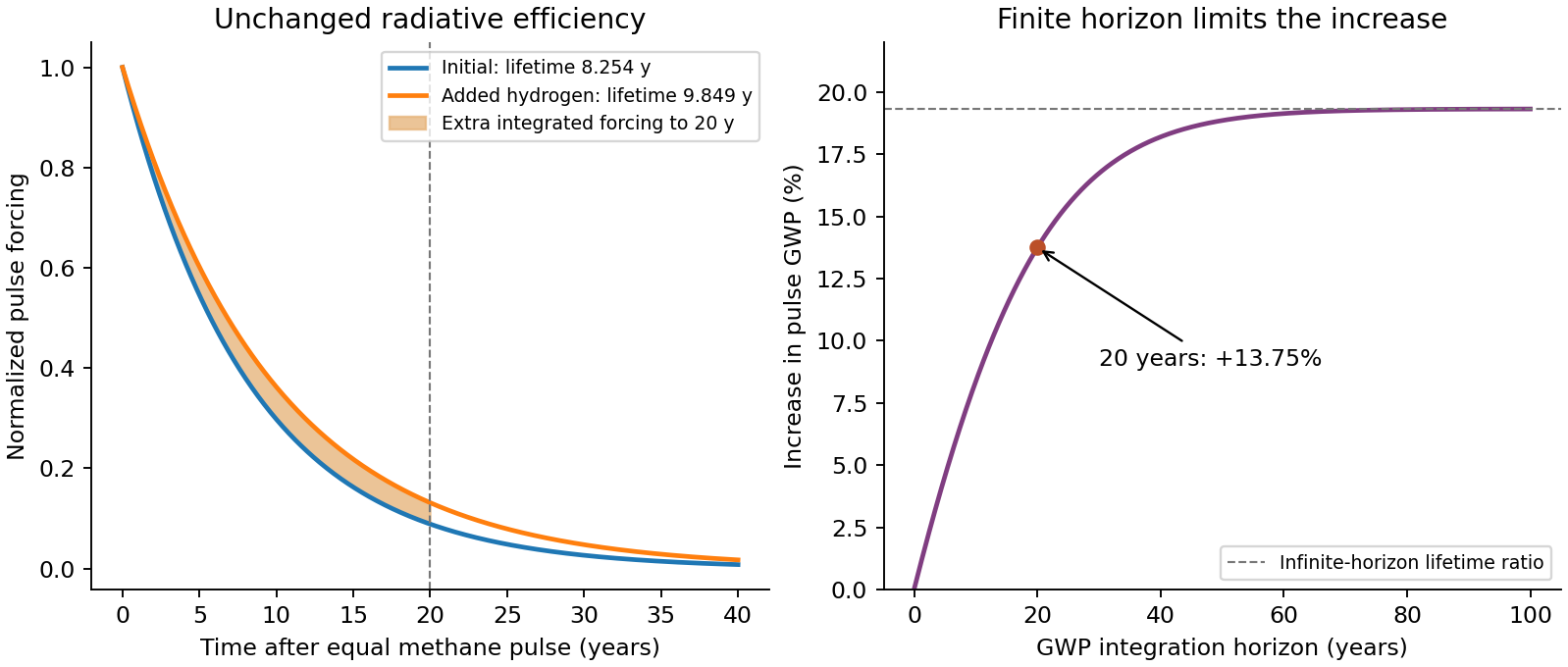
The finite-horizon GWP lifetime sensitivity follows because a longer lifetime leaves more methane from a given pulse at later times and raises the steady burden for a given constant emission rate. For the stipulated exponential pulse response and unchanged greenhouse gas radiative efficiency, the integrated methane forcing over horizon is proportional to . The same carbon dioxide reference pulse appears in both global warming potential denominators, so it cancels from their ratio:Thus the twenty-year GWP increases by under these fixed-efficiency assumptions. This is smaller than the lifetime increase because part of the extra forcing occurs beyond the finite horizon. For an infinite horizon the fractional increase would approach the lifetime ratio. Indirect forcing and the distinction between a chemical lifetime and a hydroxyl radical-coupled methane perturbation lifetime require a fuller chemical model; they are held fixed in this comparison.

Lower carbon monoxide and VOC emissions generally reduce the supply of peroxy radicals from their oxidation and therefore reduce photochemical ozone production where nitrogen monoxide is available. Lower nitrogen oxides abundance suppresses the nitrogen monoxide-to-nitrogen dioxide pathway in NOx-limited ozone production regions. These are reasons for a regional/background ozone decrease when fossil-fuel precursor emissions decline.
The response can have the opposite local sign in a nitrogen monoxide-rich urban core: reducing nitrogen monoxide weakens ozone titration, and reducing nitrogen oxides in a VOC-limited ozone production regime can initially lessen radical termination and raise ozone. Less carbon monoxide can also leave more hydroxyl radical available to remove methane, partly opposing the hydroxyl radical demand from leaked hydrogen. Changes in precursor transport, chemistry and sunlight matter. Reduced emissions usually reduce net regional ozone production, but do not guarantee a lower ozone concentration at every monitoring site.
Articles by others on the same topic
There are currently no matching articles.