For each of the balls, let be the indicator random variable that ball survives the round of uniform balls-in-bins allocation. Condition on its chosen bin. Each of the other balls avoids that bin with probability , independently, so the probability that ball is served is . Hence, for ,We used linearity of expectation to sum the indicator random variables; their mutual independence is unnecessary. For or , the next count is zero. This states the boundary cases without an ambiguous when .
There is no proof of the printed assertion: it is false for the stated expectations. The original explicitly defines as the expected remaining count, so replacing it by a deterministic upper envelope changes the problem.[ref]
Probability and Computing examination paper by the University of Oxford (2015). Printed p. 2, definition preceding Question 2(b), and Question 2(b)
Let be the actual count after rounds and . The union bound gives the valid conditional estimateBy the law of total expectation, the resulting unconditional bound isDiscarding the variance term is an expectation closure error for a nonlinear recurrence. In particular, Jensen's inequality says , which cannot justify the requested upper bound.
For an exact counterexample, start with two balls and two bins. A round serves both balls if they land separately and serves neither if they collide. Each outcome has probability , independently in successive rounds while both balls remain. ConsequentlyAt , the requested inequality would say , but
The printed bound also fails for the actual expectations. In the two-bin counterexample from part (b), at the true value and proposed bound areThe supplied premise does hold in this example: . Thus the problem is the invalid recurrence in part (b), rather than failure of the supplied starting estimate.[ref]
The intended mathematical induction is valid conditionally on the recurrence. For a deterministic nonnegative sequence satisfying and , the base case is . If , thenThis proves the proposed form for but cannot identify with .
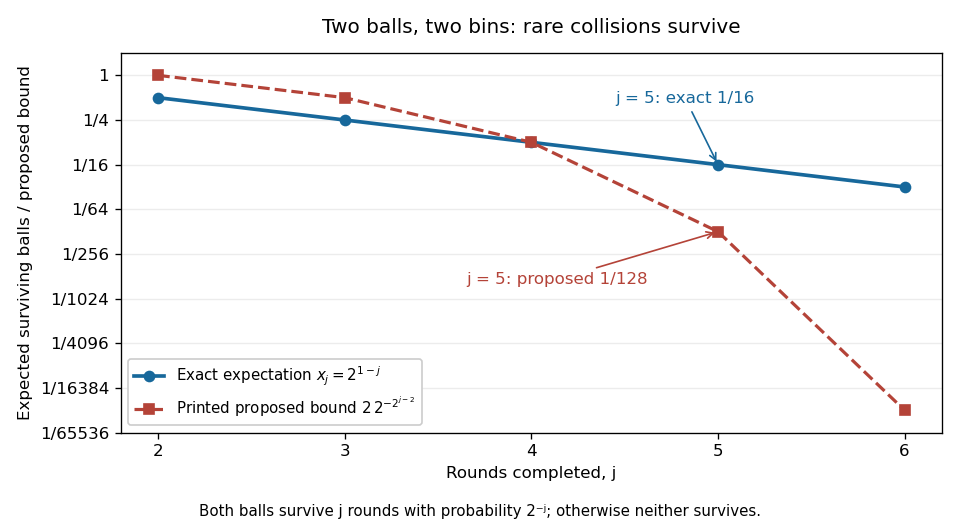

If the bound in part (c) were available, the intended answer would beIndeed , so that bound would give . Its growth is in Big O notation. Because (c) is false, this substitution alone does not prove the result for the actual repeated singleton-removal allocation.
The requested order can nevertheless be established for the actual process. Here is a concrete, deliberately generous replacement, with for the empty system:The large cutoff makes the numerical estimates below simple. A finite initial range does not affect the asymptotic analysis.
First, whenever , a ball is served with probability at leastThus part (a) gives , also for . The law of total expectation yields . This proves for the small- branch, including , whose single ball is served immediately.
For the large- branch, we need control of the random count, rather than an unjustified recurrence for its expectation. If balls are allocated in a round, changing one chosen bin changes the number of singleton bins by at most two. The surviving count therefore has the bounded differences property with constants . McDiarmid's inequality givesThis can be applied conditionally after any history, since the next allocations are fresh independent random variables.
Use this concentration inequality in three stages. Write .
- For the first eight rounds, whenever , the conditional expectation is at most . Taking shows that the next count is at most , except with probability at most . If the count has already fallen below , it stays there. Since and , this gives outside the stated exceptional events.
- Starting with , set . If and , part (a) and the union bound give . Taking gives a next count at most , except with probability at most . The deterministic solution is . It falls below within steps. After reaching that threshold the count cannot increase, so outside the exceptional events.
- From , the next conditional expectation is at most . A deviation leaves at most balls except with probability . From at most balls, the next conditional expectation is at most . Taking leaves at most balls except with probability . Conditional on this final count bound, one more round has expectation at most .
Every exceptional probability above is at most , and there are at most opportunities for an exception. For , the elementary bounds and give, by the union bound, total exceptional probability at most . The first numerical inequality holds at the cutoff and remains true because is increasing there. On an exceptional history there are at most balls. Taking the last round's conditional expectation and then averaging givesThis proves the displayed replacement for the literal process without relying on either false assertion.
Consider any edge of the simple graph. One endpoint comes first in the permutation ; suppose it is . Then has a graph neighbour preceding it, namely , so . Therefore no edge has both endpoints in :This argument uses only the order of the endpoints, with no random choice required.
Choose a uniform random permutation of the vertices, giving every one of the orders the same probability. For a fixed vertex , consider together with its graph neighbours. The relative order of these vertices is uniform, so each is equally likely to be first. The membership rule for therefore givesLet be the indicator random variable of this event. The cardinality is , and linearity of expectation givesThe indicator random variables are generally dependent; only the uniform random permutation and linearity of expectation were needed. An isolated vertex has and is always included, as the formula correctly predicts.
The expectation from part (f) is the average of over the finite collection of permutations. At least one value is as large as its average. By part (e), the corresponding is an independent set, soHere is the independence number. Since its value is an integer, one can equivalently round the right side up with the ceiling function. This application of the probabilistic method is the Caro-Wei bound.
Articles by others on the same topic
There are currently no matching articles.