In the spin-degenerate free electron model, a monovalent metal has conduction-electron number density . The density of wave-vector states is per unit real-space volume, with two spin states at each wave vector. Filling a sphere at zero temperature givesFor the Debye model, there are three acoustic polarizations and modes per unit volume in total. Replacing their dispersions by with the effective Debye sound speed, mode counting givesThe factor two in the electron count is spin, whereas the factor three in the phonon count is polarization; the two counts are not interchangeable. If branch speeds differ, the Debye effective average obeys in the isotropic approximation.
Dividing gives , where . A monatomic FCC conventional cell contains four atoms, so . ThereforeHere and below is the speed of sound, not the speed of light. The Debye cutoff counts acoustic modes in a spherical approximation to the Brillouin zone; it is not an electron-state cutoff.
Using gives the electron-acoustic recoil lengthThe temperature ratio therefore fixesIt follows that , and . Substitution givesThe resulting Fermi energy is about and the temperature ratio is indeed . These values follow from the supplied effective sound speed and free-electron/Debye approximations; they are not independent precision measurements of copper's parameters.
An electron losing energy to an acoustic phonon has, in a normal process, , with possible addition of a reciprocal-lattice vector for an Umklapp process. The energy transfer is at most of order , much smaller than . Hence the magnitudes change very little even though the momentum direction can change substantially. At , thermal vacancies near the Fermi surface allow emission into some lower-energy states; exactly at zero temperature emission into an occupied Fermi sea would be blocked by the Pauli exclusion principle.
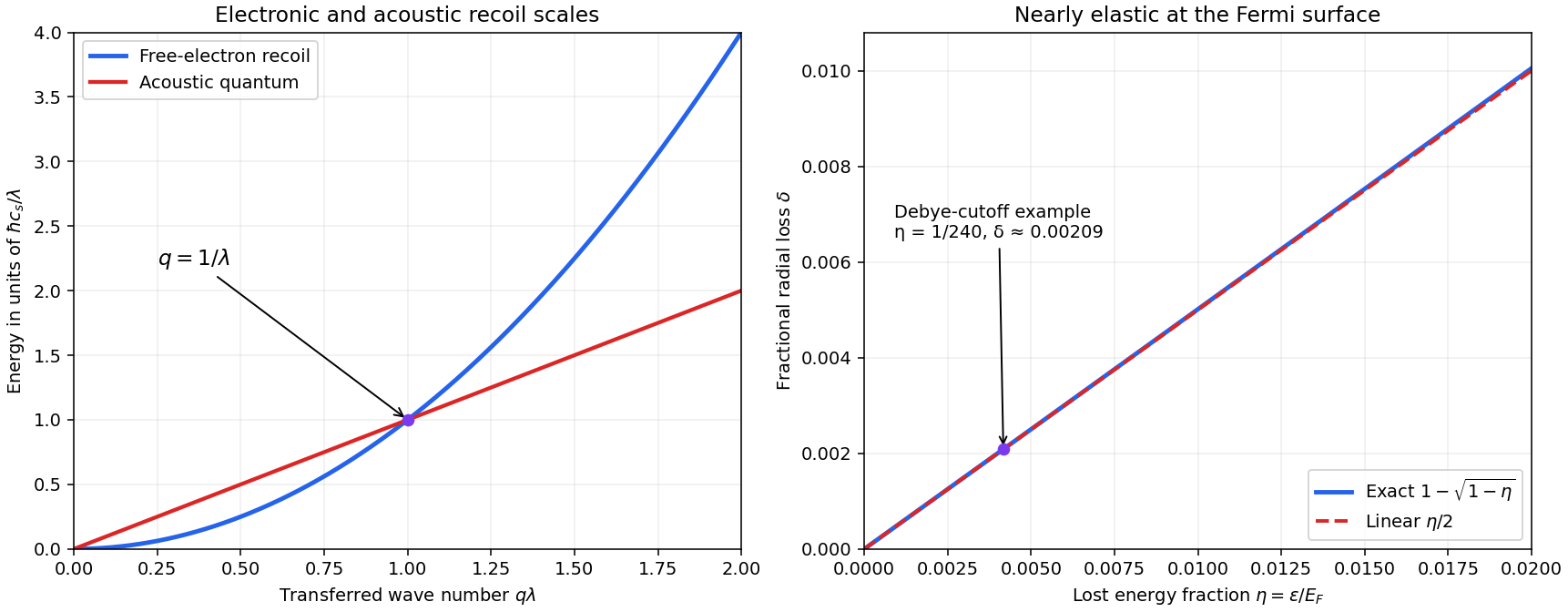
Using and the free-electron dispersion, energy conservation givesSince , the bracket is . Rearranging yieldsEquivalently . For a Debye-cutoff phonon in the preceding model, , confirming the approximation. Near-elastic scattering constrains the radial distance in wave-vector space, not the scattering angle alone.
The electron-acoustic recoil length compares electronic recoil with the acoustic quantum energy associated with the same momentum. For transferred wave number ,The dispersions cross at ; there the reduced electron de Broglie wavelength is and its free-particle group velocity is . Thus is the length scale at which an electron's localization/recoil energy and a corresponding acoustic excitation energy become comparable. At the electron recoil energy is large compared with the phonon energy; this explains the separation of electronic and acoustic energy scales when lattice wave numbers exceed .
Formally it is half the Reduced Compton wavelength with the speed of light replaced by the speed of sound. That is an analogy of scales, not a relativistic electron mass or a pair-production threshold: sound does not replace the limiting speed in electron dynamics. Also it is a reduced-wavelength convention; an ordinary de Broglie wavelength at the crossing is . No scattering lifetime appears, so is not an electron mean free path.

Articles by others on the same topic
There are currently no matching articles.