Write the two allowed moment projections as , where for spin one-half. Their Zeeman energies in the prescribed flux density are . The single-particle partition function and the mean moment along the field areFor noninteracting moments, magnetization is moment per volume:For electron-like spin-only moments , these become and .
Differentiate with respect to the specified to obtainThis derivative is not a dimensionless SI volume susceptibility. In the weak-feedback approximation , the usual dimensionless differential susceptibility is . The small-field limit gives Curie's law . At finite bias a secant response differs from the differential slope . For an internal retained self-consistently, the exact local conversion is ; demagnetizing geometry can further affect an applied-field measurement. Stating the field convention avoids a hidden factor of or confusion between a slope and a ratio.
A shell has one hole in the otherwise filled shell. Hund's rules give , , and, for a more-than-half-filled shell, : the free-ion term is . Its Landé factor isDistinguish the Curie effective moment from a saturated projection:The question then explicitly asks us to use orbital quenching in the crystal. Ligand fields split and mix orbital states, suppressing their freely orientable angular momentum. The spin-only approximation has , , so but the two field-axis projections are . The latter, not , belong in the tanh argument and saturation magnetization.
The sulfate and water environment supplies mainly closed-shell, weakly magnetic surroundings, stabilizes localized Cu2+ sites and separates their moments so that exchange can be weak on the temperature scale considered. Paramagnetism here is an approximation of weakly interacting local spins, not a claim that dilution guarantees no magnetic ordering at any temperature. Elemental copper has a filled band and itinerant conduction electrons rather than one localized Cu2+ spin per atom. Pauli spin response and orbital/core contributions then replace a local-spin Curie law; ordinary pure copper has a weak net diamagnetic response.[ref]
https://www.sciencedirect.com/science/article/pii/S1090780715000774. 2015 primary measurement, abstract: negative volume susceptibility of high-purity copper wire
There is one Cu2+ per formula unit, hence m. The spin-only weak-field SI volume susceptibility isThese neglect exchange, anisotropic factors and background diamagnetism. At high field and low temperature, saturation requires the nonlinear response in a; a field-independent Curie value then describes only the zero-field slope.
For T, use the two spin-only moment states. Their probabilities and normalized magnetization areAt 300 K, ; at 2 K, . ThereforeThe phrase “fraction aligned” is ambiguous if it is used to mean net alignment. Half the moments are already in the parallel state at zero field, but the net magnetization is then zero because the antiparallel half cancels them. The table reports both the literal parallel-state population and the imbalance that produces magnetization. At this weak field even the 2 K sample is far from saturation, so the Curie approximation is accurate within this independent-spin model.
For T, the same spin-only two-state probabilities apply, but the low-temperature argument is no longer small. At 300 K, ; at 2 K, . HenceThe 2 K sample is about of its saturation magnetization, with about of the moments in the aligned state. The two percentages describe different observables. A linear extrapolation would predict , exceeding saturation and therefore contradicting the bounded two-state population.
For completeness, at this 2 K, 5 T bias the dimensionless secant susceptibility is approximately , while the differential susceptibility is under the same prescribed-field approximation. Neither equals the zero-field Curie slope . Thus saturation reduces the incremental response even while the magnetization itself is large.
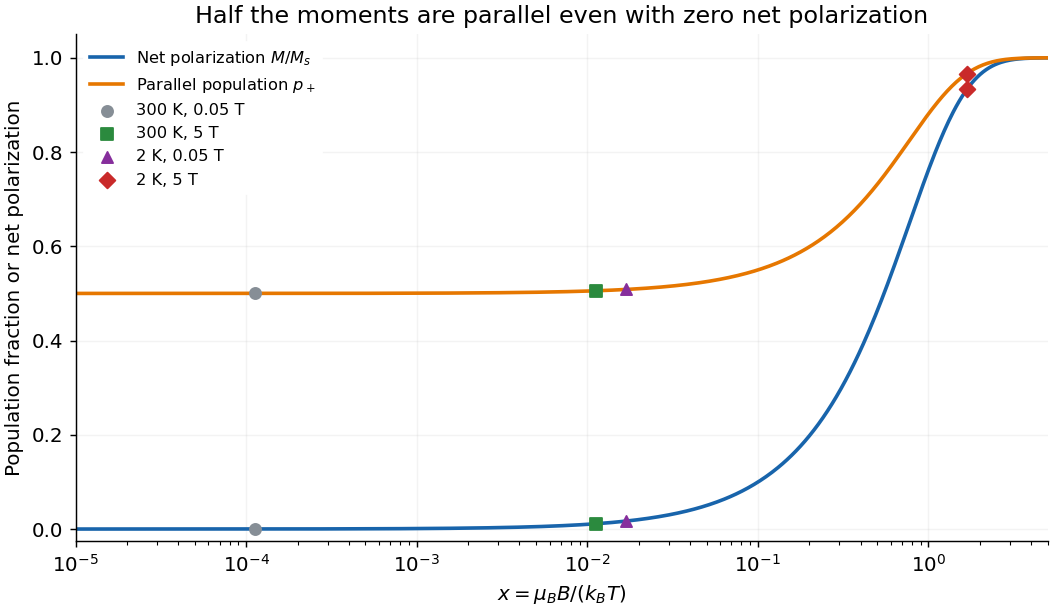
Parallel-state population and net spin polarization
. Original independent-spin calculation. At zero field the parallel-state population is one half and net polarization is zero; the four specified field and temperature combinations are marked. Details.
Articles by others on the same topic
There are currently no matching articles.