The method of characteristics replaces the first-order partial differential equation by the ordinary differential equationsAn integrating factor for the second equation gives , so their general solution of a differential equation isHere are real constants. For , eliminating gives the characteristic projectionseach restricted to either or . These are arcs of parabolas, with the straight-line exception . Along an oriented characteristic curve, increases with .
For , the characteristic projections lie on : describes either vertical half-line when . For the projection is the single point , although still changes. This last lifted characteristic curve cannot be contained in the function graph of a classical solution: at the original partial differential equation would require .
Parametrize the initial curve by , . Its tangent is , whereas the projected characteristic vector field there is . The determinantproves that these are Noncharacteristic Cauchy data: the initial curve is everywhere transverse to the characteristic curves.
There is a regularity qualification. The prescribed function is continuous and Lipschitz continuous, but is not differentiable at . Thus the data are Cauchy in this geometric sense, with data given by a smooth function on each of and ; the usual theorem giving a global classical solution from continuously differentiable data does not apply across .
Use the initial conditions , , in the characteristic equations for a transport equation. The resulting parametrized solution surface isThe Jacobian determinant of is . In fact the inverse is explicit:Consequently the explicit solution of a differential equation on the region reached from the data isTo verify it away from , set . Direct differentiation gives and . At we have , giving precisely the prescribed boundary condition.
Across the formula remains continuous and locally Lipschitz, is a smooth function on each side, and solves the partial differential equation along every characteristic curve. It is also a weak solution, since its first distributional derivatives agree almost everywhere with its ordinary derivatives. It is not a classical solution throughout the region because of the inherited corner.
Every point with has exactly one backward characteristic curve meeting , at the point . It meets the specified data precisely when . Thus the whole region determined by these data, including the two bounding characteristic curves, isIts interior is the corresponding open domain for the partial differential equation. Uniqueness here means uniqueness in the class of continuous functions satisfying the characteristic equations for a transport equation, including the piecewise smooth function defining the solution of a differential equation above. The endpoints of the initial segment determine the two boundary values by continuity.
This region is maximal for determination by the given data: on , arbitrary extensions of outside give different values on the characteristic curves with . No characteristic curve from reaches .
For ,The lower boundary is a straight line, the upper boundary is a parabola, and the characteristic carrying the corner is . All three approach the excluded origin as .
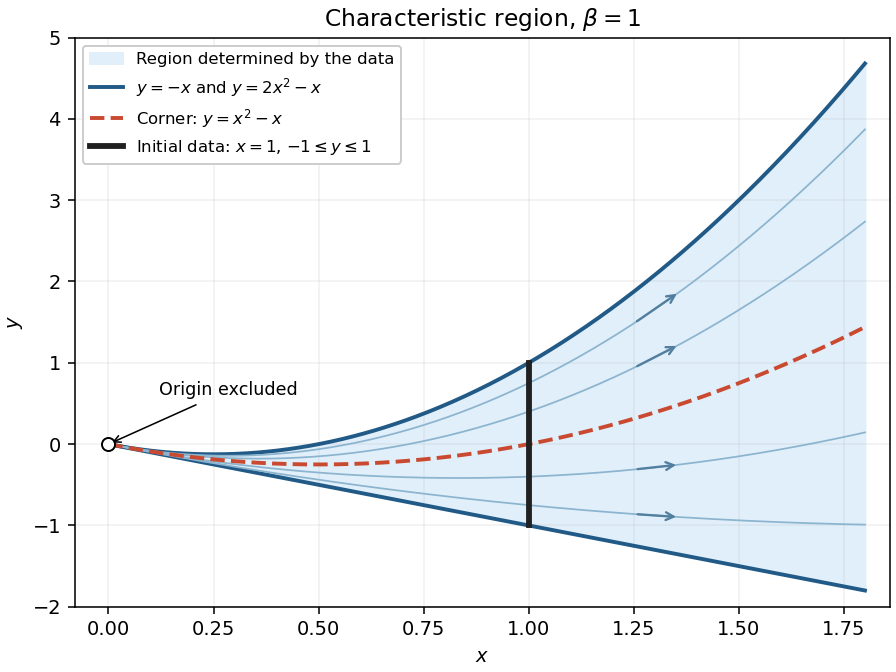

For , . On the two sides of the corner-carrying characteristic curve, the partial derivative isAt every point with , the two one-sided partial derivatives are and . Therefore does not exist on this curve; its piecewise values have a jump discontinuity of magnitude . There are no other interior discontinuities. The values on the outer boundaries are interpreted from within .
This is exactly propagation of a derivative jump along a characteristic. Already on , the data have slopes and on the two sides of . The transport equation transports this corner along the characteristic curve from , which is ; it provides no smoothing. This is consistent with Noncharacteristic Cauchy data and does not contradict the smooth-data theorem, whose differentiability hypothesis fails here.
In the convention , the coefficients of the principal symbol areThus the second-order partial differential equation isThere is no region of elliptic partial differential equation type. The terms hyperbolic, parabolic and elliptic refer to the pointwise classification of a second-order partial differential equation. At every second-order coefficient vanishes, so the principal symbol has rank zero and the equation is degenerate rather than genuinely parabolic there. Moreover the right side is , so no twice continuously differentiable classical solution can satisfy the equation at the origin.
For , the equation for the characteristic curves isThe two families are therefore and the characteristic projections from part (a), , together with the vertical characteristic . On either region or , the hyperbolic partial differential equation admits the characteristic coordinatesIndeed is constant along the first family, while . Their Jacobian determinant isThe coefficients of the two pure second partial derivatives in these coordinates vanish, and the coefficient of the mixed partial derivative is . Hence they give the hyperbolic characteristic normal form. They also remain regular at , provided .
The alternative , is valid on patches with . On , it is a parabolic partial differential equation away from the fully degenerate origin, so two independent hyperbolic characteristic coordinates are unavailable.
The second-order differential operator factors asTherefore setting turns the second-order partial differential equation into exactly the first-order partial differential equation in part (a). Conversely, given a sufficiently smooth solution of a differential equation of that equation on a coordinate rectangle, defineThe fundamental theorem of calculus gives , so this solves the second-order equation, with an arbitrary twice continuously differentiable function . This classical correspondence is local on smooth patches; for the cornered solution of part (b), it can instead be interpreted using distributional derivatives.
Articles by others on the same topic
There are currently no matching articles.