Orient counterclockwise around the body. For an arc element , the body-outward unit normal vector obeys . The pressure acts normally into the body, so its force per unit length in the suppressed third direction isIntegrating givesTaking positive torque to mean counterclockwise about the origin, the infinitesimal moment is . HenceAll three expressions are per unit span. They are the normal-pressure contributions assumed by the inviscid model; a viscous traction would require extra terms. A constant pressure contributes zero net force and torque on a closed body, since .
Use the complex velocity . For this steady, constant-mass density, irrotational flow with no body force, the applicable Bernoulli equation iswith a single constant throughout the connected regular fluid region. The body's impermeability makes the velocity tangent to . Thus is real there, givingThe complex force from part (a) iswhere the constant- term vanishes. This proves the Blasius force theorem:For the moment, observe thatTherefore . The constant pressure contribution has zero real part, because . Substituting Bernoulli's principle and the same tangency identity gives the Blasius moment theorem:The real-part operation is essential: itself need not vanish, but its real part does.
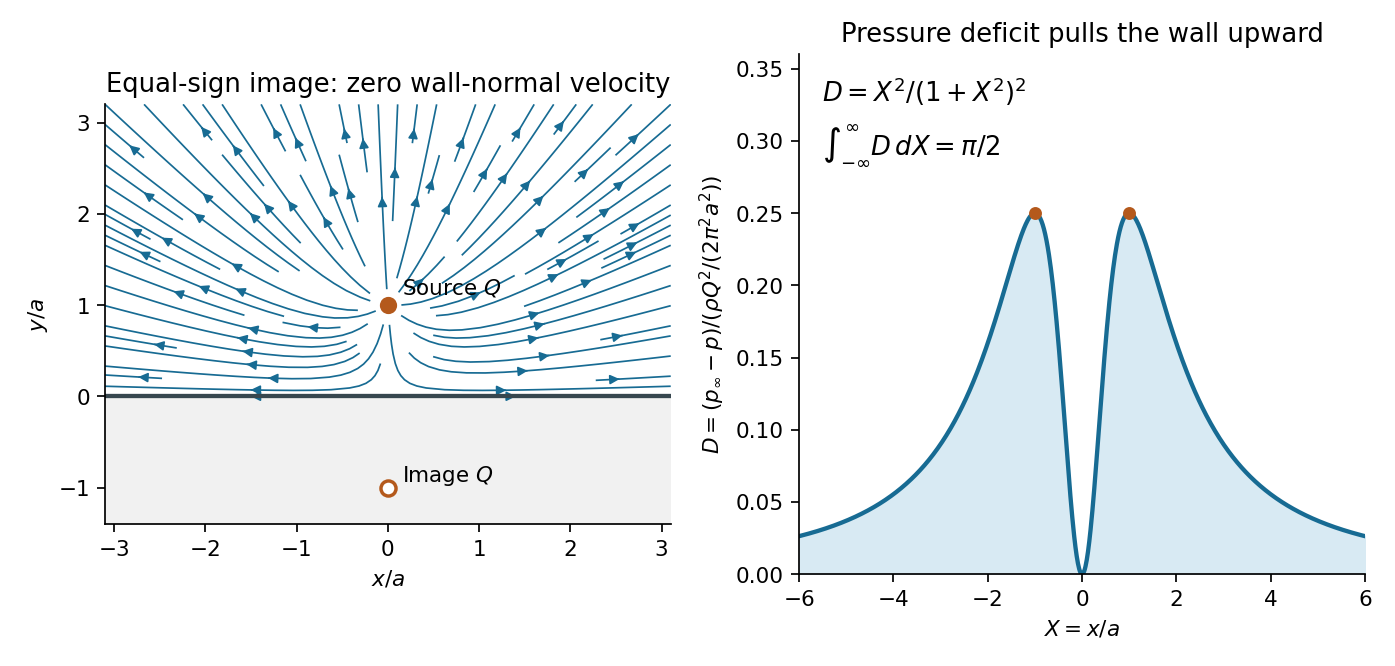
The method of images places an equal line source at , outside the physical upper half-plane. A convenient complex potential of a two-dimensional potential flow isThe two logarithms can be combined locally as ; their branches of the complex logarithm affect only the potential convention, not the single-valued complex velocity. The point source in this two-dimensional problem has the line source normalization: its outward volume flux is per unit span.
Writing , , and using , the velocity field isOn the wall , the vertical components cancel:This is the required no-penetration boundary condition. Tangential slip is permitted. At large distance the velocity decays as , and near its singular part is exactly that of the specified source; the reflected source is regular throughout the fluid. Away from the injection point, this is an incompressible flow and an irrotational flow.
Since the velocity tends to zero at infinity, the steady Bernoulli equation gives . On the wall, therefore,Compute the finite source-induced force relative to uniform ambient pressure, or equivalently use the gauge pressure . The fluid lies above the wall, so its normal force on the wall points in for positive pressure. The negative excess pressure found here consequently produces an upward net force, toward the source.
For the symmetric section , there is no horizontal force, and the vertical excess force isHere an antiderivative of is . Taking gives the hydrodynamic attraction of a wall to a line source:Each component is a force per unit length of the wall in the out-of-plane direction. The result is an attraction even though the source sends fluid away from itself: faster tangential motion reduces the wall pressure.
The excess torque about the origin isfor every , because the integrand is odd. Thus the symmetric infinite-wall limit isThe symmetric prescription matters: the separate one-sided moment integrals grow logarithmically, whereas the force integral converges absolutely. This is the appropriate Cauchy principal value for the infinite wall. If one instead asks for the absolute fluid force with no balancing ambient pressure on the other side, its vertical component on a finite section is and has no finite infinite-wall limit. The finite answer above is the flow-induced load.

Articles by others on the same topic
There are currently no matching articles.