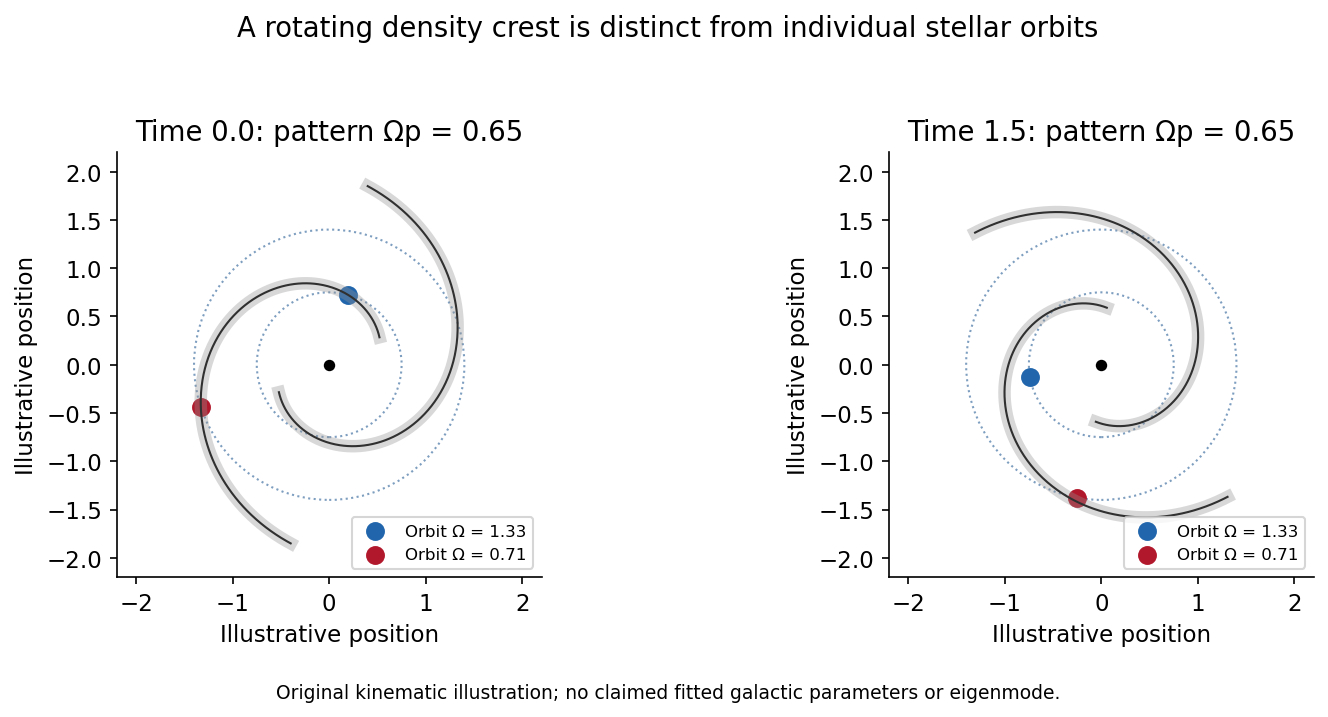
A spiral density wave is an organized density and gravitational-potential perturbation through which stars and gas can move; it is not generally a permanently labelled set of stars. Differential rotation winds a material arm rapidly. In a wave description, a perturbation has phase , with pattern speed distinct from the local stellar angular speed.
For a thin fluid disk the local tightly wound dispersion relation isRotation and pressure resist self-gravity. A collisionless stellar disk requires its stellar response function instead of simply replacing by a dispersion; the familiar local axisymmetric stability parameter is . This is distinct from the gas .
Waves exchange angular momentum at Lindblad resonances and near corotation radius. Swing amplification can strengthen a leading disturbance as shear turns it into a trailing one. Bars or companions can force a coherent spiral; recurrent self-excited disturbances also occur. Thus a single indefinitely steady wave is one model, not a description established for every spiral galaxy. Gas compression and shocks along arms can organize star formation, while gravitational torques redistribute angular momentum. Arm brightness, recent star formation and stellar mass density need not trace precisely the same pattern.[ref]
Spirals in Galaxies by Jerry A. Sellwood and Karen L. Masters. Sections4–6: wave dynamics, recurrent versus quasi-steady patterns, and gas response

Supermassive black holes are compact galactic nuclei with masses typically of millions to billions of solar masses. Their gravitational influence is measured from the motion of surrounding matter; accretion luminosity is evidence of feeding, not a necessary property of every black hole. Keplerian stellar orbits near the Galactic Centre and molecular-maser rotation curves in other nuclei provide particularly direct compact-mass constraints. A rough black-hole sphere of influence is ; resolving it helps dynamical mass estimates.
Accretion converts binding energy into radiation,The latter is the Eddington luminosity for isotropic radiation opposed by electron-scattering opacity, not an absolute luminosity ceiling for every geometry. The retained black-hole mass grows at . Sustained feeding can produce an active galactic nucleus, whereas gas-poor nuclei may be faint. Loss of gas angular momentum is a central feeding problem.
Black-hole mass correlates with classical-bulge stellar velocity dispersion through the M-sigma relation. Accretion-powered radiation, winds and jets can heat or remove gas, linking nuclear growth to galaxy evolution. Such correlations do not establish one universal feedback history, and disks and pseudobulges do not follow the same tight relations as classical bulges. Seed formation, accretion and mergers all contribute; seed masses and feeding histories remain model dependent.[ref]
Coevolution (Or Not) of Supermassive Black Holes and Host Galaxies by John Kormendy and Luis C. Ho. Dynamical evidence, bulge-dependent correlations and different feedback regimes
Galactic star formation requires gas to collect into cold dense regions that can become self-gravitating. Disk-scale gravity, turbulent motions, shear, pressure and magnetic fields affect this collection; formation then proceeds within molecular clouds. A useful local parametrization iswhere the star-formation efficiency per free-fall time summarizes inefficient conversion rather than requiring every cloud to collapse at once.
Across galactic disks the empirical Kennicutt–Schmidt law relates star formation rate surface density to gas surface density, . A slope near is a familiar integrated total-gas fit, while molecular-gas relations in ordinary disks can be closer to linear; the slope and normalization depend on tracer, averaging scale and environment. The gas-depletion time is the corresponding fuel-consumption scale, not a prediction that inflow and recycling cease.
Massive stars supply ionizing radiation, winds and supernova energy and momentum. This stellar feedback can disperse clouds, sustain turbulence and drive outflows, regulating rather than simply extinguishing all future star formation. Fresh accretion and recycled gas replenish the reservoir. UV and recombination-line emission trace young stars, while infrared emission traces absorbed and re-radiated light; extinction, stellar populations and the assumed initial mass function affect inferred rates. A galactic rate reflects supply, cloud formation and feedback together, rather than only the free-fall time of its densest gas.[ref]
Star Formation in the Milky Way and Nearby Galaxies by Robert C. Kennicutt Jr. and Neal J. Evans II. Sections3–6: diagnostics, gas relations and physical interpretation
In a matter-dominated Einstein-de Sitter universe, the growing linear density contrast is proportional to the scale factor. When , linear evolution no longer describes collapse. An overdense region initially expands more slowly than the background, reaches cosmological turnaround, and then contracts under self-gravity.
The spherical top-hat collapse model supplies a useful idealization: pressureless shells obey . At formal collapse, the linearly extrapolated growing mode isThis is a linear extrapolation, not the true finite nonlinear density at that instant. In the ideal energy-conserving spherical model, virial equilibrium gives a virial radius about half the turnaround radius; its mean density at the collapse time is times the cosmic matter density.
Real perturbations are nonspherical: tides and anisotropic collapse produce sheets, filaments and haloes. Collisionless dark matter develops shell crossing and phase mixing rather than radiatively losing its orbital energy. Baryonic gas can shock, cool and collect within the resulting potential wells. Hierarchical merging then assembles larger systems where small-scale fluctuations have sufficient initial power. Press-Schechter formalism connects a collapse threshold with the statistics of the smoothed initial field, but halo abundances and internal structure need more than the single spherical model. These ideas apply after perturbations become nonlinear; one must not extend pressureless subhorizon equations through all radiation-era or horizon-scale conditions.[ref]
Articles by others on the same topic
There are currently no matching articles.