The three printed unlettered blocks are identified below by navigation labels 1, 2 and 3. Their mark allocations are 10, 10 and 5 respectively.
A universal quantum gate set can implement any unitary operator on any finite number of qubits, exactly when arbitrary continuous gate parameters are allowed, or to arbitrary accuracy with a suitable finite gate alphabet. More precisely, for every target and there is a finite quantum circuit with in operator norm. This ignores only an overall global phase of the complete operation. Universality lets a fixed collection of controllable elementary operations run arbitrary quantum algorithms rather than requiring a different physical interaction for each algorithm.
All single-qubit unitary gates, together with the controlled-NOT gate between selectable pairs, form an exact universal quantum gate set. One way to see sufficiency is to eliminate entries of a finite unitary matrix by two-level rotations between computational basis vectors; these rotations decompose into controlled single-qubit rotations, which in turn decompose into single-qubit gates and controlled-NOT gates. Single-qubit gates alone preserve product states and cannot supply general quantum entanglement. A finite approximate universal example is the Hadamard gate, the T gate , and the controlled-NOT gate; finite exact words over a finite alphabet cannot represent every continuously parameterized unitary operator exactly.
Distinguish the Hamiltonian operator from the Hadamard gate . For the printed collisional phase gate,As written, has units of energy. The Schrödinger equation givesbecause only has a nonzero energy eigenvalue. In the ordered computational basis , defineIf an interaction strength is instead quoted as an angular frequency , the Hamiltonian operator is and . An alternative definition with would have . The minus sign above follows the usual time-evolution operator convention. At these conventions give the same .
For the quantum circuit, use on the first qubit to move the selective minus sign from to :Conjugating the target of this Controlled-Z gate by the Hadamard gate gives the required controlled-NOT gate:The rightmost matrix acts first. Thus the network applies , then , then , and maps to , where is exclusive or.
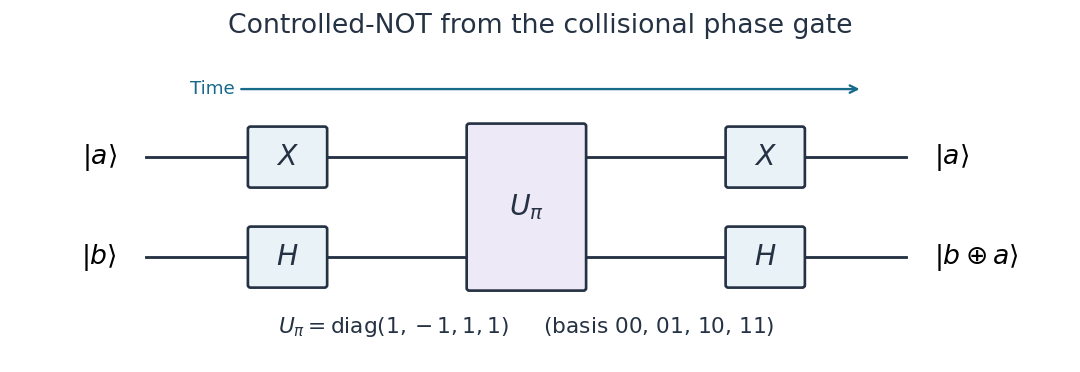
Controlled-NOT from the printed collisional phase gate
. Time runs from left to right. Pauli X gates act on the first wire and Hadamard gates on the second, before and after the selective phase gate. The phase gate changes the sign of 01 only. Details.
Define the Hadamard basis and write . After the two-qubit quantum state isApplying the Hadamard gate to the first qubit gives the normalized quantum stateFor , , soThe first is a product state. The second is exactly the minus Bell state in the printed phase gate convention; its reduced density matrices are .
For three qubits, let use the ordered pair and the ordered pair . The two diagonal quantum gates commute. For their action before the final Hadamard gates isIf is even this is , and gives . If is odd, group the quantum superposition by the middle qubit:Since and , the final states areThe odd case is a GHZ state: each individual qubit has reduced density matrix , and it is related to by the local Pauli gates . Conversely, applying those gates converts to that standard form. They have not been applied in the printed network, so the actual output used in the next part is .
Keep the actual odd- GHZ state from the preceding calculation. Resolving its first qubit in the Hadamard basis givesThus the outcome leaves and the outcome leaves , each with probability . Conditional on a known result the remaining qubits share a maximally entangled state.
When the result is not revealed, the appropriate density matrix is the probability-weighted mixture from a nonselective quantum measurement:The cross terms cancel. The displayed convex combination of product states proves directly that this is a separable quantum state. It still has perfect computational-basis measurement anticorrelation, so it is not itself a product state. It also equals the partial trace , as required by the no-communication theorem: a local quantum measurement with an unobserved outcome cannot change the remote reduced density matrix.
Articles by others on the same topic
There are currently no matching articles.