Put . In the source's complex beam parameter convention,Substitution separates the transverse wave amplitude and phase:Thus the Gaussian beam is circularly symmetric, has a Gaussian function transverse light intensity, and narrows to a beam waist at before spreading by diffraction. Its wavefront is planar at the beam waist, converging before it and diverging after it. The quadratic transverse phase identifies the signed radius of curvature:Define spot size as the wave amplitude radius, equivalently the light intensity radius. ThenThe Rayleigh range is where ; the far-field beam divergence half-angle is . The factor also produces a longitudinal phase shift relative to a plane wave, changing by across the beam waist; its sign here follows the given convention. The on-axis light intensity decreases as while transverse integration leaves the power constant. These are scalar paraxial approximation results.
A thin lens has ray transfer matrixThe complex beam parameter transformation gives , henceThe sign is also obtained by multiplying the incident wave amplitude by the thin lens phase .
Choose the thin lens plane as and put , the incident Rayleigh range. Since the incident beam waist lies there, . Immediately after the thin lens,Subsequent free propagation adds , so write . Comparing real and imaginary parts givesFor a positive focal length, the new beam waist lies downstream but closer than the geometrical focus. At fixed , as ,This is the formal unbounded-aperture scalar limit; eventually finite aperture and the paraxial approximation limit the extrapolation.
A chirp is variation of the instantaneous frequency through a signal. Here the group delay relative to the pulse centre at the optical lens isConsequently orders lower frequencies before higher frequencies; reverses that ordering. A representative strongly chirped optical pulse iswith a smooth localized envelope . The carrier oscillations become closer together towards later times for positive and farther apart for negative .
The relation between the spectral phase and a locally assigned instantaneous frequency is a stationary phase method, not an exact reconstruction from spectral phase alone: the spectral wave amplitude also matters. For example, if the spectral envelope is , a Fourier transform of a Gaussian gives the exact real-field phase up to a constant, where . The slope retains the sign of and approaches for .
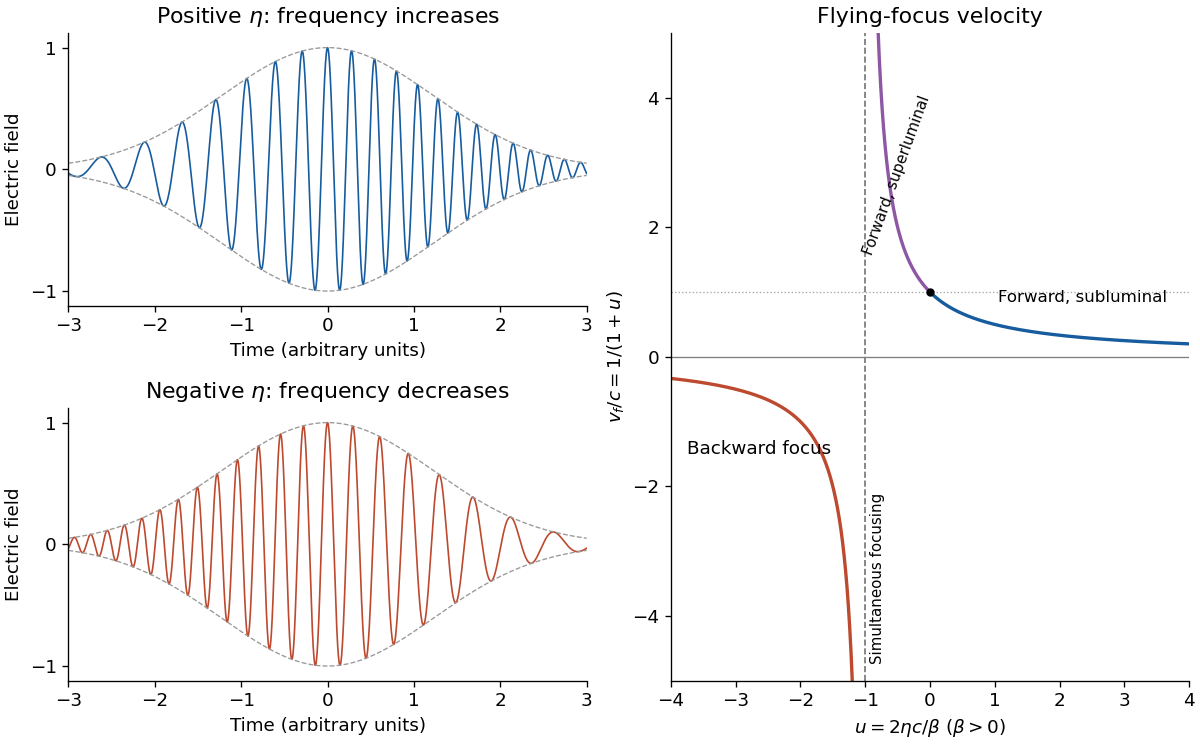

Place the optical lens at . For a sufficiently broad incident Gaussian beam, the beam waist positions approach the focal lengths frequency by frequency:Add the group delay at the optical lens to propagation through vacuum:Here an arbitrary common time origin has been omitted. Differentiating both equations with respect to angular frequency yieldsFor , define . The velocity graph in the preceding figure has horizontal asymptote zero and a vertical asymptote at . For , : the higher-frequency components both enter later and travel farther. At , . For , : the farther-focusing components leave earlier, partly compensating their extra travel. At every component focuses at the same time, so the trajectory is not a finite-velocity function of time. For the farther positions focus first, giving ; it tends to zero from below as .
A flying focus is a moving pattern assembled from different portions of an optical pulse. Each portion propagates causally at in this model. The superluminal or backward motion of the focus therefore does not describe a material object or information overtaking light. The calculation assumes negligible additional frequency-dependent group delay from the optical lens; any such delay must be included in .
Articles by others on the same topic
There are currently no matching articles.