The five DiVincenzo criteria are: a scalable collection of well-characterized qubits; preparation in a known fiducial quantum state; relevant coherence times long compared with quantum gate times; a universal quantum gate set; and qubit-specific quantum measurement. The criterion is useful control of the whole computation, including errors, rather than merely observing two resolved levels.[ref]
The Physical Implementation of Quantum Computation by David P. DiVincenzo. Section III, numbered requirements 1–5; Section IV's two communication requirements are additional
For trapped ions, the implementation is:
- Scalable characterized qubits. Two long-lived hyperfine structure levels or an optical ground/metastable pair in each ion encode . An ion trap confines individually addressed ions. Extending a chain adds qubits, but increasing motional complexity, addressing errors and heating limit straightforward scaling; segmented traps and transport can help.
- Initialization. Optical pumping prepares the internal quantum state. Doppler cooling and, where required, resolved sideband cooling prepare the shared motion used for quantum gates.
- Coherence. Long-lived internal levels give coherence much longer than controlled pulse times. Magnetic noise, laser noise, scattering and motional heating cause quantum decoherence; suitable clock-state encodings and control reduce these errors.
- Universal control. Resonant optical, microwave or Raman transitions give arbitrary one-qubit rotations. Shared motional normal modes, coupled through the Coulomb force, mediate entangling two-qubit gates. Together these supply a universal quantum gate set.
- Readout. State-selective cycling fluorescence, often with electron shelving, produces a bright/dark signal resolved for individual ions.
For trapped neutral atoms, the corresponding implementation is:
- Scalable characterized qubits. Long-lived ground-state hyperfine structure levels encode qubits in an optical lattice or an array of optical tweezers. Large arrays are feasible, but random loading, vacancies, atom loss and individual addressing must be controlled.
- Initialization. Cooling plus optical pumping prepares the internal quantum state. Filling or rearranging traps prepares a usable register; motional cooling is needed when the chosen quantum gate depends on motion.
- Coherence. Weak environmental coupling of neutral ground-state chemical atoms allows long coherence. Trap-light scattering, differential light shifts and magnetic noise limit it; switching traps or choosing suitable encodings can reduce these effects.
- Universal control. Microwave or Raman transitions implement one-qubit rotations. Ground-state chemical atoms do not have the ions' long-range Coulomb force, so that motional-bus construction cannot simply be copied. Controlled collisions or Rydberg blockade can nevertheless supply entangling two-qubit gates.
- Readout. State-dependent fluorescence or state-selective removal followed by imaging identifies a chosen qubit. Optical resolution, cross-talk and atom loss constrain repeated measurements.
Thus neither platform is forbidden from meeting a criterion in principle. Weak neutral-ground-state interactions make entangling control harder, but claiming that trapped neutral atoms cannot implement a universal quantum gate set would be false. Gate-model quantum algorithms using Rydberg blockade had already been demonstrated in a programmable neutral-atom processor by 2022.[ref]
Multi-qubit entanglement and algorithms on a neutral-atom quantum computer by T. M. Graham and others. Nature 604, 457–462 (2022), abstract and controlled-phase gate implementation
Let and let be one only at the marked input. A three-qubit implementation of Grover's algorithm starts with , applies a Hadamard gate to each qubit, queries the reversible quantum oracle , applies the Grover diffusion operator to the first two qubits, and measures those two qubits in the computational basis. Here . The full three-wire quantum circuit is the composition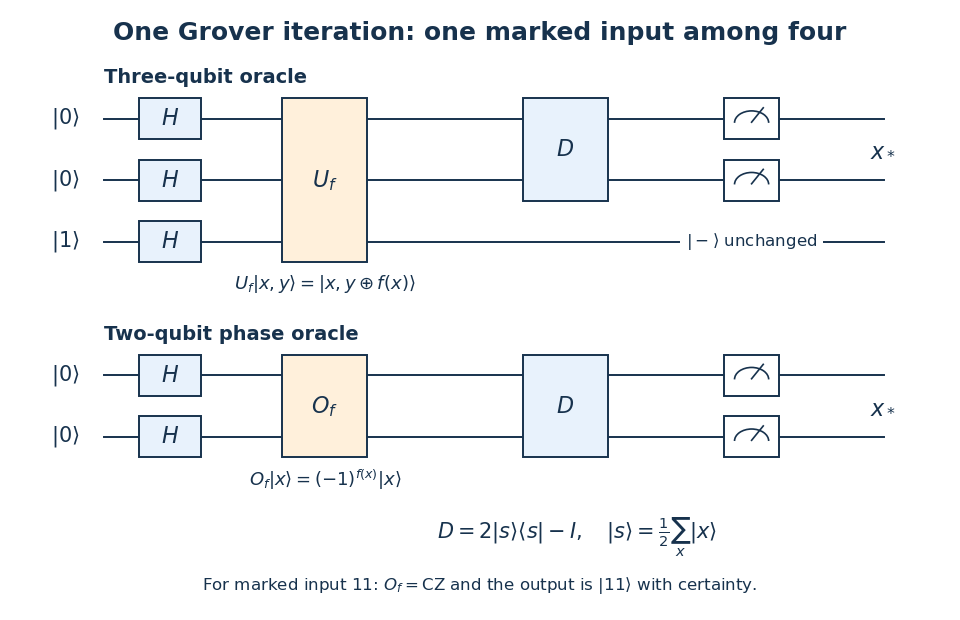
Figure 1.
Three- and two-qubit implementations of Grover's algorithm for four inputs
. Details. 
Here . Since , phase kickback gives . The third qubit remains separable and unchanged. A direct marked-state phase oracle therefore replaces the three-qubit query using only two qubits:For the explicit choice only at , is a Controlled-Z gate. Immediately after it,The mean of these four probability amplitudes is . The Grover diffusion operator maps each probability amplitude to . The three unmarked probability amplitudes become zero and the marked one becomes one. A single query consequently finds with probability one.
A gate-level implementation of is . Up to an irrelevant global phase, it is . For any other chosen marked word, conjugate the Controlled-Z gate by Pauli X gates on precisely the positions where the marked word has a zero.
In liquid-state NMR quantum computing, use two distinguishable spin- atomic nuclei in one molecule as the two qubits. Their different resonance frequencies permit selective radiofrequency pulses for one-qubit rotations. In a suitable rotating frame, refocusing removes unwanted one-spin terms while the NMR scalar coupling suppliesAssuming , free evolution for implements . Define . ThenThis equality follows directly by evaluating the four diagonal entries: the first three are and the entry is . Negative can be handled by refocusing or reversing the effective interaction sign. The global phase can be ignored.
Thus the marked-state phase oracle for requires scalar-coupling evolution and calibrated one-spin rotations. For a marked word , conjugate by , realized as selective pulses. The Grover diffusion operator uses the same entangling operation with additional one-qubit pulses. Liquid-state NMR quantum computing usually reads an ensemble signal and often prepares an effective pseudo-pure deviation from a large mixed background; that reproduces this small quantum algorithm's signal without providing a scalable source of pure initialized qubits.
Articles by others on the same topic
There are currently no matching articles.