Eutectic solidification is the coupled transformation of a liquid into two distinct solid phases at the eutectic temperature and composition, . At fixed pressure in a binary system the three-phase equilibrium is invariant. An exactly eutectic liquid can therefore finish freezing at one temperature, instead of over a broad liquid-plus-solid interval.
Eutectic compositions are useful in joining alloys, for example silver-copper brazing filler: the comparatively low melting temperature and narrow freezing interval help liquid flow into a joint and then solidify. Alternating growth of the two phases often produces a fine lamellar eutectic microstructure. The eutectic is a two-phase aggregate, not a new single solid phase.
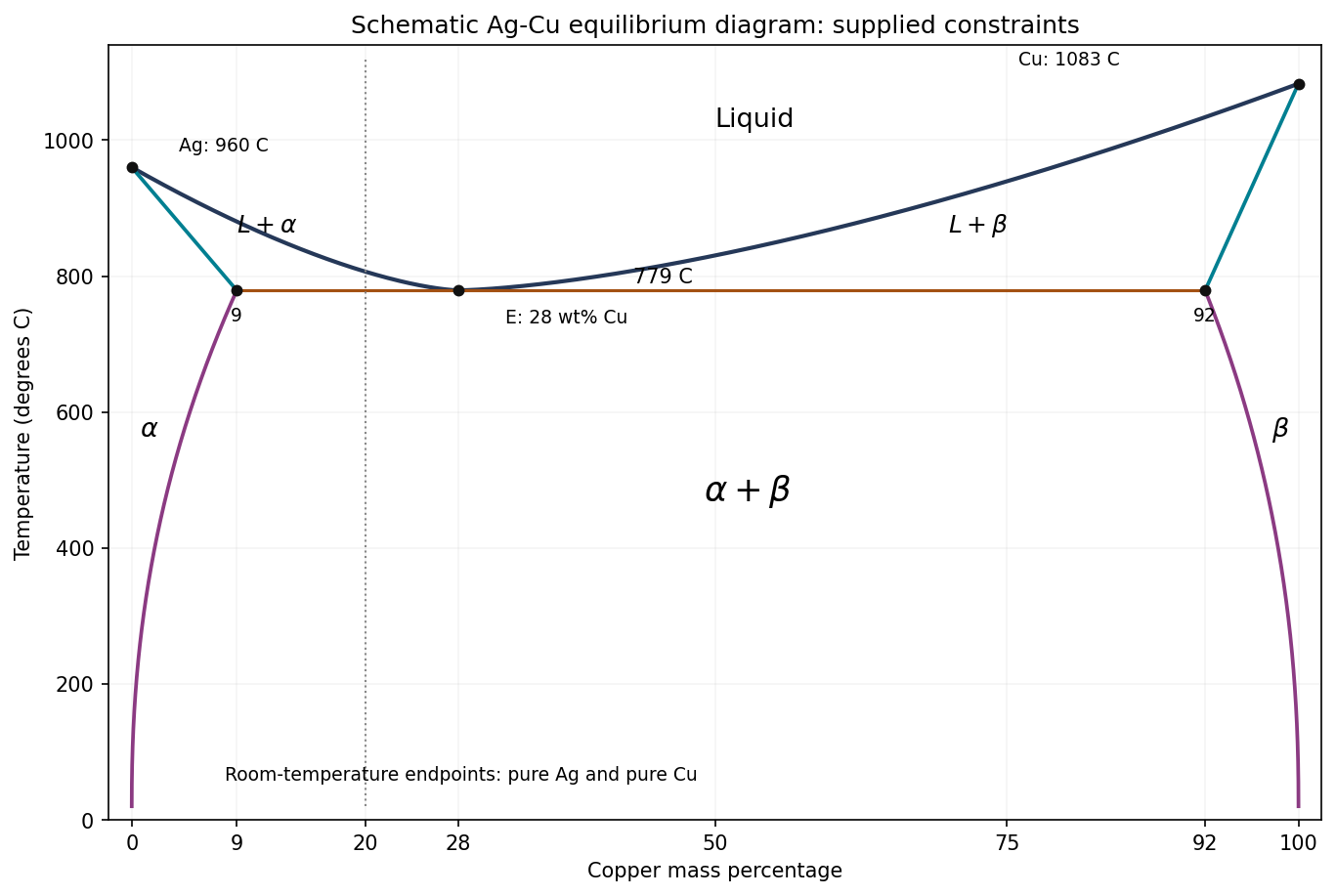
Original schematic Ag-Cu phase diagram constrained by the supplied endpoints and eutectic tie line; unprovided curve shapes and intermediate temperatures are illustrative
. Details. 
The horizontal axis is copper mass percentage. The two liquidus branches meet at and connect to pure silver at and pure copper at . The terminal solid-solution boundaries at the eutectic temperature are Cu for and Cu for . Label the single-phase fields , the two liquid-plus-solid fields , and the lower two-solid field .
The solidus boundaries link the pure-component melting points to their terminal solubility limits; the eutectic isotherm spans the three-phase tie line. Below it, the solvus branches approach pure Ag and pure Cu at room temperature. The supplied data determine this topology and the marked points, not the exact shapes of every boundary. The drawing therefore does not invent a numerical liquidus temperature for an intermediate composition.
Apply the lever rule on the solid tie line. All compositions are copper mass percentages:Thus the equilibrium material is 77.1% and 22.9% by mass just below the eutectic temperature. These are phase fractions; converting them to volume fractions would require densities.
The room-temperature endpoints are pure Ag and pure Cu. Conservation of the total copper mass therefore givesThe answer is 72% silver phase and 28% copper phase by mass. The change from the high-temperature fractions is caused by decreasing solid solubility: the phases reject the opposite component during equilibrium cooling. Simply retaining the eutectic-temperature lever-rule fractions would violate the stipulated room-temperature equilibrium compositions.
The cooling curve first falls in the entirely liquid field. On crossing the liquidus, primary Ag-rich begins to grow. Latent heat release makes the descent shallower; the remaining liquid becomes richer in copper and approaches the eutectic composition.
At , the remaining liquid solidifies as , giving an isothermal arrest under the ideal equilibrium, heat-extraction model. After the liquid is exhausted, temperature falls through the two-solid field. Continued loss of solid solubility causes additional redistribution and precipitation; it does not require another invariant liquid-freezing plateau.
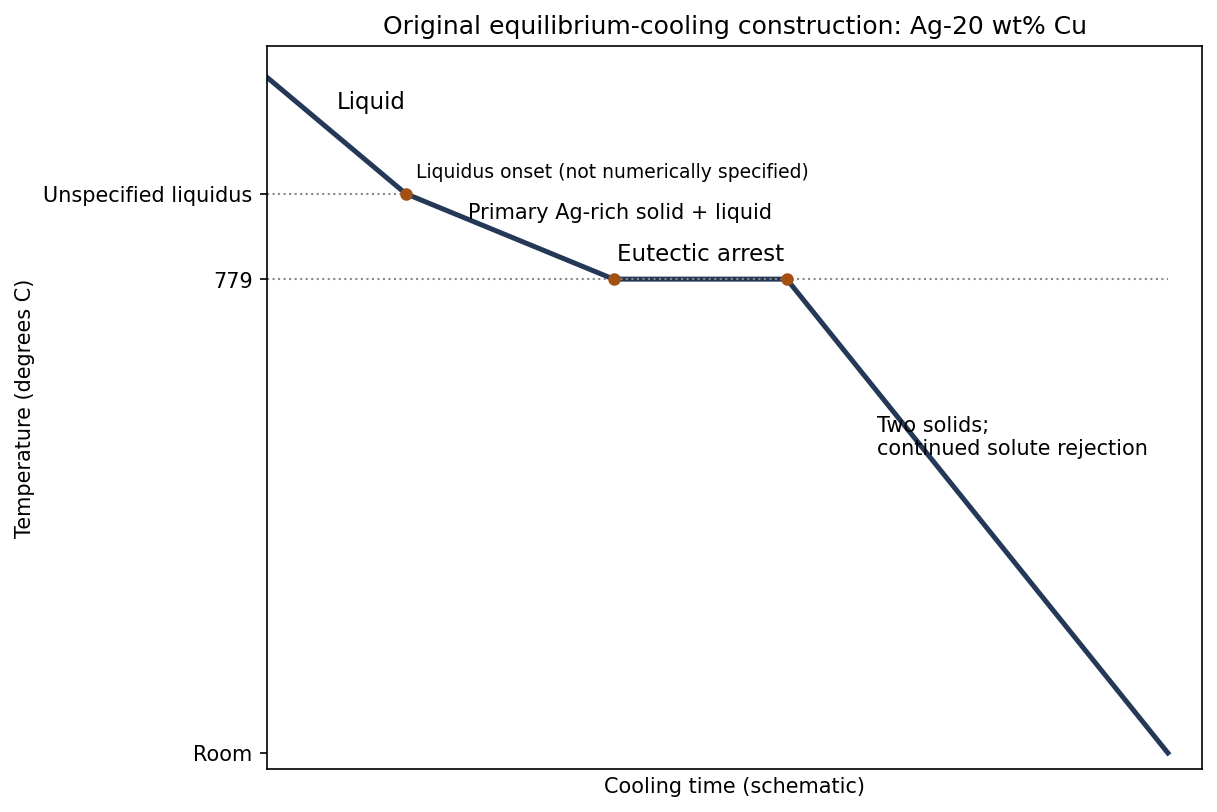
Original schematic cooling curve for Ag-20 wt% Cu, with an unspecified liquidus kink and a labelled eutectic arrest
. Details. 
Immediately before the eutectic reaction, the remaining liquid fraction isThe arrest represents freezing of roughly of the sample by mass. Its duration cannot be calculated without the heat-extraction rate and latent heat, and the onset temperature cannot be calculated exactly from the supplied phase-diagram points alone.
At equilibrium at room temperature the phases are pure Ag and pure Cu, with mass fractions and . A representative solidification structure contains primary Ag-rich grains or dendrites surrounded by a finer two-phase eutectic aggregate. Subsequent equilibrium solute rejection modifies both constituents as they cool.
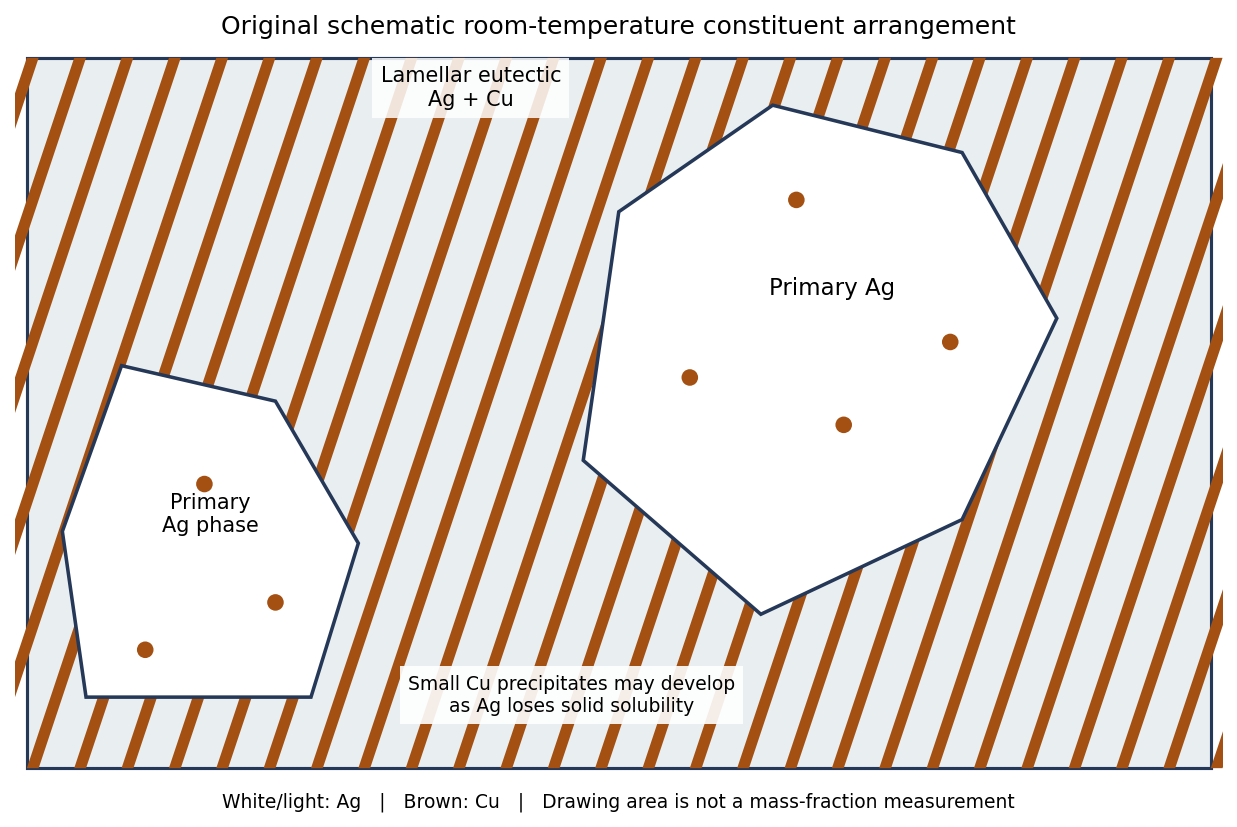
Original schematic primary-silver and lamellar eutectic arrangement; geometrical drawing areas do not assert mass or volume fractions
. Details. 
The primary- and eutectic-constituent fractions calculated at the eutectic arrest describe how the liquid froze. They are not the final pure-Ag and pure-Cu phase fractions. For example, just below the arrest the total copper-rich phase fraction is ; it rises to as solubility is lost on further equilibrium cooling. The distinction separates a microstructural constituent from a thermodynamic phase.
Faster solidification usually refines the dendrite and eutectic spacings. If solid-state diffusion cannot keep up, composition gradients, supersaturated solids and delayed precipitation can persist. Their exact fractions then depend on the thermal history; faster cooling does not change the alloy's overall copper inventory. Complete long-term equilibration would restore the same equilibrium phase compositions and mass fractions.
Articles by others on the same topic
There are currently no matching articles.