In crystal polymorphism, the same chemical composition has different crystal structures; for an chemical element, this is a form of allotropy. Diamond has a three-dimensional tetrahedral network of covalent bonds, giving high hardness and a wide band gap. Graphite has strongly bonded planar sheets, with weaker interactions between sheets. Sliding between sheets makes it a useful solid lubricant; mobile electronic states give good electrical conduction within the sheets. Their different properties come from different bonding and structures, despite both being carbon.
Barium titanate has a high-temperature cubic perovskite structure, with Ti centred in its oxygen octahedron on average. This phase is paraelectric. Near room temperature the structure is tetragonal, with relative ionic displacements that give a spontaneous electric polarization. This phase is ferroelectric: an applied electric field can switch between differently polarized domains. Both phases have the same composition, BaTiO; the transition near changes crystal symmetry and electrical response.
The zinc blende structure has an FCC sulfur sublattice and zinc on half its tetrahedral sites. One conventional unit cell uses S at and Zn at those positions displaced by , reduced modulo one. The wurtzite structure has ABAB sulfur layers, instead of ABCABC layers. One hexagonal-cell convention uses S at and Zn at , with ideal . Looking along superposes S and Zn in that latter coordinate convention; the height labels distinguish them.
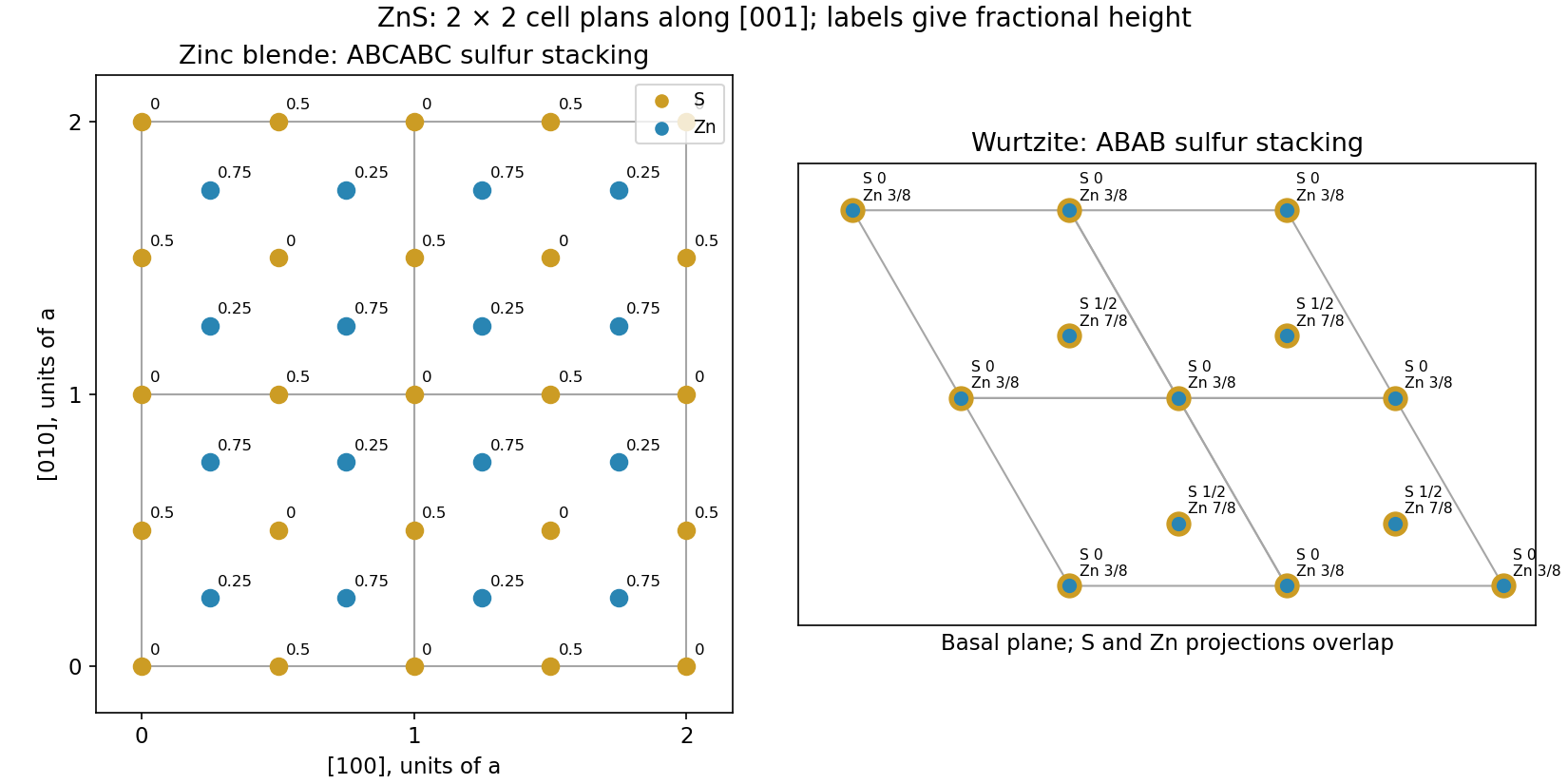
Two-by-two zinc sulfide unit-cell projections along the stacking axes
. Original coordinate constructions. Heights are fractional coordinates along the viewing axis. The hexagonal plan uses basal vectors at 120 degrees. Details.
The closest-packed sulfur planes are , with four distinct plane orientations, for zinc blende structure, and , with one orientation, for wurtzite structure. Opposite normals describe the same unoriented plane orientation. Hexagonal four-index notation writes the latter basal family as .
The solid trace is wurtzite; the dashed trace is zinc blende. The isolated strong dashed peak is the cubic reflection. The solid trace has hexagonal , and reflections in this angular interval; its central peak is the one at , while cubic occurs at . These assignments are consistent with the absence of lower-angle reflections.
In the ideal close-packed model, the cubic and hexagonal reflections probe the same local alternating layer geometry. Their scattering strength per suitably normalized amount of material and their angular factors are therefore very similar, but powder diffraction multiplicity differs: the cubic family has eight directed normals, while hexagonal has two. This explains the approximately fourfold greater intensity of the dashed peak. Comparing unnormalized conventional-cell structure factors alone would be misleading because the cells contain different numbers of formula units. Peak heights additionally depend on line widths; the multiplicity argument applies most directly to integrated intensities.
Taking Cu K wavelength , Bragg's law gives . For cubic , and the nearest Zn–S separation is . For ideal wurtzite structure, and the nearest separation is . ThereforeBoth have tetrahedral nearest-neighbour coordination number four, but different further-neighbour stacking and lattice relaxation can shift their equilibrium bond lengths. The hexagonal value assumes ideal and ; a real distorted wurtzite structure can have unequal axial and inclined bonds. One measured spacing alone does not determine every bond length without that structural assumption.
Articles by others on the same topic
There are currently no matching articles.