A phylogenetic epoch is a time interval between successive branching events during which the number of ancestral branches is constant. Read backward from the four sampled leaves: there are four branches until the first merger, then three until the next, then two until their common root. Write the random durations as , with expected values .
The original solution diagram below places time horizontally and labels each branch by its number of descendant leaves. Type A is the pectinate topology; type B is the balanced topology. The coloured time strips identify the three phylogenetic epochs; their drawn widths are schematic, not estimated times.
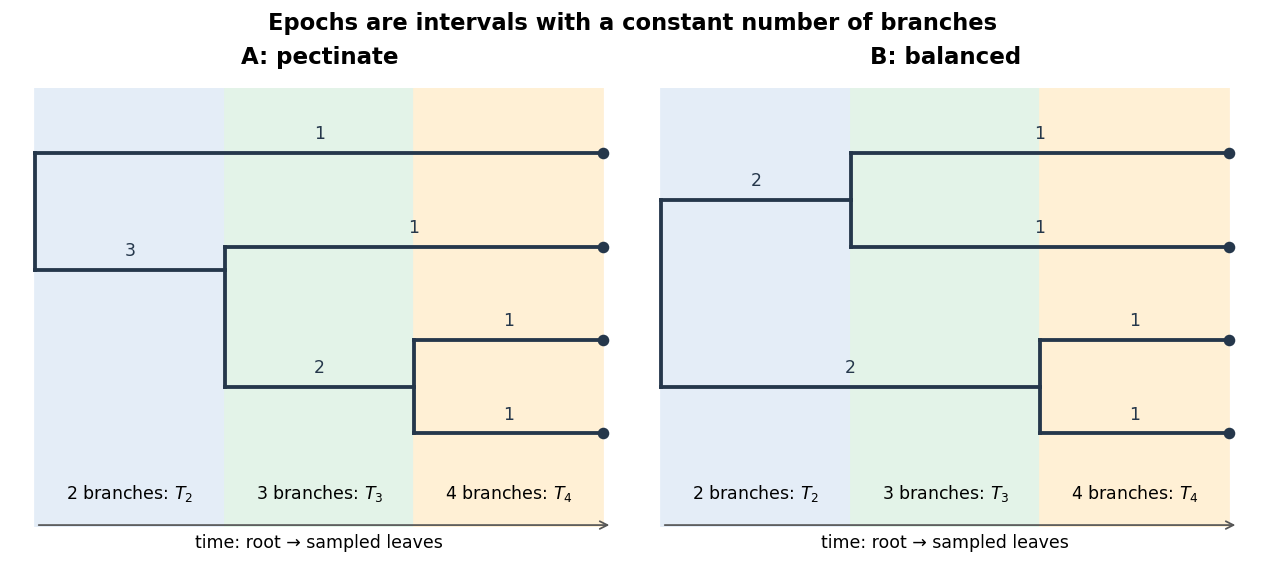
Epochs and descendant counts for four sampled lineages
. Time runs from the common root to the sampled leaves. The two panels distinguish the three-plus-one and two-plus-two root splits; numbers on branches count sampled descendants. Details.
Count the number of descendant leaves on each branch during each phylogenetic epoch. From the tips backward, both topologies have branch-size lists during , then during . During , type A has and type B has .
Let be the total length of branches carrying descendant leaves. Adding the relevant phylogenetic epoch durations givesFor example, type A has one external branch and one three-descendant branch throughout , while type B has two two-descendant branches. In either case the total expected branch length is , a useful accounting check. The stem above the common root is excluded because mutations there would be shared by all four samples.
In the Yule process, each of branches gives birth independently at rate per generation. The next birth therefore has total rate . Its waiting time has an exponential distribution, so the mean phylogenetic epoch duration isFor the ensuing calculation use , and . This is the inter-event waiting-time convention requested in the question, including an observation interval with four branches. Stopping the forward process immediately when the fourth branch is born would instead leave a zero terminal interval and describe a different sampling convention.
For a haploid population with possible parents, each pair of ancestral lineages merges backward at rate in the Kingman's coalescent approximation. With lineages there are pairs. Hence the mean phylogenetic epoch duration isThus , and . For an autosomal sample from diploid individuals, replace the number of gene copies by , giving . A mitochondrial sample naturally uses a haploid maternal effective population size; the common factor cancels in the ratios below.
Under the stated topology probabilities, and . Averaging the branch lengths from part (b), the expected length producing the folded class isThe factor in type A includes both the one-descendant and three-descendant root branches. The expected length producing the class isWith a common mutation rate per unit branch length, it cancels from the ratio of expected counts in this folded site frequency spectrum:For the Yule process,For Kingman's coalescent,These are ratios of ensemble expected mutation counts, not the expected value of the random ratio in one tree. The stipulated topology weights apply to both processes, and their waiting-time rates depend only on the current number of branches.
The observed folded site frequency spectrum has a larger to ratio than either expectation in part (d), and is closer to the Yule process expectation than to the constant-size Kingman's coalescent expectation. Both models can nevertheless produce deviations in one finite sample, especially because all mitochondrial sites largely share one genealogy; this observation alone is not a formal model-selection result.
For the Yule process, one possible violation is a recent reduction in the per-lineage branching rate rather than a constant . Lengthening the terminal four-branch interval adds one-descendant branch length and therefore preferentially increases the class.
For Kingman's coalescent, one possible violation is recent population expansion rather than a constant effective population size. Backward in time, coalescence is slow in the large recent population and faster in the smaller ancestral population. The resulting long external branches tend to increase the class relative to the class.
Articles by others on the same topic
There are currently no matching articles.