Source paper: www.whatdotheyknow.com/request/physics_preliminary_examinations/response/1162943/attach/3/Twain.7z?cookie_passthrough=1
The dated cover identifies the 11 September 2013 resit despite its printed “Trinity Term” heading. The separate June paper is not substituted for it. All Section B alternatives are solved. In Question 10, editorial scopes separate the two bullet points and the subsequent marked blocks.
Squaring first is simpler than expanding the tenth powers. Since and , while , the requested Cartesian forms areThus the real part is zero in each case, and the imaginary parts are and . The results are complex conjugates, as also follows because the two inputs are complex conjugates and the fifth-power polynomial has real coefficients.
Write . Every cube root has complex modulus and an angle one third of one of these complex arguments:Equivalently the three complex roots areThey lie on the circle of radius centred at the origin in the Argand plane, spaced by . Further integer values of repeat these three points. Cubing any of them multiplies its angle by three and cubes its complex modulus from to , giving .
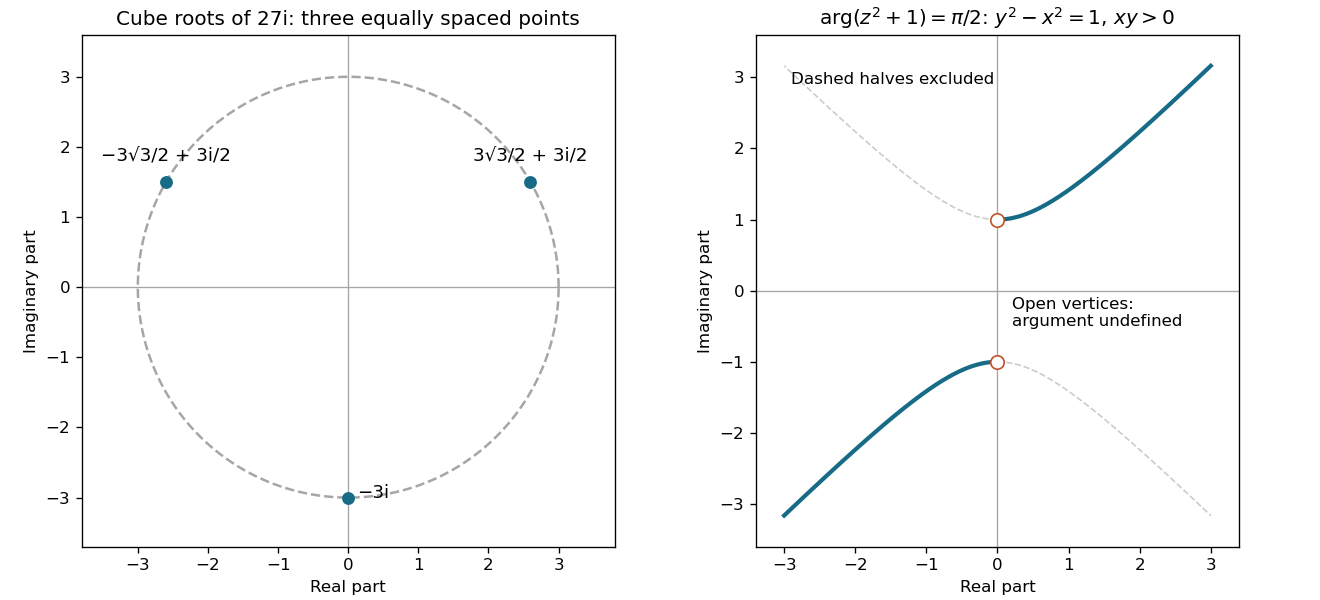

Put . The expression whose complex argument is constrained becomesIts principal argument is exactly when its real part is zero and its imaginary part is strictly positive. HenceThe locus consists of the upper-right half of the upper hyperbola branch, with , and the lower-left half of the lower branch, with . The vertices are excluded because there and zero has no complex argument. The remaining halves have negative imaginary part and give argument , not . The right panel of the original illustration marks the excluded vertices with open circles.
Use parametric equations for the two lines,Their cross product is . Projection of the separation of the base points onto this common normal gives the shortest distance between skew lines:This projection is a lower bound on every connecting segment because adding either line's direction leaves its normal component unchanged. It is attained: imposing perpendicularity of to both directions gives and . The corresponding points are and ; their difference is , perpendicular to both lines and of length .
Subtracting the first equation from the third gives , so . The second equation then becomes . The third fixes . Therefore the three possibilities areFor the first case the coefficient determinant is , confirming uniqueness. At its matrix rank is two. The augmented matrix has the same matrix rank only for , giving one free variable in a linear system; otherwise the linear system is inconsistent.
A real square orthogonal matrix satisfies . A complex square unitary matrix satisfies , where denotes conjugate transpose. A Hermitian matrix satisfies . The distinction between transpose and conjugate transpose matters for imaginary entries.
For the three displayed matrices, in their source order:
- First: a unitary matrix, but neither an orthogonal matrix nor a Hermitian matrix.
- Second: an orthogonal matrix, a unitary matrix, and a Hermitian matrix.
- Third: a Hermitian matrix, but neither an orthogonal matrix nor a unitary matrix.
For the first matrix, and , so but . It also fails , even if complex orthogonality is considered. The second matrix is real diagonal with entries : its transpose, conjugate transpose and inverse all equal itself. In the third matrix the imaginary off-diagonal entries are conjugate pairs, establishing the Hermitian matrix condition. Its first column has squared norm , so it is not a unitary matrix; it is not real orthogonal, and the complex bilinear first-column square is as well.
For this homogeneous tangent differential equation, set on an interval not containing . Since , cancellation gives . Away from zeros of , separation and integration giveRestoring a signed constant yields the compact implicit solutionA complete real branch description isHere is real and the interval must satisfy and . The strict inequality excludes points with , where the original tangent function is undefined. Separating divided by , so its zeros must be checked separately: gives . These are exactly the branches already included. The branch integer is fixed on each connected solution interval; it cannot be changed arbitrarily at a regular point.
The constant term belongs on the forcing side: the equation is . Set to obtain the first-order linear equation . A particular solution is , while . Imposing fixes . Integrating and then using givesDirect differentiation gives and , so . Both initial values vanish. The nonzero exponential term is required by the initial derivative, even though the forcing is polynomial.
Let be the scalar triple product. The reciprocal basis satisfies and all mismatched dot products vanish, with cyclic analogues. Apply the given vector triple product identity to obtainDotting with givesThe sign is retained: a negatively oriented original basis has a negatively oriented reciprocal basis. Equivalently, if the original vectors are columns of , their reciprocals are columns of , whose determinant is .
The denominator for taking reciprocals a second time is . The preceding cross-product result therefore givesCyclic permutation gives and . Thus taking the reciprocal basis twice returns the original basis. The matrix statement is the same reciprocal basis involution: . Noncoplanarity is essential, since otherwise the defining denominator and the matrix inverse do not exist.
Dot the reciprocal-basis expansion with each member of the original basis. All mismatched dot products vanish and the matching one equals one. ConsequentlyThese are coefficients in the reciprocal basis. They would instead involve dot products with the reciprocal vectors if were being expanded in the original basis. The two coefficient conventions should not be interchanged for a nonorthonormal basis.
Use the preceding coefficient identities with the three prescribed plane equations. They immediately giveFor example, its dot product with is , because while the other two terms give zero; the other equations follow cyclically. This verifies existence. If two points satisfied all three equations, their difference would be perpendicular to all three members of a basis and therefore zero. Hence the intersection is unique, not merely one possible intersection point.
Use active rotations on column vectors and positive angles counter-clockwise when viewed from the positive axis toward the origin. Rotation about takes to , to , and leaves fixed. These images are the columns of the rotation matrix:It satisfies and . Stating the viewing convention avoids confusing this active rotation with a passive change of axes.
With the same active rotation convention, the axis remains fixed, while moves toward . ThereforeFor instance, a positive quarter-turn maps to and to , checking both signs. This is again an orthogonal matrix of determinant one.
The first operation acts nearest the column vector, so the composite rotation matrix is :At this reduces toSolving gives . Normalization yields the fixed-axis unit vectorsBoth signs describe the same unoriented axis. The operation is a cyclic permutation, and ; it is not generally obtained by reversing the multiplication order.
Choose the unit vector , which is perpendicular to . Then . Their dot product is , and the rotation matrix preserves their norms, soThe same unsigned angle holds for every nonzero vector perpendicular to the axis: this is the rotation plane of a three-dimensional proper rotation. Alternatively, gives the same rotation angle .
Take the imaginary part of De Moivre's theorem at exponent five. Writing and givesFor real , put . The equation becomes , so . The distinct sine values are , , and . To establish completeness over the complex numbers as well, factor the polynomial:Thus all polynomial roots, including their multiplicities, areThe repeated sine values account for the double roots; there are no additional nonreal roots hidden by the trigonometric parametrization.
Set , with . For a nonzero integer , all solutions of areThis covers negative integers too: is then nonzero and . No equals one. Inverting the Möbius transformation and using half-angle identities gives the cotangent roots of a powered Möbius transformation:These solutions are distinct and purely imaginary. For there is no solution: every defined zeroth power is one, not . For negative , must additionally be excluded from the equation's domain; none of the displayed roots equals it.
For the cubic, direct expansion showsSince is not a root, the cubic is precisely the case. Taking yieldsFor an algebraic check, the cubic factors as , which gives the same three distinct roots.
Set , so the equation is linear: , with . An integrating factor is on either connected side of . ThusConsequently the full real solution isThe original equation is undefined at , so a continuation of the formula through that point is not a solution on an interval containing it. Constants can be chosen independently on the two separated domain components.
Again put , requiring . Substituting gives . For real the factor never vanishes, so separation loses no constant real solution:Each real solution is defined on a connected interval avoiding zero and every pole of the tangent function. Changing the constant by an integer multiple of gives the same branch. If complex-valued solutions are also allowed, the separated-out constant values supply the additional solutions ; these do not occur in the real-valued family.
The characteristic polynomial of the homogeneous constant-coefficient equation is , with roots . Its real complementary function is therefore . The forcing is not resonant because is not a root. Substituting into the differential operator gives , so . HenceA useful independent check is the substitution : the equation becomes , whose general solution is .
Articles by others on the same topic
There are currently no matching articles.