For a nonzero real solution use the Bernoulli power substitution . Dividing the differential equation by gives . The integrating factor yieldsDirect substitution shows this formula also solves the equation at its zeros. Division temporarily discarded the additional solution . Since the real power is not locally Lipschitz at zero, the complete real solution family also permits waiting-time solutions of a sublinear Bernoulli equation: join a zero interval to a displayed branch at a root of . At a joining point the branch and its derivative are both zero, so the joined function satisfies the original equation. On each open nonzero interval every solution has the displayed form.
Set . Wherever , the chain rule and the given implicit differential equation giveThus and . Squaring without losing the square-root sign restriction giveswith either sign of on its interval of definition. These parabolas satisfy . Their vertex is a regular point as a parametrized curve but cannot belong to a differentiable graph satisfying the equation: there while . The degenerate case gives the separate solution in the differential-form interpretation printed in the paper. It would be lost by dividing the equation by .
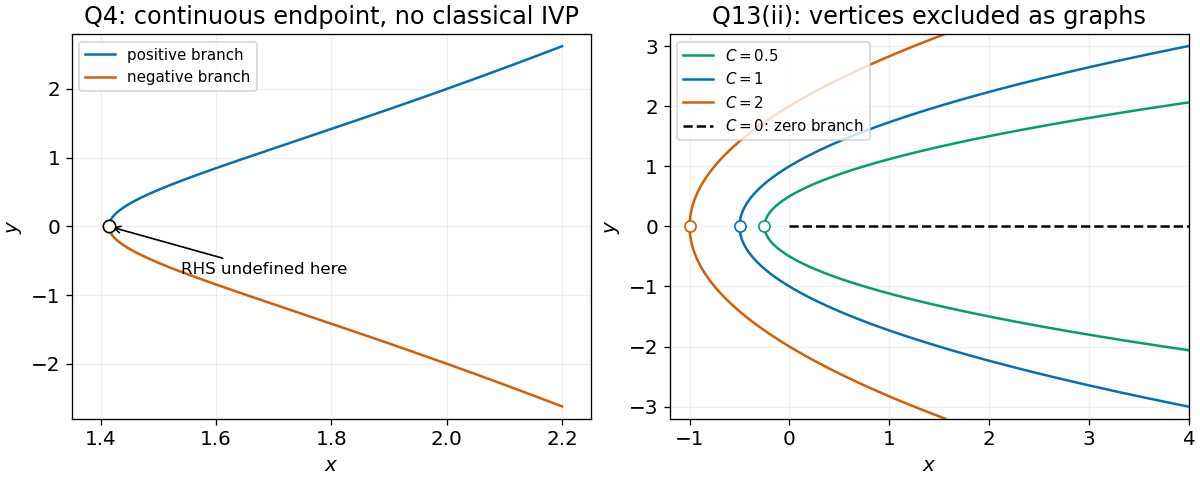
Singular initial-point branches and the parabolic integral curves, with their graph-domain restrictions
. Details. 
For the linear differential operator , the exponential function is an eigenfunction: . Distinct give the two homogeneous solutions, while the method of undetermined coefficients supplies a particular solution at the distinct forcing exponent :
With and , the first equation is . Multiplication by its integrating factor gives , henceThis holds whether or not . If , solving by a second integrating factor givesThe extra factor is the response to the resonance condition at the forcing exponent; the coincident-root case requires the next part.
When all three exponents equal , write . The exponential shift rule for differential operators gives and . Thus . Two integrations giveThe repeated characteristic root supplies and as homogeneous solutions; forcing at that same exponent needs the further factor.
Articles by others on the same topic
There are currently no matching articles.