Let a differentiable curve lie on the level surface , and pass through the point under consideration. Differentiating the constant relation along the curve givesEvery surface tangent vector arises as the velocity of such a surface curve, so the gradient is orthogonal to every tangent direction. At a regular point, where , it therefore defines a normal direction, with unit normalIf , the dot-product identity is still true but the zero vector does not determine a normal direction; a regularity hypothesis or another defining function is needed. For example, defines the plane at level zero but has vanishing gradient everywhere on that plane.
Write the fixed point as and the variable point as . Then andSince the fixed point is not on the surface, at every point being considered. Componentwise differentiation gives , henceThus the gradient points from the fixed point towards the variable point and is a unit vector. Keeping the fixed point fixed is important: differentiating a distance between two simultaneously moving points would include both endpoint derivatives.
Let , , and define the outward-from-focus unit vectors and . The ellipse is the nondegenerate level curve , with . The previous gradient result givesIf is a unit tangent at , orthogonality to the level-curve gradient impliesTherefore . These absolute dot products are the cosines of the acute angles made by the two focal lines with the unoriented tangent line. Thus those angles are equal.
Equivalently, the outward unit normal is , the bisector of the two unit focal directions. Its denominator is nonzero for a nondegenerate ellipse. Using , the specular reflection formula becomesThis algebra proves the equal-angle statement with the incident and reflected ray directions correctly oriented, rather than confusing the line with the outgoing direction .
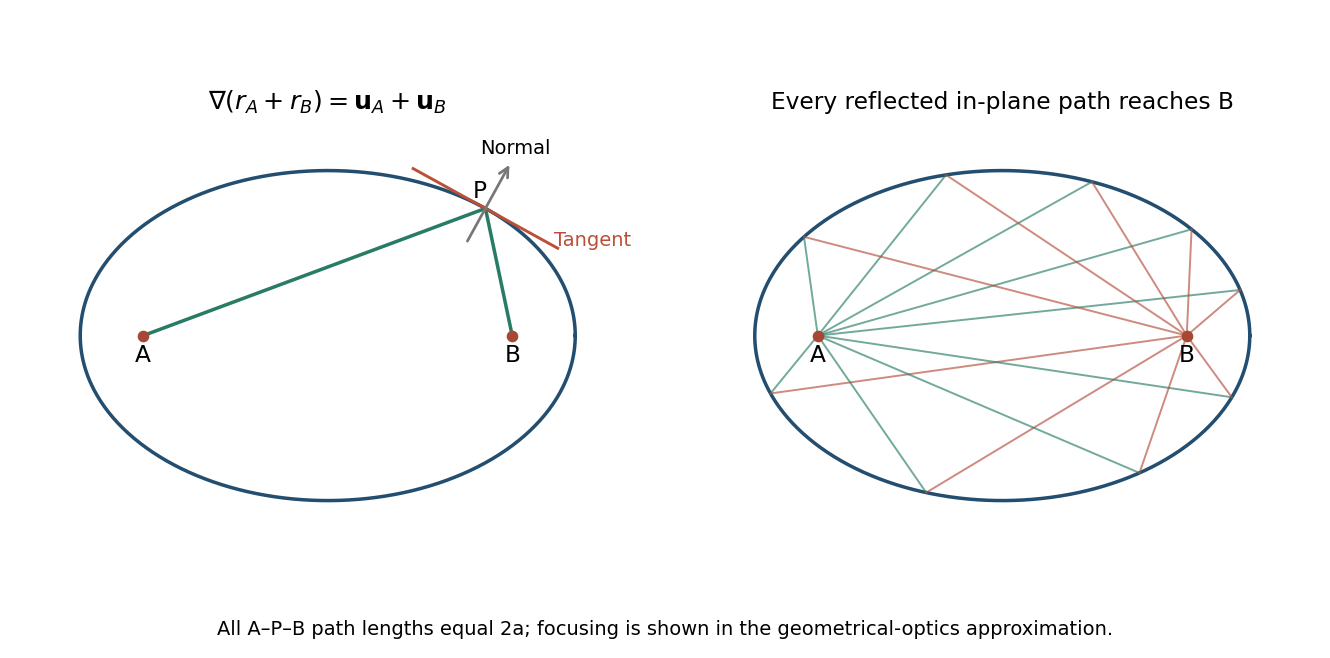

A ray leaving focus and reaching a boundary point has incoming unit direction . By the law of reflection, its normal component reverses and its tangential component stays fixed. The result just derived shows that the reflected direction is , pointing exactly from to focus . Thus all such in-plane rays from one focus converge to the other after one reflection, in the ideal geometrical optics model.
Moreover, every reflected path has the same total length . In a uniform medium their propagation times are equal as well, so different reflection points do not introduce a geometrical path-length spread. Finite wavelength, surface errors and incomplete reflecting coverage limit a real focus; the ideal argument concerns rays in the plane of the ellipse. It does not assert that an arbitrary three-dimensional surface with only one elliptical section focuses every out-of-plane ray.
Articles by others on the same topic
There are currently no matching articles.