Wave dispersion means that different frequencies propagate with different phase velocities, so a wave packet generally changes shape. Equivalently the dispersion relation is not proportional to over the relevant band. Three natural examples are the colour separation in a rainbow, where the refractive index of water depends on wavelength; deep-water surface gravity waves, for which and long waves have larger phase velocity; and capillary waves, whose short-wave limit is and whose shorter waves have larger phase velocity. Here is gravitational acceleration, is surface tension, and is fluid mass density, with positive and negligible viscosity.
A distinct application is an optical prism spectrometer: the wavelength-dependent refractive index produces different refraction angles, separating spectral components for measurement. This exploits wave dispersion deliberately.
Take constant complex amplitude and real wavenumber and angular frequency . Substitution of the complex exponential givesThus every nonzero plane wave of the given form solves the equation precisely whenThe wavenumber specifies spatial wave phase change per unit length, with wavelength . The angular frequency specifies temporal wave phase change per unit time, with period and ordinary frequency . The constant in this equation has dimensions time divided by length squared; without an additional dimensional coefficient, it is not an ordinary physical mass.
For propagating oscillatory solutions assume real . If , the equation becomes and only among these spatial plane waves is possible; the usual dispersion relation branch and velocity discussion would degenerate.
A fixed wave phase satisfies , so the signed phase velocity is . The group velocity gives the leading translation of the wave envelope of a narrow-band wave packet on a differentiable dispersion relation branch.
Here . For the conventional positive branch , and ,On the opposite propagation branch it is , so is the phase speed for either sign of . More generally, for real use with , allowing the sign of to follow that of . The constant solution has no distinguished phase velocity.
For equal complex amplitudes, the superposition principle and the complex exponential formula for the cosine give the exact identityThe cosine is a real periodic modulation of the rapidly varying carrier. It varies slowly when and . Its signed wave envelope travels with velocity ; its magnitude gives the visible amplitude envelope.
Equal magnitudes need not mean equal initial wave phases. If the two complex amplitudes are and , write and . The same result becomes , still with a real slowly varying modulation.
Apply the dispersion relation separately to the two components and subtract:In the narrow-band limit this is the group velocity, since givesEquivalently on the positive branch , and its reciprocal is . The factor of two applies to signed velocities on either nonzero propagation branch.
There is a small but useful finite-band qualification. Adding the two component relations gives . Thus the carrier formed by their exact midpoints has phase velocity , and its finite-band envelope-to-carrier velocity ratio isThe exact derivative relation refers to a single central point on the dispersion relation; the two-tone midpoint ratio approaches two as .
The result depends on the component amplitudes and wave phases; adding many frequencies does not by itself guarantee one localized wave packet. For a definite sketch, take many equally spaced wavenumbers in the same fixed band, with equal, aligned complex amplitudes . Linearize the dispersion relation as , where . Then with the wave envelope isfor odd . This is a normalized Dirichlet kernel: constructive interference occurs near , while most other positions undergo partial cancellation. At finite there are repeated groups separated by .
As grows with the half-bandwidth fixed, decreases and the repetition spacing grows. The continuous flat-band limit isThus a sinc function envelope has a central group between its first zeros at , smaller side lobes and rapidly oscillating crests. At fixed bandwidth the limiting central width is ; it does not shrink indefinitely just because more components are added. Smoother spectral weights can reduce the side lobes, and random wave phases would produce a different shape.
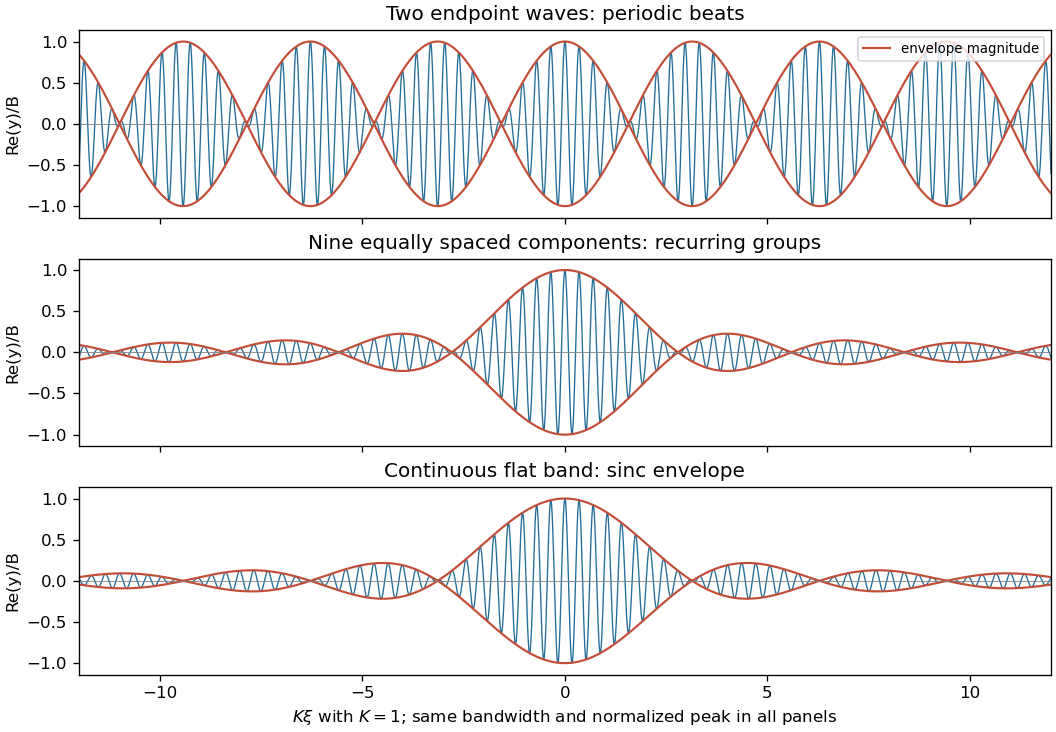
Equal-phase waves in a fixed band: a two-tone beat train, finite groups, and the continuous sinc envelope
. Details. 
For the exact quadratic dispersion relation,The additional quadratic wave phase makes the wave packet spread and change shape. The translating sinc function approximation is valid while ; the preceding figure is the exact comparison, where that approximation introduces no error.
Articles by others on the same topic
There are currently no matching articles.