For an assay begun by mixing free enzyme and substrate, take . The complex has not yet formed and no product has been made. The later small-enzyme limit assumes . Other preincubation protocols could require nonzero initial complex, but these initial conditions are the ones used by the stated inner solution.
Mass action givesThus and are conserved. Eliminating free enzyme yields the stated two-equation system.
With , and , substitution givesThe dimensionless initial data are . The parameter named here is an enzyme kinetic coefficient and is unrelated to the loss parameter used in the later blood-cell question.
Set , , and . On fast time ,For , leading substrate remains . The initial complex buildup therefore solves , , givingTime belongs inside the exponential. Its placement outside the exponential bracket in the printed expression is a typographical error; the derived form satisfies both the kinetic equation and zero initial complex concentration.
Use the longer scale and . The equations becomeAt leading order the fast complex variable has equilibrated to the quasi-steady manifold. ThereforeMatching from the initial layer gives for this outer problem; its implicit solution is . The dimensional substrate loss is the Michaelis-Menten rate with maximum rate and Michaelis constant .
The fast scale resolves the rapid complex buildup that is compressed into a thin initial layer on the substrate-depletion scale. The outer scale follows depletion over a much longer time and cannot satisfy by itself.
In the overlap , the inner solution tends to . The outer solution as has the same limit. Subtracting this common part produces a leading composite approximation,It satisfies the leading initial values and tends to the outer quasi-steady solution after the initial layer. Corrections of order describe the small substrate loss during complex buildup.
In physical concentration coordinates, the two nullclines areSince , the substrate nullcline lies above the complex nullcline for . Starting at , the complex rises and substrate falls; with , this fast segment is nearly vertical when the axes use their respective concentration scales. The trajectory then follows the complex quasi-steady manifold toward the origin. On its slow descending portion it is slightly above the complex nullcline so that ; the leading outer curve itself sets that derivative to zero only at zeroth order.
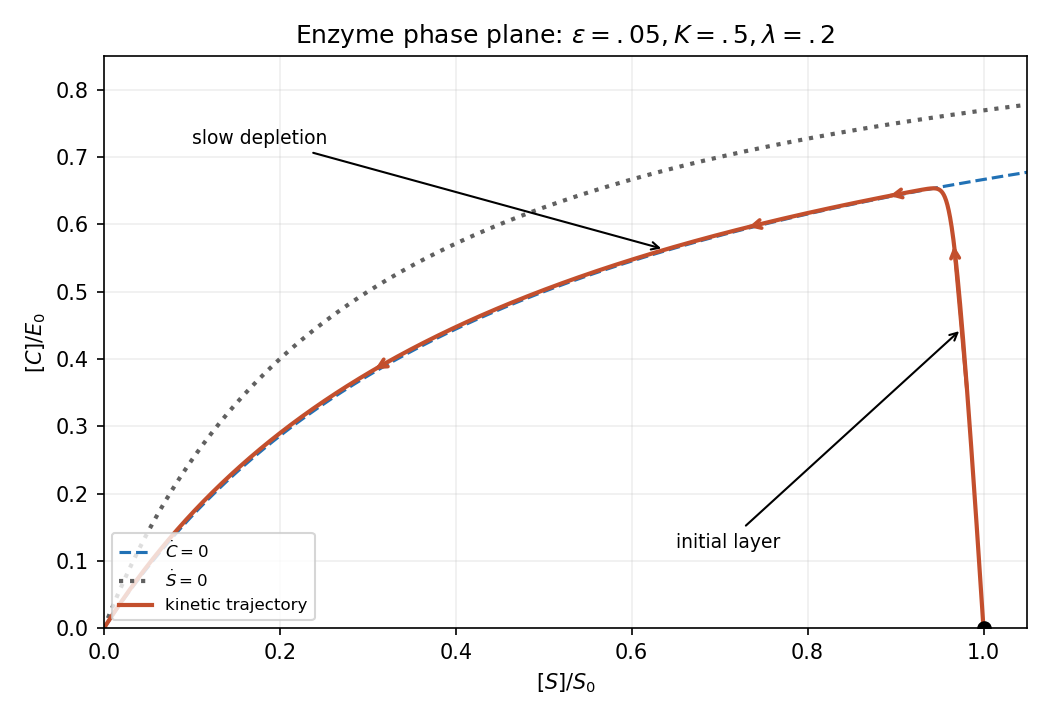
Enzyme kinetics in scaled concentration coordinates: rapid complex buildup followed by slow substrate depletion
. Details. 
Articles by others on the same topic
There are currently no matching articles.