Distinguish physical time from scaled time . PutThen , givingA steady state must be positive, since otherwise ventilation vanishes while production remains positive. It solves , soThe value printed in the question agrees only through first order. Thus it is a small- approximation with error of order , not an exact equilibrium for nonzero . The other quadratic root is negative and inadmissible for this steady ventilation balance.
Since the steady state is strictly positive, the positive-part function is differentiable in a neighbourhood of it. Write . Retaining first-order terms givesSubstitute the exponential mode to obtainHere the last equality uses the exact steady-state equation. For small , and . Linearizing at the exact root avoids carrying a spurious constant residual from the printed approximate equilibrium.
For real , draw and . The first is nonnegative and increasing, while the second is negative and approaches zero from below. They cannot intersect on the nonnegative real axis. At zero the characteristic function equals , so a stationary zero-root crossing is excluded as well.
Consequently a loss of stability from a stable regime cannot occur by a real eigenvalue crossing through zero. It must involve a conjugate pair crossing the imaginary axis at nonzero frequency, yielding oscillatory instability. This does not mean that every characteristic root is nonreal: negative real roots may exist and are harmless for stability. The graph and imaginary-axis conditions are shown together below.
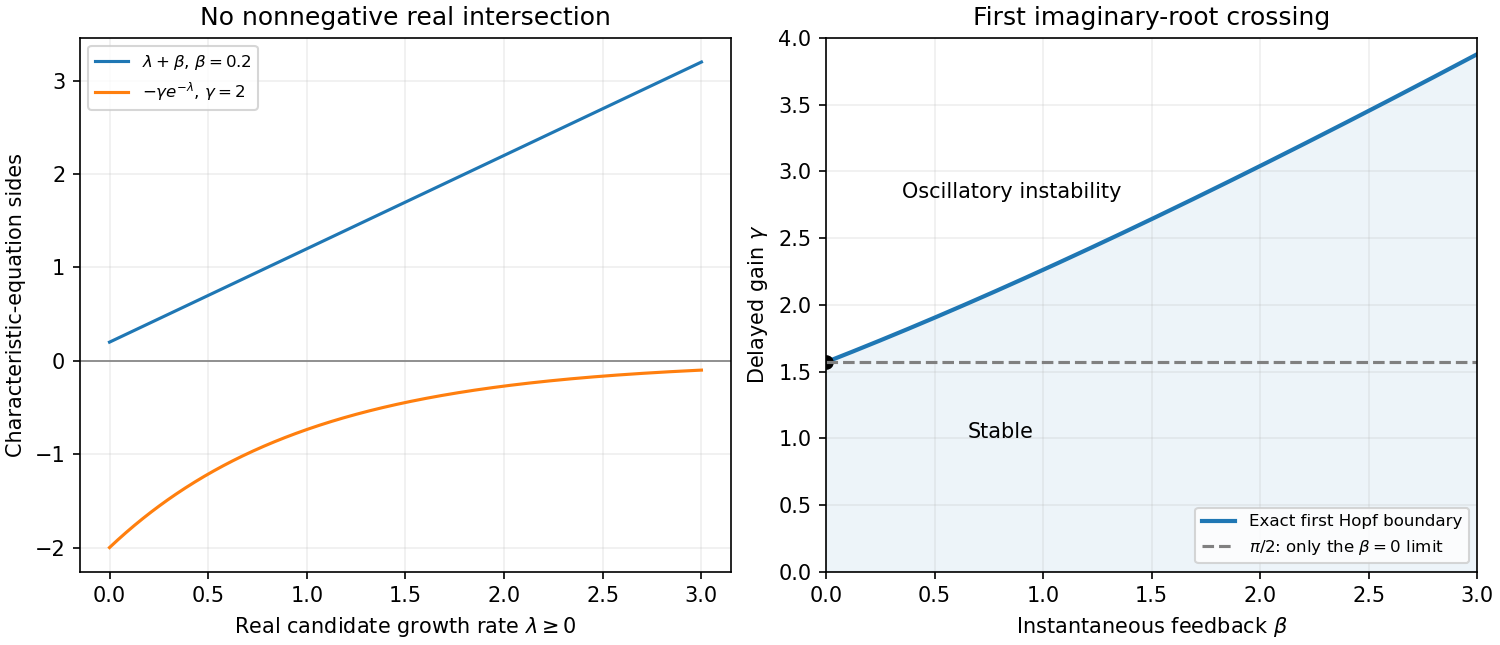

For the first Hopf boundary of scalar delayed negative feedback, first, if a root has nonnegative real part then . For this is impossible, apart from the potential equality case , already excluded. Thus is necessary for instability, although not sufficient by itself.
At an imaginary root with , separate real and imaginary parts:The first crossing uses for , and satisfiesThe period is in scaled time; its physical value is . Higher-frequency branches have larger critical gains. For fixed , stability at zero delayed gain and absence of any earlier imaginary or zero-root crossing identify this lowest branch as the first stability boundary. Its crossing is transverse: implicit differentiation of gives at the imaginary rootFor very small , , so and . Therefore is exact in the limit and is the leading approximation for small positive . At that limit first has an imaginary pair at ; subsequent pairs occur at and cannot be the first loss of stability. A nonlinear Hopf theorem, including its nondegeneracy conditions, is needed to turn the linear imaginary mode into a claim about a particular finite-amplitude periodic branch.
Articles by others on the same topic
There are currently no matching articles.