Write for the homogeneous cubic correction and for the nilpotent linear part. The chain rule gives the transformed cubic vector field as . Thus the cubic coefficients in the first equation arewhile those in the second equation areConsequently one explicit near-identity transformation isThe transformed equations have no cubic correction in , and only survive in . The cubic coefficients areThis is the cubic elimination at a nilpotent double-zero point; the extra is the nilpotent cubic damping invariant contribution from the first equation. Higher-order terms generated by the substitution are outside the cubic truncation.
The linearization of this reduction of the FitzHugh-Nagumo model at its trivial equilibrium point isA double zero eigenvalue requires both the constant and linear coefficients to vanish. Hence the codimension-two point isThere the polynomial is . The kernel of a linear map of is one-dimensional, so its zero eigenvalue has a nontrivial size-two block in Jordan normal form. This is a reflection-symmetric double-zero point of Bogdanov–Takens bifurcation type, with one stable direction; the nonlinear coefficients are computed below rather than assumed.
A simple zero eigenvalue occurs on , except at . The odd symmetry of the vector field gives a pitchfork bifurcation. Near this curve the critical eigenvalue isFor the other two eigenvalues are stable: this is a supercritical pitchfork bifurcation as decreases through . For it is a subcritical pitchfork bifurcation in the center direction, with an already unstable transverse direction.
For a Hopf bifurcation, factor the characteristic polynomial as . Comparing coefficients givesThus the trivial branch has the local bifurcation curvesThe second curve is a Hopf bifurcation with a stable third eigenvalue. The Routh-Hurwitz stability criterion gives the stable trivial region , . Its Hopf bifurcation is subcritical. To check the sign, normalize the critical right eigenvector by and putThe second component of the normalized left projection is . There is no quadratic term at the origin, and the cubic derivative in the second component is . The cubic Hopf coefficient is therefore . A small repelling periodic orbit lies on the stable-origin side. The diagram also includes the nonzero-branch information derived next.
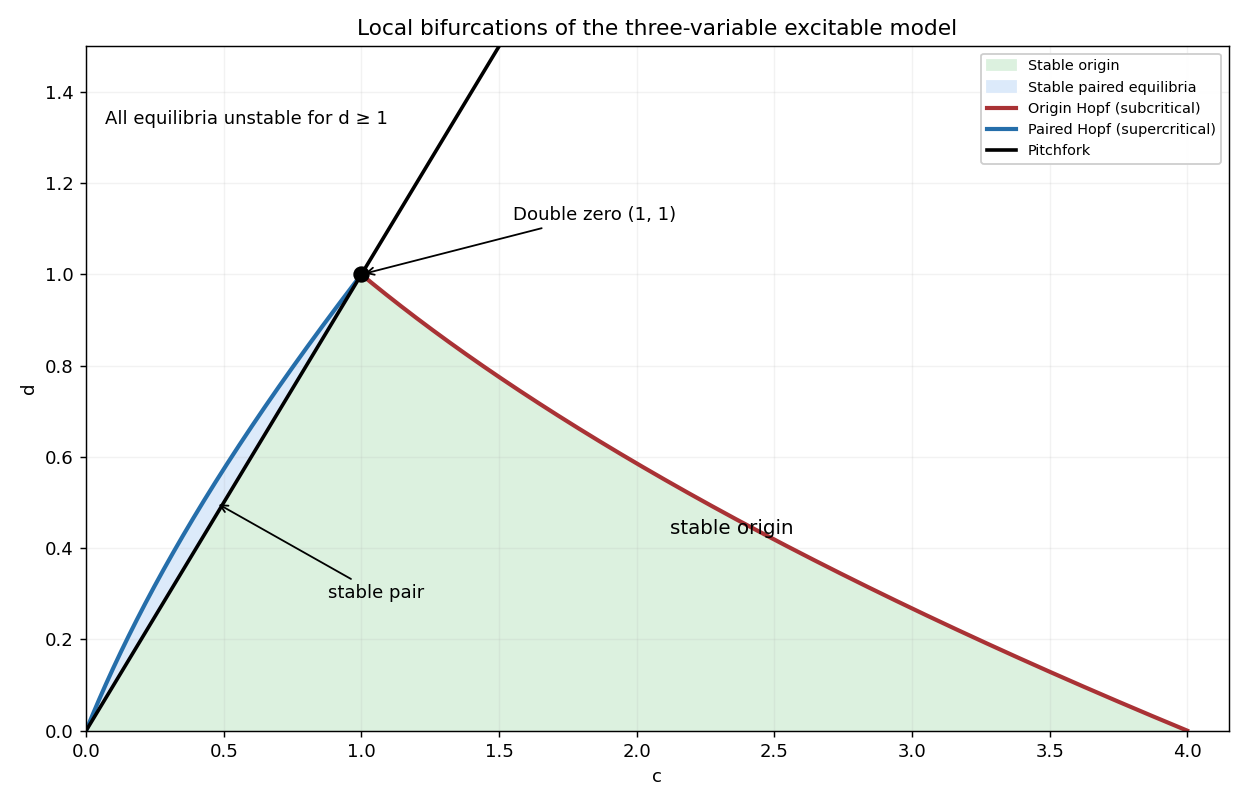

The nonzero equilibrium points are paired by reflection:At either equilibrium point, the derivative of the second equation with respect to is . The characteristic polynomial becomesIts constant term is nonzero away from the pitchfork bifurcation, so there is no further steady local bifurcation. At a Hopf bifurcation the condition givesIndeed and require ; within this range is equivalent to . The apparent singularity at does not hide another solution of the coefficient equation. The Routh-Hurwitz stability criterion shows that both equilibrium points are stable for , , and unstable for . For , , so no nonzero equilibrium point is stable.
Their Hopf bifurcations are supercritical. Here is a coefficient check that includes the effect of the quadratic term around . Let , and normalize as before. The inverse-linearization term has . AlsoThe resonant cubic Hopf coefficient isIn this simplification . Thus stable small periodic orbits appear around each nonzero equilibrium point on the side. This classifies the local branches; the sketch does not infer uncomputed distant global bifurcations.
The specified coordinate change gives the exact equationsAt linear order on the center manifold. More precisely the stable coordinate obeys at linear order, while , . Thus relaxes towards its center-manifold value and can be eliminated by center manifold reduction or a properly ordered adiabatic elimination.
Write , where is homogeneous of degree . At degree two the graph invariance equation is . On homogeneous quadratic polynomials the operator is nilpotent, so adding makes it invertible. Hence . Equivalently, the odd vector field permits a symmetry-compatible odd graph: odd symmetry removes even center-manifold jets. No quadratic forcing is present for adiabatic elimination either. However, setting alone is insufficient at cubic order, because the evolving graph has a nonzero derivative.
To include the stable-variable lag in nilpotent center-manifold reduction, let . Invariance of the center manifold requiresFor the homogeneous polynomial , comparison of coefficients successively givesOnly is needed for the requested cubic normal form. The reduced first equation has ; the reduced second equation, obtained by replacing with in its cubic term, has and . Therefore the cubic elimination at a nilpotent double-zero point yieldsIn particular, ignoring the lag and imposing exactly would incorrectly give . The full cubic graph above provides a direct substitution check.
Articles by others on the same topic
There are currently no matching articles.