Use and normalize the stationary time at infinity. For a regular stationary, asymptotically flat electrovacuum black hole, the Kerr-Newman metric hasInitially assume and , so the outer Killing horizon is nondegenerate. Its surface gravity, angular velocity, electric potential and area areThese are horizon quantities for the generator .
The laws of black-hole mechanics provide the first reason to regard and area as thermodynamic variables. The Zeroth law of black-hole mechanics makes constant on an equilibrium horizon. The first law for the Kerr-Newman family readsFor example, write the horizon relation as and use ; differentiating eliminates and to give this law. The last two terms are rotational and electric work. The classical second law of black-hole mechanics says that area cannot decrease under the null energy condition and appropriate global horizon assumptions. The third law of black-hole mechanics concerns unattainability of a zero-surface-gravity regular horizon by a finite physical process.
This analogy alone does not determine the temperature scale: if entropy were , the first law would only give . The decisive input is quantum field theory in the collapsing or stationary background. In a collapse vacuum that is regular for freely falling observers, the late outgoing retarded time and a regular affine null coordinate satisfy the Hawking exponential ray mapAn outgoing mode therefore behaves as . Continuing this power through the horizon changes its amplitude by the factor . Its positive- and negative-frequency decomposition consequently has the thermal ratio of Hawking Bogoliubov coefficientsCombining that ratio with bosonic normalization gives a Planck occupation . The fermionic normalization instead gives the corresponding Fermi factor. Thus Hawking radiation fixesFor rotating charged modes, the horizon energy is , so the emission spectrum contains the same temperature with angular-momentum and charge chemical potentials. Exterior scattering supplies greybody factors; it changes the received flux, not the horizon temperature. Superradiant bosonic modes require the usual signed absorption factor, and a globally regular thermal bath need not exist throughout an asymptotically flat rotating exterior. The collapse-state emission argument is the relevant one.
A complementary check is the Euclidean black-hole regularity condition. The local corotating nondegenerate horizon geometry is Rindler-like:Smoothness at requires to have period . Imaginary-time periodicity is precisely inverse temperature, agreeing with the radiation calculation. Matching the resulting temperature to the first law fixes the Bekenstein-Hawking entropy to . The generalized second law then uses : the classical area theorem alone does not apply to the negative-energy quantum flux responsible for evaporation.
Substitution gives the Kerr-Newman horizon temperatureIt reduces to for a Schwarzschild black hole. The nonextremal limit towards gives zero temperature. At exact extremality the Euclidean horizon is degenerate, so the elementary conical-period argument does not itself fix a period; zero temperature here is the limiting semiclassical result. The reasoning assumes ordinary Einstein–Maxwell dynamics, a regular horizon, the stated normalization at infinity and a regime where quantum fields on a slowly evolving classical geometry are a useful approximation. The mechanical laws, radiation spectrum and Euclidean regularity agree under these assumptions, which is substantially stronger evidence than the classical analogy alone.
The mass statement needs a nonzero parallel spinor and an isolated asymptotically flat spacetime; the zero spinor solves the equation on every geometry and cannot imply anything about mass. Assume the usual complete regular spin initial data and dominant energy condition used by the positive energy theorem, with the spinor tending to a nonzero constant at infinity. Let be its future causal Dirac current.
The Nester two-form can be written, up to normalization, asIt is bilinear in and . For a spacetime-parallel spinor it vanishes identically, and hence so does its asymptotic flux. The ADM boundary term of the Nester two-form identifies that flux, up to a fixed positive normalization, asThe positive energy theorem gives . Since is nonzero future causal, a future timelike ADM momentum would have strictly positive contraction with it. Consequently the ADM momentum is zero or null:In a rest frame, when one exists, this immediately says . The usual regular asymptotically flat rigidity conclusion also excludes a nontrivial null-momentum configuration and gives flat initial data. This is the spinorial boundary-charge proof, not an inference that every Lorentzian manifold with a parallel spinor is flat. Without the asymptotic and global hypotheses the local spinor equation alone does not define, let alone determine, an ADM mass.
For the modified connection, it is important to fix the Clifford algebra normalization. WriteThe compatible spinor curvature identity isIndeed, rescaling conventional gamma matrices by rescales by , while leaving the geometric spin connection unchanged. Since the connection is torsion-free and , the cross terms cancel in the modified commutator:Thus the Killing-spinor integrability with rescaled gamma matrices equation isA factor of two in the convention for antisymmetrization multiplies the whole zero equation and cannot change this relative coefficient.
The two printed coefficients are consistent with , namely . In that convention the displayed integrability equation becomes on each solution. With the customary convention , the coefficient is instead , and the final Ricci coefficient below is . The PDF does not state its Clifford normalization, so these alternatives must be distinguished rather than mixing them.
In four spacetime dimensions the complex Dirac spinor fibre has dimension four. Four independent solutions of span that fibre at every point: a solution vanishing at one point vanishes everywhere by parallel transport. Therefore the integrability matrix annihilates every spinor and is the zero matrix. The six bivector matrices are linearly independent, as is seen by taking traces against them; their trace pairing is a nondegenerate multiple of the metric on two-forms. Expressing therefore givesThis proves that maximal Killing spinors force constant negative curvature, not merely an Einstein Ricci tensor. Contracting in four dimensions givesFor this is the requested Einstein equation. Since , its Ricci tensor automatically has rank four; under the maximal-spinor hypothesis the additional rank assumption is redundant. If the stated four-dimensional solution space is interpreted directly as the pointwise kernel of the algebraic integrability equation, the same spanning and trace argument applies.
Take , set , and denote the squared areal radius by . The positive-area exterior has . The stationary norm is , where , so its candidate Killing horizon is at . There it has areaA regular horizon must have . The curvature singularity then lies strictly inside the horizon, and ingoing coordinates extend smoothly across it because . In the future interior , the gradient of is timelike and future causal curves move to decreasing , rather than back to infinity. Thus the regular black hole condition isThe equality case has zero horizon area and a curvature-singular null limiting surface. It is often included in the family as a singular extremal solution, but it is not a regular black hole. If that limiting nomenclature is used, the family condition is with this essential qualification. This geometry has the same spherical form as the magnetically charged dilaton black hole; no unprinted field equation is needed for the horizon comparison.
For and , the physical exterior starts at . Throughout it, , so the putative zero of is not in the exterior and no regular horizon shields the curvature singularity. The normal to has positive limiting squared norm , identifying a timelike singular boundary. Outgoing radial null geodesics obey and escape from arbitrarily close to that boundary. HenceAt , the singular boundary coincides with and is null. There is no regular shielding horizon of positive area; this marginal singular extremal case must be separated from both the regular black hole and the supercritical timelike naked singularity. If “naked” is used simply to mean unshielded by a regular horizon, equality belongs on that side of the distinction, but its causal boundary is different.
The usual positive-mass restriction matters. For , at every positive radius and there is no positive-radius horizon; the central zero-area boundary at is singular and naked. For its angular sectional curvature is , which diverges there. For , with , and the angular sectional curvature also diverges as . The displayed family is undefined at with nonzero ; its uncharged zero-mass limit is flat.
The absorption question concerns the geometric-optics capture cross-section, assuming rays reaching the central singular boundary are absorbed. Null geodesic motion alone does not specify a wave boundary condition at a singularity.
By spherical symmetry choose an equatorial ray. Conservation of energy and angular momentum gives , , and null normalization givesHere is the impact parameter measured at infinity. A returning ray has an exterior turning point; capture occurs when none exists. The critical impact parameter obeys , and the cross-section is the area in the incident impact-parameter plane.
For , cancellation for gives . There is no regular exterior circular photon orbit: the supremum occurs at the singular limiting surface, with . Rays with turn at ; those with reach the central boundary. Thus the extremal dilaton metric photon capture result isThe critical ray is a measure-zero boundary of the capture set. The finite capture cross-section is not the horizon area, which vanishes in this limit. Nor is it a claim about a low-frequency quantum absorption cross-section or an unspecified reflection law at the singularity.
Assume an asymptotically flat Reissner-Nordstrom spacetime, with , time normalized at infinity, and . PutNear , the Euclidean radial-time metric is . With , it becomesThe Euclidean black-hole regularity condition removes a conical defect only if has period . Therefore the Reissner-Nordstrom Hawking temperature isEquivalently this is the Reissner-Nordstrom horizon surface gravity divided by . The derivation assumes a nondegenerate horizon; the value zero at is obtained by the nonextremal limit, not by imposing conical regularity directly on the degenerate geometry.
For fixed nonzero , write . The horizon equation givesThe mass is increasing with , andThus the fixed-charge Reissner-Nordstrom temperature maximum occurs atThe curve starts at zero at , rises to this maximum, then falls as for large mass. During evaporation from , the mass moves from right to left: the temperature initially increases, reaches its maximum, and then decreases towards zero.
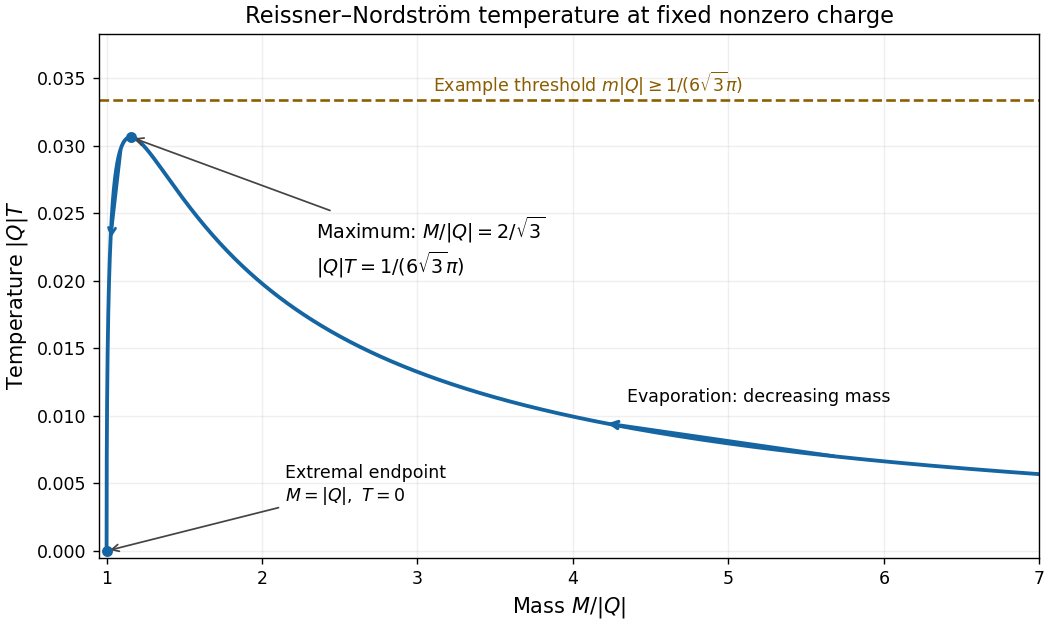
Reissner-Nordstrom temperature at fixed charge, its maximum and the evaporation direction
. Details. 
Under the printed thermal-emission cutoff, charged emission is absent throughout precisely when the entire mass path remains at or below the threshold:Equality is allowed because emission is assumed to require , not merely . The initial large mass ensures that the path includes the maximum.
With charge then conserved, neutral Hawking radiation lowers the mass until the system approaches the charge-preserving Reissner-Nordstrom evaporation endpoint:The limiting state is an extremal black hole, rather than a neutral zero-mass endpoint. Exact attainment in finite time is not established: near extremality , and the ideal radiation rate tends to zero. The conclusion is within the assumed thermal cutoff model, which omits nonthermal charge creation and other quantum corrections. For , the Schwarzschild temperature instead grows without bound in the extrapolated model, so no finite satisfies the stated all-the-way temperature bound.
Interpret first as an infinitesimal screen area transported along generators of a future event horizon, not as the total area of an arbitrary trapped surface. Horizon generators form an affinely parametrized, hypersurface-orthogonal null geodesic congruence. The two-dimensional screen metric is positive definite. Its optical tensor has zero twist and decomposes asThe scalar here agrees with the supplied derivative definition: nullness and the affine geodesic equation remove the longitudinal terms in the contracted norm, leaving .
To derive the focusing equation, vary neighbouring geodesics and let be their screen Jacobi map. The geodesic deviation equation is , where . Hence satisfies . Taking its screen trace yields the Null Raychaudhuri equationSet . Since , the area-square-root optical focusing equation isThe PDF's plus sign before is inconsistent with its own positive shear definition. This is an actual source error, not an antisymmetrization or curvature-sign convention.
For an explicit check, take a flat-space twist-free beam with screen Jacobi factors and , for . ThenIts Ricci term is zero, so the result equals and has the opposite sign to the printed equation. This is flat-space anisotropic beam shear focusing.
Under the null convergence condition , the correct equation gives concavity of each local area square root. Equivalently . If a horizon generator had , integration gives a focal point within affine distance at most . Such a generator could not remain on an achronal boundary beyond the focal point. Under the usual global hypotheses that horizon generators remain regular and future complete, this contradicts their being generators of the event horizon. Hence and . Integrating over the horizon patches, and including newly joining generators which can add area, proves Hawking's area theorem. Global predictability/completeness assumptions are essential; the local differential inequality alone is not a theorem about arbitrary trapped-surface areas.
For the perfect fluid stress tensor, null contraction eliminates the pressure-metric term:A nonzero null vector cannot be orthogonal to a timelike fluid velocity. Thus the perfect-fluid null energy condition is preciselySeparate requirements or are not needed for this null focusing argument. With the Einstein equation, .
A cosmological constant contributes only a term proportional to , whose null contraction is zero:Therefore a nonzero cosmological constant does not change the fluid condition or the local area-focusing argument, though it can change the global asymptotics and which horizons and completeness hypotheses are appropriate.
Articles by others on the same topic
There are currently no matching articles.