Use units in which the proton electric charge is one. The up quark and down quark both have spin angular momentum and form a flavour isospin doublet:Their antiquarks have the opposite charges and third components of isospin, with the same total isospin and spin. This is strong-interaction flavour isospin, not the chiral weak isospin assignment.
The Clebsch-Gordan decomposition for SU2 says that spins combine into every from to in unit steps. It applies independently to spin and isospin. ThusBefore exchange symmetry is imposed, three light quarks have total spin or , and total isospin or ; the doublet occurs twice in the uncoupled tensor cube. With zero orbital angular momentum, .
Physical baryons must also be colour singlets. The three-quark colour singlet is completely antisymmetric, so the Pauli exclusion principle requires symmetric spatial-spin-flavour symmetry. For a symmetric spatial S-wave state, the spin-flavour factor is symmetric. The flavour quartet is symmetric, whereas the flavour doublets have mixed permutation symmetry; the spin factors have the analogous symmetries. Symmetric flavour therefore pairs with symmetric spin, while the two mixed factors pair in their unique symmetric combination. This is the Pauli constraint on three-quark flavour multiplets; it leavesEquivalently the symmetric cube of the four-dimensional two-flavour spin space has dimension . The unmatched spin-isospin pairings in the bare tensor product do not describe the usual symmetric-spatial ground-state baryons.
For three light quarks, charge addition gives . The observed nucleon doublet and Delta baryon quartet have the following assignments; the listed contents specify flavour counts, not the complete spin-flavour wavefunction:The proton and neutron have ; all four Delta baryons have . These states have positive parity in the zero-orbital ground-state model.
For a light quark-antiquark meson, both spin and flavour doublets combine into singlet plus triplet. In a conventional choice of phases the flavour states areEach row can have or , since the two constituent spins couple to zero or one. At zero orbital angular momentum their parity is negative, following the meson parity and charge conjugation rule . The spin-zero isotriplet is the pion multiplet, and the spin-one isotriplet the rho meson multiplet. The nonstrange spin-one isosinglet is the idealized omega meson flavour direction. Its spin-zero counterpart is the nonstrange direction contributing to the eta and eta prime mesons; it is not automatically a physical mass eigenstate once other flavours and mixing are included.
Now introduce an isospin-zero quark of spin and charge . For baryons with one isospin-singlet quark, the two light quarks have either the antisymmetric flavour singlet or the symmetric triplet . Their colour pair is antisymmetric. Hence light-diquark spin-isospin correlation gives for and for . Coupling the spin producesThe three triplet rows have . For a strange-like charge , these are the neutral spin-one-half Lambda baryon, the spin-one-half Sigma baryon triplet of charges , and its spin-three-half starred partners. For a charm-like charge , they are the spin-one-half Lambda c baryon of charge , and the Sigma c baryon triplets of charges with spins and . Both possible new charge assignments have thus been covered; charge-conjugate antibaryons have opposite charges and unchanged .
The meson doublets with one isospin-singlet quark are , withFor their charges are , giving -like kaons and their vector partners; the conjugate doublet has and charges . For the charges are , giving -like D mesons and their vector partners, with charge-conjugate partners as well. Finally a hidden-flavour pair , if included, is neutral with and or . These are quantum-number classifications; charge and isospin alone do not determine particle masses or mixing angles.
The invariant tensors of SU(3) include , and its upper-index counterpart. Consequently an antisymmetric pair of upper fundamental indices can be converted into one lower antifundamental index, and conversely; a completely antisymmetric triple is a determinant singlet. In the Young-symmetrizer tensor decomposition, complete columns of three can therefore be removed. A remaining diagram has rows of lengths : its two-box columns become dual indices and its remaining boxes give defining indices. The irreducible highest-weight component is represented by a mixed SU(3) tensor representation symmetric in all upper indices, symmetric in all lower indices, and with every upper-lower contraction removed. Such contractions produce the lower-weight components. The resulting symmetric traceless SU(3) tensor representation has Dynkin labels ; this is an equivalent canonical realization, not a claim that an arbitrary tensor already has those symmetries.
There are symmetric upper-index components and symmetric lower-index components. All contractions are equivalent under the separate symmetries. Their image is the separately symmetric tensor space with indices. To subtract its dimension legitimately, we must show that contraction is onto.
Represent such tensors by polynomials of bidegree in three variables and three dual variables . Up to a nonzero normalization, contraction isIf has bidegree , differentiation givesChoose and . Thenhas bidegree and : consecutive terms cancel, and the last further derivative vanishes. This constructs a preimage of every contraction target. If or , there is no contraction. Therefore the number of trace-free components isThe highest-weight vector lies in this kernel. The Young-symmetry construction identifies the traceless highest-weight component with the irreducible representation of labels ; equivalently its Weyl dimension formula agrees with the independently calculated kernel dimension above.
For traceless matrices , the tensor square of the SU(3) adjoint representation decomposes asThe component maps make the decomposition concrete. The singlet is . The two octets are the antisymmetric commutator and symmetric traceless anticommutator . Symmetrizing the two upper and two lower indices in and removing contractions gives , the 27. Its highest component is already visible in .
For the 10, contract the two lower indices with and symmetrize the three upper indices ; for its conjugate, contract the upper pair with and symmetrize the three lower indices. These maps are antisymmetric under exchange of . They are nonzero: produces a nonzero all-upper-1 component, and produces the conjugate all-lower-1 component. Thus they reach the irreducible and , each of dimension ten. The octet maps are also nonzero, for example on a pair of noncommuting matrix units and on equal nonzero traceless diagonal matrices. These equivariant maps supply distinct irreducible constituents, with the two octets separated by exchange symmetry. Their dimensions exhaust the product:
An octet operator between baryon octet states defines an intertwining operator . Its covariance follows from the commutator transformation law in the question. By Schur lemma, the number of independent reduced matrix elements is the multiplicity of the output octet in the product: there are exactly two independent coefficients. To display them, use a Hermitian octet matrix basis , , normalized by . The two allowed actions areWith and , this gives the two reduced octet matrix elements:up to the common normalization absorbed into . All component dependence is fixed by the invariant symmetric and antisymmetric tensors. For a Hermitian operator and this Hermitian basis, may be chosen real; neither their values nor a relation between them follows from symmetry alone.
Work first in a finite-dimensional SU(2) representation, with its invariant positive inner product. In the complexified Lie algebra, choose and . Let be a highest-weight vector with and , and put . The commutator with givesInduction also givesFor this is . For the induction step, use on : the coefficient becomes . In particularwhich proves the assumed formula rather than merely invoking it.
The norm identity shows that, for nonnegative integer , the ladder is nonzero for and stops with . Distinct eigenvalues make these vectors independent. Their span is stable under , and in the irreducible module it is the full space. ThusFor normalized states, , with the last state killed. General finite-dimensional SU(2) representations are direct sums of these ladders.
The representation category matters here. The Lie-algebra relations alone allow an infinite Verma module even at integral highest weight: its nonzero vector is singular. The finite representation can instead be constructed algebraically by taking the basis with the displayed actions and declaring ; all three Lie brackets then hold, including at the endpoints. Thus the finite-dimensional assertion uses the integrable SU(2) module, or this explicit finite quotient, rather than assuming that a singular vector must vanish in every highest-weight module.
For rank two, take a Cartan subalgebra with commuting basis elements. A root is a nonzero linear functional on for which a root space contains an element satisfyingChoose simple roots and their coroots . In the PDF's index convention, the Cartan matrix isNormalize so . The difference of distinct simple roots is not a root, so the mixed positive-negative bracket is zero. This givesThe transpose in the last formula is essential and is printed correctly in the original PDF.
A highest-weight vector of labels is killed by both and is an eigenvector of the two . Repeated words in generate its highest-weight representation; each lowers the weight by the corresponding simple root. Restricting to the sl2 subalgebra associated with a root for either simple root gives the preceding integer ladder, so finite-dimensional highest labels must be nonnegative integers. The finite irreducible module is the highest-weight quotient imposing and the submodules generated by these relations, together with the Serre relations. Choosing independent nonzero lowering words gives a simultaneous weight basis; an extra multiplicity index is needed where a weight space has dimension greater than one.
For the specified B2 root system, the simple-root squared lengths are and their inner product is , givingThe positive root is generated by , and by . No further positive sums occur, so and . These are the relevant Serre relations. Applying the Cartan commutators to a weight vector proveswhenever the image is nonzero.
To enumerate the requested representation without guessing when arrows stop, realize it concretely as the Adjoint representation. For a Euclidean weight , its labels are . The highest root has labels , so it generates the irreducible adjoint module of this simple rank-two Lie algebra. Its nonzero weights are exactly its eight roots, and its zero weight space is the two-dimensional Cartan subalgebra. This gives the B2 adjoint representation weight diagram and the nine distinct states labels:Their actual production by lowering can be seen fromAn arrow labelled denotes a nonzero action of between the indicated weight spaces. The two paths into zero produce independent Cartan vectors. Hence there are nine distinct pairs, as requested when degeneracy is disregarded, but the full representation has dimension ten, not nine.
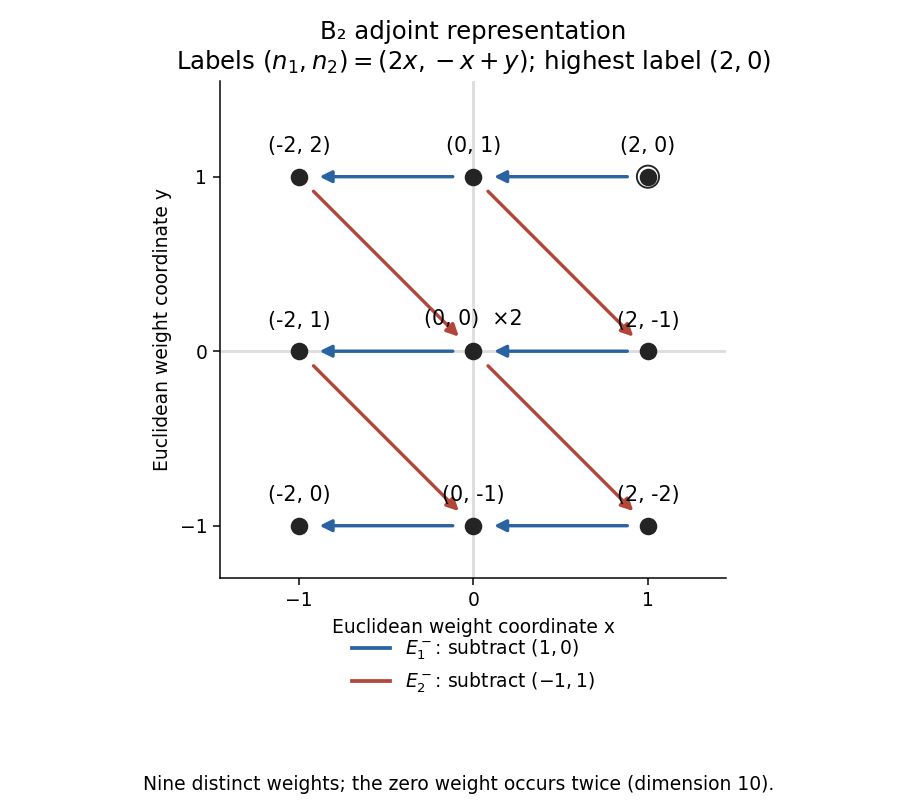

Let on the Lie algebra itself. The Jacobi identity says, for every ,Therefore , proving that the displayed structure-constant matrices form the Adjoint representation of a Lie algebra.
The bilinear form is the Killing form. It is symmetric by cyclicity of trace. Its invariance follows by expanding the two commutators:In components this is preciselyEquivalently, the adjoint action preserves the bilinear form, so it is an invariant tensor.
The invariant abelian subalgebra is an abelian ideal of a Lie algebra . Assume it is nonzero, as required for the conclusion. For and , the map sends into , because it is an ideal. It vanishes on , because preserves the ideal and kills it. Relative to and a vector-space complement, this map has zero diagonal blocks, so its trace is zero. ThusThis proves that abelian ideals lie in the radical of the Killing form. Choose a nonzero in the ideal. Then for every , so the coordinate vector is a nonzero null eigenvector of the Killing matrix. The nonzero-ideal qualification cannot be dropped: the zero ideal is abelian even in a semisimple algebra with nondegenerate Killing form.
Now suppose is invertible and let in any Lie algebra representation. In matrix notation invariance is , where . Multiplying by the inverse form gives . HenceNo commutativity of the representation matrices has been assumed. This proves the centrality of the quadratic Casimir operator formed with the inverse Killing form. Schur lemma makes it a scalar on every finite-dimensional complex irreducible representation.
For SU(2), make the normalization explicit. In a Hermitian angular-momentum basis with , the structure-constant matrices obeyThus . In the compact anti-Hermitian basis , the brackets have real structure constants and the Killing form of the SU(2) Lie algebra is instead ; the inverse contraction gives the same . This sign change is a basis convention, not a different spectrum.
In the complex highest-weight basis used earlier, the same Killing form and its inverse areConsequentlyOn a highest vector of weight , the ladder calculation gives and . Its Casimir eigenvalue is thereforeCentrality gives the same value throughout the irreducible multiplet. This is the Killing-normalized SU(2) quadratic Casimir; the familiar angular-momentum operator has eigenvalue and is twice this inverse-Killing-form contraction.
Articles by others on the same topic
There are currently no matching articles.