Define neutral-hydrogen column density along a ray by , in atoms per unit area. The neutral-hydrogen column-density distribution per redshift isso is the expected number of absorbers in those intervals along one sightline. A logarithmic column bin instead has distribution ; the bin convention must be specified.
Let be a constant comoving number density and a constant physical interception area. The corresponding physical number density is . Proper light-path length satisfies . The expected intersection count, or first-order probability in infinitesimal , is thereforeThe Friedmann equation, the constant-equation-of-state density scaling for pressureless matter, and the present cosmological density parameters giveCombining them yields the absorber incidence and comoving number density relationHere the constant cross-section is physical, as required for this result; a fixed comoving cross-section would instead decrease in physical area as . It is convenient to define absorption distance by and , so a population with these non-evolution assumptions has constant incidence per .
A useful description of the low-column Lyman-alpha forest at is a power law , with around – over the ordinary unsaturated forest range. The same column dependence holds for at a fixed redshift. It is not a universal unbroken power law: saturation, increased neutral fraction and changing absorber populations produce breaks. Lyman limit systems become optically thick at because with . Damped Lyman-alpha systems have and strong radiative damping wings. They are rare in number but contain substantial neutral mass. The highest-column distribution steepens or cuts off rather than extending indefinitely.
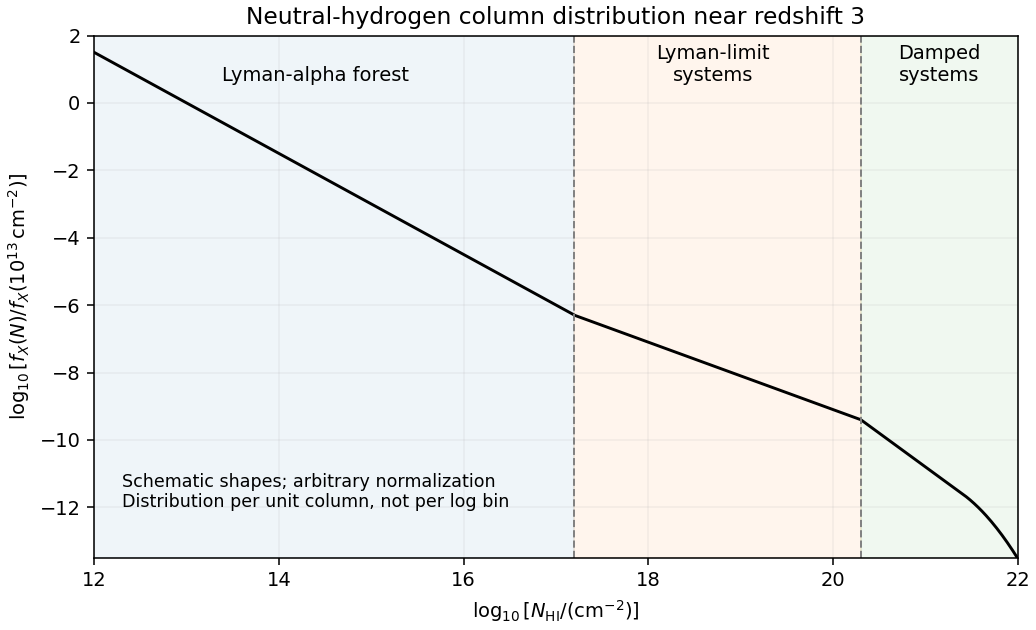
Schematic neutral-hydrogen column distribution showing the forest, optically thick Lyman-limit systems and damped systems
. Details. 
This sketch shows representative shapes and transition scales, not an observational fit; its ordinate is distribution per unit column, not counts per logarithmic bin. In an Einstein-de Sitter universe, , so a fixed comoving population with fixed physical cross-section above a fixed column threshold has . ThusThe observed redshift evolution of the Lyman-alpha forest is much stronger for commonly selected forest lines. For example, Kim, Cristiani and D'Odorico's absorption survey finds an index about in for over , corresponding to an increase by approximately . This number is selection-dependent. Expansion changes the gas density, and the evolving cosmic ionizing background changes its neutral fraction through photoionization equilibrium, moving systems across a fixed neutral-column threshold. Structure also evolves. A non-evolving population with fixed physical cross-section is therefore not an adequate physical model of the observed forest.
Use absorption distance and its distribution . Summing hydrogen columns per unit gives . The physical light-path length per isThe mean neutral-hydrogen number density is therefore . Divide by to obtain its comoving density, multiply by hydrogen atomic mass, and divide by today's mass critical density . This derives the neutral gas density from an absorption distribution:If “neutral gas” includes helium, replace by , with a stated abundance correction approximately . Equivalently, for the distribution per redshift the prefactor inside the integral is multiplying . In the PDF's energy-density convention, both the mass density and critical density are multiplied by , leaving their ratio unchanged. The usual quoted abundance uses comoving mass density relative to today's critical density; a ratio of physical density to the epoch's critical density instead multiplies this answer by .
To infer total gas, one needs the neutral fraction for each absorber. The ionized gas density from an absorption distribution isThis is an ionization-corrected integral, not an inference available from the observed columns alone. For optically thin, almost fully ionized hydrogen, photoionization equilibrium gives . If the absorbing depth is specified, andThus photoionization rate, temperature and depth are all needed.
One useful physical closure sets to a local Jeans length, , with local gas fraction . Solving then gives the Jeans-length ionization correction for the Lyman-alpha forest:This illustrates why weak, highly ionized forest lines can dominate the total gas inventory even though damped Lyman-alpha systems dominate the neutral-column-weighted inventory. It is a model for locally confined optically thin gas; optically thick Lyman limit systems and damped Lyman-alpha systems require a separate radiative transfer treatment. The physical basis and observational application of this closure are developed in Schaye's absorption-based matter-density calculation.
No measured normalization of the neutral-hydrogen column-density distribution, ionizing field or gas temperature is supplied, so the paper's formulas do not determine numerical densities on their own. With observational data and suitable ionization corrections, the high-redshift Lyman-alpha forest gives a total gas density of order a few relative to today's critical density, comparable to the cosmological baryon density – for . The conclusion is that a large fraction of baryons at reside in diffuse ionized gas, rather than that every baryon has been individually accounted for. Schaye's analysis and Kim and collaborators' survey support that interpretation under their stated gas and ionizing-background assumptions.
The neutral-gas reservoir traced predominantly by damped Lyman-alpha systems is much smaller, of order in the same convention. It is broadly comparable in order of magnitude to today's luminous stellar matter, whose cosmic stellar mass density is a few , but exact comparisons depend on cosmology, helium correction and which stellar components are counted. Storrie-Lombardi, McMahon and Irwin's neutral-gas census finds especially close comparison with present stellar disks. Most high-redshift gas is ionized; the smaller neutral reservoir has a mass of roughly the same order as today's visible stellar population. This comparison does not imply that the measured neutral reservoir alone simply becomes all present-day stars: gas accretion, recycling, ionization changes and outflows continue during galaxy evolution.
The neutral gas density from an absorption distribution is comparatively robust for high columns where the hydrogen is mostly neutral, but saturated lines, dust-obscured quasars, incomplete surveys and small numbers of rare high-column systems affect the integral. The ionized gas density from an absorption distribution has additional systematic uncertainty in the cosmic ionizing background, temperature, absorber depth, helium treatment and small-scale density inhomogeneity. At low columns, line blending and incompleteness matter; at high columns, attenuation makes an optically thin ionization correction invalid. A single power law extrapolated outside the measured column range can also produce a misleading mass integral. Hot gas, molecular gas and gas missed by the selected absorption population are not included automatically. These are observational and modelling qualifications to a baryon census, not failures of the column-mass accounting itself.
Articles by others on the same topic
There are currently no matching articles.