Use a finite-dimensional unitary representation of SU(2) and units , so the isospin generators are Hermitian and . Their commutators areOn the normalized highest-weight vector, the given quadratic Casimir operator identity gives . Since the quadratic Casimir operator commutes with every generator, this eigenvalue is unchanged down the ladder. Each application of lowers by one. For a normalized descendant,Positivity first gives . In a finite-dimensional representation the descending ladder must terminate; the norm vanishes only at . Thus the number of lowering steps is , a nonnegative integer, andFor , define the normalized descendant by dividing by its positive norm. This fixes its relative phase and givesActing with and using provesThe resulting isospin multiplet has states. More explicitly,The factorial arguments are integers, even for half-integer .
Put . Differentiation and the commutators givewhile is unchanged. Hence at the half-turn,The half-turn preserves and reverses , so . Since , comparison of the two ways to rotate a raised state gives .
To fix the remaining phase, expand the supplied highest-state rotation identity as a finite sum. The th term isAs , all terms vanish except . The product of the lowering coefficients gives . The surviving coefficient is therefore one, fixing . The half-turn phase of an SU(2) multiplet isIn particular the recurrence and highest-state phase are consistent with .
Charge conjugation is a linear unitary symmetry. If , conjugation preserves the commutator and the scalar , soThus the conjugated generators obey the same SU(2) Lie algebra. The charge conjugation action on is exactly the same pair of sign reversals as . Their product consequently satisfies for all . For integer , its value on the neutral member isCommuting through the ladder operators transfers that value to every state in the same isospin multiplet. Therefore the G-parity of an isospin multiplet is
A photon has charge conjugation value minus one, so a two-photon state has value plus one. The electromagnetic two-photon decay preserves charge conjugation, giving . Since the pion has , all three pion charge states have G parity minus one:The rho meson has , , hence , whereas the omega meson has , , hence . On an -pion state the internal symmetry acts on each pion, giving independently of orbital angular momentum. Conservation of G parity in the isospin-symmetric strong interaction therefore gives the G-parity selection rule for pion multiplicities:The allowed channels can also satisfy angular momentum and physical parity: the two pions from a rho can have relative orbital angular momentum one and total isospin one, while three pions can couple to the omega's , . The rule refers to the ideal isospin-conserving strong amplitude; small symmetry-breaking or electromagnetic contributions are not excluded.
When the three light-quark masses are equal, the mass term is proportional to the identity in flavour space, so rotating by SU(3) leaves it unchanged. The gluon coupling is also flavour blind. Nearly equal masses therefore give an approximate flavour symmetry, distinct from the exact colour gauge symmetry. The quark transforms as and the antiquark as .
For mesons, a quark-antiquark tensor is a matrix. Its trace and traceless parts are invariant subspaces, givingThe trace is the eta singlet state; the traceless part is the meson octet. For baryons, first separate a pair of quarks into symmetric and antisymmetric tensors:The antisymmetric pair transforms as by contraction with the invariant epsilon tensor. In , complete symmetrization gives of dimension ; the remaining mixed-symmetry subspace has dimension eight. In , trace and traceless parts give a singlet and another octet. Thus the tensor cube of the defining SU(3) representation isThe two octets carry the two mixed permutation-symmetry components. Their weight diagrams are identical; the extra copy is a multiplicity, not a new arrangement of weights.
The printed charge relation fixes the half-hypercharge convention, rather than the usual Flavor hypercharge normalization:The quark weights are , , ; adding three weights gives the baryon weight diagrams in the half-hypercharge convention. The baryon octet has at , the isotriplet and the isosinglet at , and at . The baryon decuplet has rows at , at zero, at , and at . The three-quark flavour singlet is the antisymmetric state at .
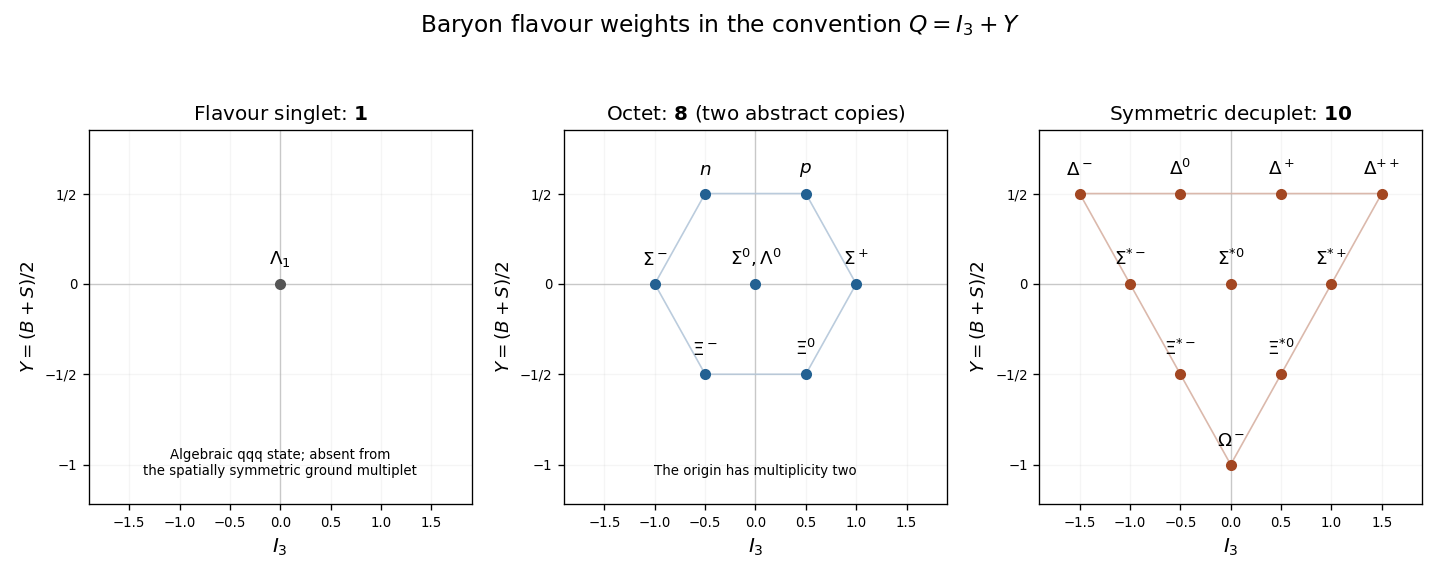

The fully symmetric flavour representation is precisely the baryon decuplet, . For a spatial ground state, the orbital wavefunction is symmetric. Spin is the symmetric part of three spin- quarks, so a spin- decuplet would have a completely symmetric space-spin-flavour wavefunction. In particular the state with all spins aligned has no antisymmetric factor. This conflicts with the Pauli exclusion principle for the three fermions.
An additional colour degree of freedom resolves the conflict. With three colour labels the normalized colour state isIt is completely antisymmetric and an SU(3) colour singlet. Multiplying it by the symmetric remaining wavefunction gives the required fermionic antisymmetry. Three orthogonal labels are the minimum needed for a nonzero third exterior power: for . Thus the decuplet suggests at least three colour states, and three supply the minimal colour-singlet construction used in the quark model. This argument motivates three colours rather than deriving their exact number without further physical input.
The Pauli constraint on three-quark flavour multiplets also explains the absence of a flavour-singlet baryon in the lowest spatial multiplet. After extracting the antisymmetric colour factor, spin-flavour must be symmetric. Singlet flavour is completely antisymmetric, so its spin factor would also have to be completely antisymmetric. Butso three spin- quarks have no such spin state. By contrast, mixed flavour and mixed spin can combine symmetrically to produce the ground-state baryon octet with spin . The two abstract flavour-octet copies do not imply two independent ground-state octets after the full Pauli constraint on three-quark flavour multiplets is applied. Excited orbital wavefunctions can permit three-quark flavour singlet; the exclusion is for the spatially symmetric low-energy ground multiplet, not for every baryon at every energy.
A flavour-singlet meson is allowed: a quark and an antiquark are not three identical fermions, and the invariant flavour combination can combine with an appropriate spin and colour singlet. The missing three-spin antisymmetric state therefore causes no meson exclusion.
Finally, has baryon number one, strangeness zero and , so it is a pure channel. These quantum numbers match the Delta baryon , the low-energy resonance with spin . For , the kaon contributes strangeness plus one, giving total , . No ordinary baryon can have positive strangeness, since every quark contributes minus one. Hence that channel has no matching state in the ordinary low-energy three-quark multiplets. A resonance would require exotic quark content, for example , and is not mandated by this spectrum. This is strangeness selection in pion-proton and kaon-proton resonances.
The Adjoint representation of a Lie algebra acts on the Lie algebra itself by . The Jacobi identity givesThus it is a Lie algebra representation. In the basis with , its matrices areThe column index labels the basis vector being acted on; this convention fixes the matrix signs.
Work in finite dimension over characteristic zero, as in the usual real or complex gauge algebras. A simple Lie algebra is nonabelian and has no nonzero proper Lie algebra ideal. A semisimple Lie algebra has no nonzero solvable ideal; equivalently it is a direct sum of simple ideals. The nondegenerate Killing form is . Its invariance follows from the representation identity and trace cyclicity:
For the reduction, take a nonzero proper ideal , if one exists, and define its Killing-orthogonal complement . Invariance makes it an ideal: for , , , . Moreover , because for , , and any ,and the global Killing form is nondegenerate. Their intersection is consequently an abelian ideal: its elements lie in both commuting ideals. Semisimplicity forces that intersection to be zero. The dimension formula for a nondegenerate bilinear form then givesThe summands commute and are semisimple, since a solvable ideal in either summand would also be an ideal of . Repeating on smaller summands terminates in simple ideals. This proves the orthogonal ideal splitting for a nondegenerate Killing form and describes the required reduction; abelian one-dimensional factors do not occur in a semisimple algebra.
If with , invariance givesso after lowering the output index with . The bracket already gives . These two adjacent transpositions generate all permutations, proving that the structure constants of a Lie algebra are completely antisymmetric. This is the antisymmetry of Killing-lowered structure constants; the scalar cancels in the chosen normalization.
For the gauge calculation write , , and . The representation generators here obey ; factors of and the gauge coupling are absorbed in this connection convention. Expanding the varied derivative givesFor this to equal , choose the gauge transformation in the derivative-plus-connection conventionThen all extra terms cancel, proving covariance of the gauge covariant derivative for arbitrary space-dependent parameters.
Apply both derivatives to a test field. The second derivatives commute and the terms involving one derivative of the field cancel, leaving the Yang-Mills field strengthThus its components areThe already obtained variation can be written . The operator Jacobi identity then yieldsorFinally, with fixed space-time metric,The contracted product is symmetric in , while is antisymmetric in those indices. Hence the Yang-Mills action density is gauge invariant, with the sign convention derived rather than assumed.
Use a finite-dimensional complex semisimple Lie algebra, or the complexification of its compact real form, as required for the root construction. Choose a Cartan subalgebra with basis . Simultaneous diagonalization of its adjoint action gives the root-space decompositionThe nonzero weights are the roots of a root system; each root space is one-dimensional in this setting, and roots occur in opposite pairs. This supplies the Cartan and root-vector basis.
The Jacobi identity givesIf the bracket is nonzero and , it is a nonzero vector in the root space of weight , so that sum is a root. The printed implication needs the opposite-root exception: for , can be a nonzero Cartan element, while zero is not a root. The supplied simple-root commutator itself gives this counterexample. This is the root bracket and the opposite-root exception.
Choose a real linear functional nonzero on every root; positive roots are those on which it is positive, and negative roots are their negatives. The simple roots are positive roots not decomposable into two positive roots. They form a basis of the root span, and every root is an integer combinationwith all for a positive root and all for a negative root. Positive roots can be decomposed repeatedly until simple roots remain; the finite root set makes this procedure terminate.
For , has simple-root coefficients of both signs and is not a root. It is also nonzero, so the root-space bracket rule givesThe operators have the SU(2) Lie algebra normalization , . In a finite-dimensional representation, a vector killed by is a lowest-weight vector in its SU(2) summands. If its value is , those summands have spin , soOne can also read the termination from successive raising coefficients starting at the lowest weight.
Apply this result in the finite-dimensional Adjoint representation, taking the lowest-weight vector to be . The vanishing bracket just proved is its lowering condition. If , the lowest-weight result forces with a nonnegative integer. It also yieldsThe last identity is exactly the requested nested commutator. This is the SU(2) proof of the Serre relations, and the identities are the Serre relations in these Chevalley basis conventions.
To construct a highest-weight representation, start from its highest-weight vector and apply negative-root operators. Fix an order on the negative roots. The Poincaré-Birkhoff-Witt theorem gives spanning vectorsof weight . The spanning assertion follows by commuting all negative-root operators to the left, Cartan operators to the middle and positive-root operators to the right; commutators supply lower-order words, positive operators kill the highest-weight vector and Cartan operators act there by scalars. In the finite-dimensional highest-weight representation, impose the simple-root string relations and the commutator/Serre relations. At each weight retain a linearly independent set of the resulting words, discarding zero words and dependencies. This gives a basis, with separate independent vectors retained when a weight has multiplicity greater than one. The construction is finite in the assumed finite-dimensional representation; treating all lowering words as automatically independent would overcount.
For SU(3), put , and . The off-diagonal Cartan entries are minus one, so the Serre relations give . With , these implyFor , expand the commutator using Jacobi identity and the distinct-root brackets:since . Similarly,and the same calculation on gives . ThusThese signs also agree with the explicit model , , , , , .
For the SU(3) Casimir in Chevalley generators, setUsing , , and putting Cartan elements on the left, the four terms of areTheir sum is . The remaining terms giveThe last two cancel, so . Also commutes with every Cartan polynomial and with each : their raising and lowering weights cancel in the product. HenceOn , and vanish and therefore vanishes as well. All three terms consequently give zero, leavingThe paper's normalization is relative to the conventional SU(3) quadratic Casimir eigenvalue. For example it gives in the fundamental representation, in the octet and in the decuplet.
Articles by others on the same topic
There are currently no matching articles.