Use geometrized units and positive mass . The Schwarzschild metric initially describes an exterior region, not the whole black hole:Here is the areal radius and is Schwarzschild time, normalized at infinity. We must distinguish a removable coordinate singularity from a genuine curvature singularity. The Kretschmann scalar isIt is finite at and diverges at . Thus can be crossed in a better chart, whereas cannot be made a regular point by changing the coordinate chart.
First integrate the Schwarzschild tortoise coordinate:The radial metric becomes . Set ; the ingoing Eddington-Finkelstein coordinates giveThe radial block has determinant minus one and smooth coefficients at , so it extends through the future Schwarzschild event horizon. Its ingoing radial null geodesics have constant , while the outgoing radial null geodesics obey . In the future interior both future-directed radial null families decrease ; is therefore an unavoidable future boundary for causal motion there. The outgoing chart similarly gives , extending through the past horizon. A single one of these null charts does not display both horizons or the entire extension.
To regularize both horizons together, introduce Kruskal–Szekeres coordinates in the original exterior:ThenFor the right side defining decreases monotonically from one to minus infinity. In fact its derivative is . Thus it determines a unique smooth wherever , including . At the radial metric coefficient is finite and nonzero, proving actual regularity of both horizons and their intersection, rather than merely relabelling the old coordinate divergence. Allowing all real with produces the simply connected maximal analytic extension, the Kruskal spacetime.
There are four regions of the Kruskal spacetime. The original exterior is ; a second asymptotically flat exterior is . The future black hole has and ; the past white hole has and the same range of areal radius. The horizon branches are and . Their intersection is a regular bifurcation surface, a two-sphere of radius , not the centre of the spacetime. Each point of the radial diagram represents a symmetry two-sphere.
Put and . Radial null geodesics have slopes , and the curvature singularities haveThe upper branch is the future spacelike Schwarzschild singularity; the lower branch is the white hole past singularity. The Killing vector field extends as . It is future directed in the original exterior and past directed in the other exterior for the chosen global time orientation; inside, this stationary vector is spacelike. In the future interior, is a time coordinate decreasing toward the singularity. For example, a radial infaller of unit specific Killing energy obeys and reaches from the horizon in finite proper time . The curvature divergence and this geodesic endpoint show why the extension stops there.
For the global causal picture, compactify the null coordinates using , and let , . The conformal compactification rescales the metric to remove the coordinate factors from the radial metric while preserving its null directions. Since gives on the two singular branches, they become the horizontal lines . The resulting Penrose diagram displays the two exteriors, each with its own past null infinity, future null infinity and spatial infinity, plus the future and past interiors. The singularities are spacelike boundaries; the horizons are interior null surfaces. Future event horizons separate events that can escape to an exterior's future null infinity from events in the black-hole interior.
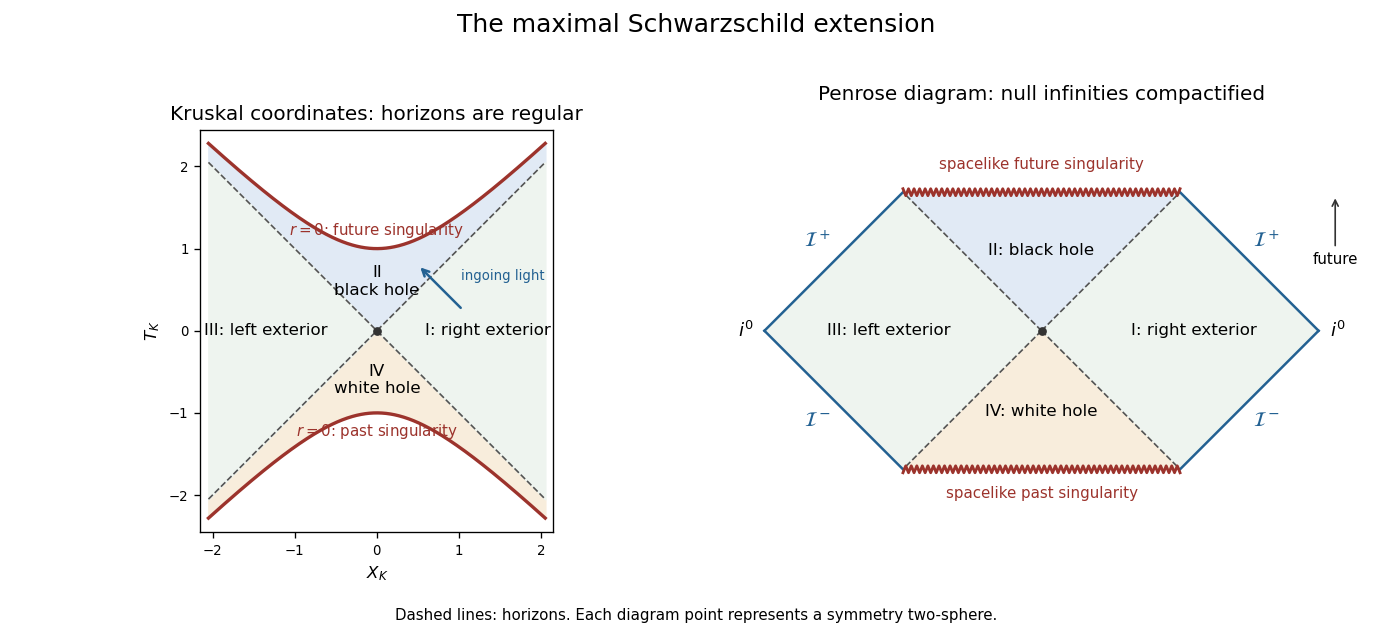
Kruskal and compactified diagrams of the maximal Schwarzschild extension, showing both exteriors, horizons and spacelike singularities
. Details. 
The time-symmetric spatial slice has a bridge between the exteriors, but it is not a traversable passage. Future-directed causal curves have nondecreasing and . Moving from the right exterior to the left would require to decrease from positive to negative; the reverse passage would require to decrease. Both are impossible. This proves the non-traversability of the Schwarzschild bridge. The complete eternal vacuum extension has two exteriors, a black hole and a white hole; it has no causal route between its exteriors. A black hole made by stellar collapse is a different global spacetime: its matter-filled past replaces the white hole region, and it normally has only one exterior. The vacuum extension constructed here should not be mistaken for the collapse history of a single star.
With electric charge, spherical electrovacuum instead gives the Reissner-Nordstrom metric, in an electromagnetic normalization absorbing the charge conversion constants:For , there are two simple horizons. Outside the metric is static; between and , and is timelike. Inside , again, so is spacelike and the singularity is timelike. The outer horizon is the event horizon; the inner horizon is a Cauchy horizon. The same logarithmic tortoise-coordinate and exponential-null-coordinate method crosses each simple horizon locally, but one exponential scale does not regularize both simultaneously: their surface gravities have different magnitudes,Continuing the exact metric through successive inner horizons produces repeated blocks with further exteriors, and evolution beyond a Cauchy horizon is not uniquely fixed by data on the original Cauchy hypersurface. The timelike singularity can be avoided by some trajectories in this ideal extension, unlike the unavoidable spacelike singularity of the future Schwarzschild spacetime interior. However, the enormous inner-horizon blueshift makes this exact continuation unstable: perturbations can cause mass inflation. This is an important qualification on the global structure of a charged spherical black hole.
At the two horizons coalesce, and surface gravity is zero. The horizon is a degenerate Killing horizon, the tortoise-coordinate divergence becomes a pole and the ordinary nondegenerate Kruskal spacetime construction must be replaced. The exterior develops an infinitely long spatial throat and the formal Hawking temperature vanishes. For , no real zero of remains: the electrovacuum solution has a naked singularity, not a black hole. Consequently arbitrarily allowing charge changes the causal structure, not just the horizon radius.
Use and normalize the time-translation Killing vector field at infinity. The simple outer zero and positivity on its exterior imply . Near the horizon, write ; then . The Wick rotation gives the radial Euclidean metricDefine , so . Its leading near-horizon form isThus is a polar angle. Smoothness at the origin requires period , rather than a cone or a multiple cover with a branched origin. The Euclidean black-hole regularity condition isA thermal quantum state has imaginary-time period . Since , this time coordinate is normalized to the clocks at infinity, and the Hawking temperature isA static clock at radius measures the redshifted local temperature ; that local quantity is not the temperature requested with the asymptotic normalization.
The static coordinates are singular on the horizon, so calculate its surface gravity in a regular ingoing chart. With , the metric and the same normalized Killing vector field areThe inverse radial block has , , . Direct calculation givesSince has constant coordinate components, its acceleration isOn the future horizon, and is null, so the defining equation gives . In the outgoing chart regular on the past branch, the radial cross-term is and the same calculation gives for . Hence the branch-independent physical statement isThis proves the Euclidean temperature and signed horizon surface gravity relation directly. Rescaling the Killing vector field would rescale its surface gravity; the condition at infinity fixes that otherwise arbitrary normalization.
Use Planck units for the following formulas. The black-hole area theorem is a classical statement with hypotheses. Assume the Einstein field equations, the null energy condition and appropriate global future regularity/predictability. For a clean version of the focusing sketch, take the future horizon generators to remain on a regular horizon and to be future complete in affine parameter. The usual strong asymptotic predictability formulation supplies the global causal control needed to exclude the same focusing pathology; an arbitrary spacetime with naked future breakdown is not covered by the theorem.
Let be an affinely parametrized generator of a smooth portion of the event horizon, and let be its null expansion. The horizon is a null hypersurface, so its generators have zero null twist. In four dimensions the Null Raychaudhuri equation isThe Einstein field equations give , since the metric terms vanish when contracted with a null vector. The screen-space null shear term is also nonnegative, so . If at , integrating this inequality while the congruence remains regular givesIt focuses within affine distance at most . The vanishing area element is a focal point to an earlier spacelike horizon cut. Past such a point the null geodesic can no longer generate an achronal boundary, but the event horizon is precisely such a boundary. Future completeness and the global hypotheses exclude its escaping this contradiction by ending prematurely at a pathology. Therefore everywhere the smooth horizon description applies.
Integrate between ordered horizon cuts. Every continuing generator contributes a nondecreasing area element. New generators can enter at past endpoints or merger crease sets, adding area; generators cannot leave a regular future horizon through future endpoints under these hypotheses. Thus, including the total area of disconnected components,This is the future-complete horizon focusing proof of the area theorem. A smooth elementary congruence proof requires the stated regularity; the general theorem also treats the horizon's nonsmooth joining set rather than assuming mergers have a globally smooth horizon.
Hawking radiation changes the situation because the quantum field state in a collapsing geometry is not a classical positive-energy fluid. For a large isolated Schwarzschild black hole,in natural units. Outgoing quantum modes at future null infinity have a nearly thermal occupation, modified by greybody factors; an accompanying negative Killing energy flux near the horizon reduces the hole's mass. On timescales short compared with the evaporation time but long compared with , its geometry is approximately Schwarzschild spacetime with slowly decreasing . It is not an exactly stationary vacuum solution with a parameter changed by hand: the radiation's stress-energy tensor sources the time dependence through the semiclassical Einstein equation. The distant luminosity is carried by the outgoing radiation, while the horizon-area decrease accompanies the inward negative-energy contribution.
As the black hole loses mass, its horizon scale and Bekenstein-Hawking entropy shrink, its temperature rises and its luminosity increases. This is the negative heat capacity of a Schwarzschild black hole. Large astrophysical holes evaporate extremely slowly in isolation; small holes evaporate more rapidly, and increasingly massive particle species become accessible as the temperature rises. An incoming radiation bath or accretion can instead offset the loss, so the pure evaporation law assumes negligible incoming energy. A formal complete evaporation also raises the black hole information paradox; the low-curvature calculation alone does not determine how information or the final state is resolved.
For an elementary luminosity estimate, treat the horizon as emitting photon blackbody radiation. In natural units the Stefan–Boltzmann law has , givingThe horizon area used here is an estimate of emitting area, not the exact frequency-dependent absorption cross-section. More generally write , where includes the greybody factors and the active particle species. For constant effective , energy balance and direct integration giveHere is time measured at infinity. The formal evaporation timescale is ; with the photon blackbody estimate it is . Restoring constants givesfor that specified estimate. If particle thresholds make mass dependent, the precise leading law is instead . The robust result is the inverse-square mass-loss rate for a fixed species regime and the cubic mass scaling of its lifetime. This is the semiclassical cubic mass law for Schwarzschild evaporation. Extrapolating its zero to a definite end state is unjustified once approaches the Planck mass and curvature requires quantum gravity.
There is no contradiction with the classical area theorem: the renormalized quantum stress-energy tensor can violate the null energy condition used in the focusing inequality. In the evaporation regime,which is permitted when that hypothesis fails. The thermodynamic replacement is the generalized second law, concerning rather than horizon area alone. Outside radiation can carry entropy while the hole's Bekenstein-Hawking entropy decreases.
Use geometrized units until converting the clock readings. By the Birkhoff theorem, the spherical vacuum exterior is a portion of the Schwarzschild spacetime with fixed mass :The exterior is not flat and is not radiating merely because the surface moves. When the surface crosses , this exterior must be represented in regular ingoing Eddington-Finkelstein coordinates, rather than treating the Schwarzschild-coordinate divergence as a physical barrier.
The Oppenheimer-Snyder model has a homogeneous pressureless matter interior. Since its initial expansion vanishes but its density is positive, the Friedmann equation requires positive spatial curvature. Choose a comoving radial angle and the boundary's proper time , with the stopwatch set to zero at release. The interior FLRW metric and density areThe density law follows from the dust stress-energy tensor and its covariant conservation. The Friedmann equation and the initial rest condition giveIts contracting branch has the parameterizationIndeed and satisfy the displayed equation; is the turning point and is the final curvature singularity.
For homogeneous dust-ball matching, the boundary has areal radius . Matching its mass to the exterior givesThis is the gravitational mass parameter, not the integral of rest density over the curved proper-volume element. The matching can also be checked directly. The outward angular extrinsic curvature inside is ; outside it is . The boundary motion hasso these curvatures agree. The induced metric is on both sides and because the pressure-free boundary is geodesic. No artificial surface stress layer is required.
The observer moving with this boundary meets the event horizon when . From , the proper-time horizon crossing in homogeneous dust collapse occurs atThe singularity is reached at , so the remaining clock time isThese are finite proper times, even though the external static time diverges at horizon crossing.
Convert the supplied rounded units consistently: Planck masses and Planck lengths. Thus , , and in Planck units. Multiplying geometric times by seconds givesAt the accuracy justified by the rounded constants, these are about three milliseconds to horizon crossing and about seven microseconds more to the singularity. For , expanding gives , independently confirming the microsecond scale. The exact expression above retains the finite release-radius correction.
Strictly, this boundary clock reading is when the observer crosses the horizon, not when the horizon first exists anywhere. The event horizon inside an Oppenheimer-Snyder cloud is an outgoing radial null ray. Since , the interior metric is conformal to , and that ray has . Tracing it back from givesFor this cloud it starts at the centre after release, at comoving time seconds. This answers the literal global-formation interpretation as well; it is not an event on the outer observer's worldline. The distinction matters because an event horizon is defined by the entire future causal escape problem, not by a locally detectable signal of formation.
For the observer at infinity, use the boundary's conserved Killing energy in the exterior:As , and . Consequentlywhere fixes a harmless dimensionless logarithm. For actual outgoing light signals the relevant retarded time is . Since ,Therefore she never receives a signal showing the surface cross the horizon at any finite asymptotic time. Radiation emitted ever closer to crossing arrives ever later and is increasingly redshifted and diluted; photons emitted at or inside the event horizon cannot reach her. The formal crossing time at infinity is infinite, not the finite boundary stopwatch reading. Nor can the earlier global birth of the horizon be observed directly as a local flash from its central birth event.
Articles by others on the same topic
There are currently no matching articles.