Write . The admissible equilibrium points are , when , and when . The Jacobian matrix isAt the eigenvalues are and ; at they are and . At a positive coexistence equilibrium point,It is therefore asymptotically stable. It is a node for , a focus for the reverse inequality, and has repeated real eigenvalues at equality. The node–focus change does not alter the attracting equilibrium point's topology.
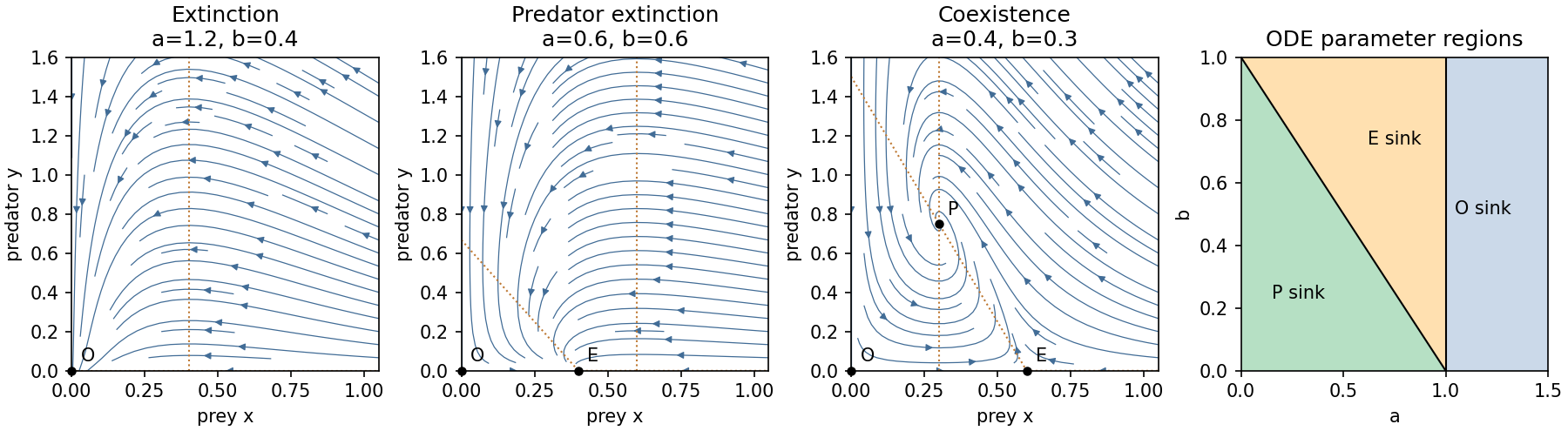
There are three open physical parameter regions:
The axes are invariant. On , decays exponentially; on , prey obey the logistic differential equation. Positivity follows because each right-hand side has its population as a factor. Also is bounded by logistic comparison, while satisfies , so all forward trajectories are bounded. The Dulac function has divergence in the interior, excluding periodic orbits by the Bendixson-Dulac criterion.
In the extinction region, , and then is eventually negative. In the prey-only region, the upper bound implies predator decay and convergence of interior prey to . In the coexistence region the Lyapunov functionhas . Its positive-quadrant sublevel sets are compact, and the only invariant subset with also has . The LaSalle invariance principle proves convergence of every interior trajectory to . These facts justify the complete qualitative phase portraits, not just their local arrows.
At , and meet in a transcritical bifurcation; positive prey decay algebraically. At with , and exchange stability. On its centre manifold, gives , so the physically positive side is still attracting. There is no interior Hopf bifurcation since the coexistence trace never vanishes.
The characteristic polynomial of a real matrix is . Thus vanishes exactly when , and vanishes exactly when . These are the required eigenvalue conditions.
For and , the discriminant is negative, andTheir moduli equal one. Taking with gives . The strict trace inequalities exclude and hence exclude the repeated real multipliers .
The quadratic discrete predator-prey map equals the identity plus the vector field of part (a), so its admissible fixed points are the same . Their Jacobian matrices are the identity plus the corresponding continuous-time Jacobian matrices, but map stability requires eigenvalues inside the unit circle rather than the left half-plane.
At the multipliers are : it is a sink for and a saddle for . At they are and . ThereforeFor , the prey multiplier is below : is a saddle when and a repeller when . For , makes it a saddle. The crossings at and are the two transcritical bifurcations already encountered. The crossing at is a prey period-doubling bifurcation.
At positive coexistence,For clarity, derive the relevant Schur stability criterion directly: setting in givesThe open unit disk maps to . A real quadratic has both roots there precisely when all three displayed coefficients have the same positive sign. Since , the coexistence fixed point is a sink precisely whenThis region exists only for . In the coexistence triangle , put . If , one root lies below and the other in , so is a saddle. If but , it is a repeller; if , it is a sink. These signs give the complete local fixed-point partition, including real and complex multipliers.
The coexistence period-doubling bifurcation lies at ; its segment adjoining the sink region has . The other multiplier there is and lies strictly inside the unit circle on this segment. This coexistence flip is subcritical on that segment. To calculate its direction, normalize the eigenvector by and the left eigenvector by . The symmetric quadratic derivative is given explicitly in part (d). Eliminating the quadratic term from the one-dimensional centre manifold map gives the effective cubic flip coefficientFor a scalar reduced map , its second iterate satisfies . Thus on the stable-fixed-point side , and the two-cycle multiplier is . An unstable coexistence two-cycle meets the stable fixed point as increases to the flip curve. The other multiplier remains inside the unit circle. The complex unit-modulus crossing lies at , with . The two curves meet at with a double multiplier . The prey flip and predator invasion curves meet at with multipliers .
The sketches mark the sink regions and all these local thresholds. They are a local atlas, not a claim that the map has only these global attractors. Indeed the full nonnegative quadrant is not invariant: becomes negative when . On the prey axis the logistic map already supplies new dynamics. Its nontrivial two-cycle, obtained by factoring after removing the fixed-point factors, isIts longitudinal multiplier is , so it is stable on the axis for . The transverse multiplier is , making the cycle stable in the plane when additionally . Further flips and more complicated logistic dynamics show why the differential equation's three global regions cannot be transferred unchanged to its unit-step map.
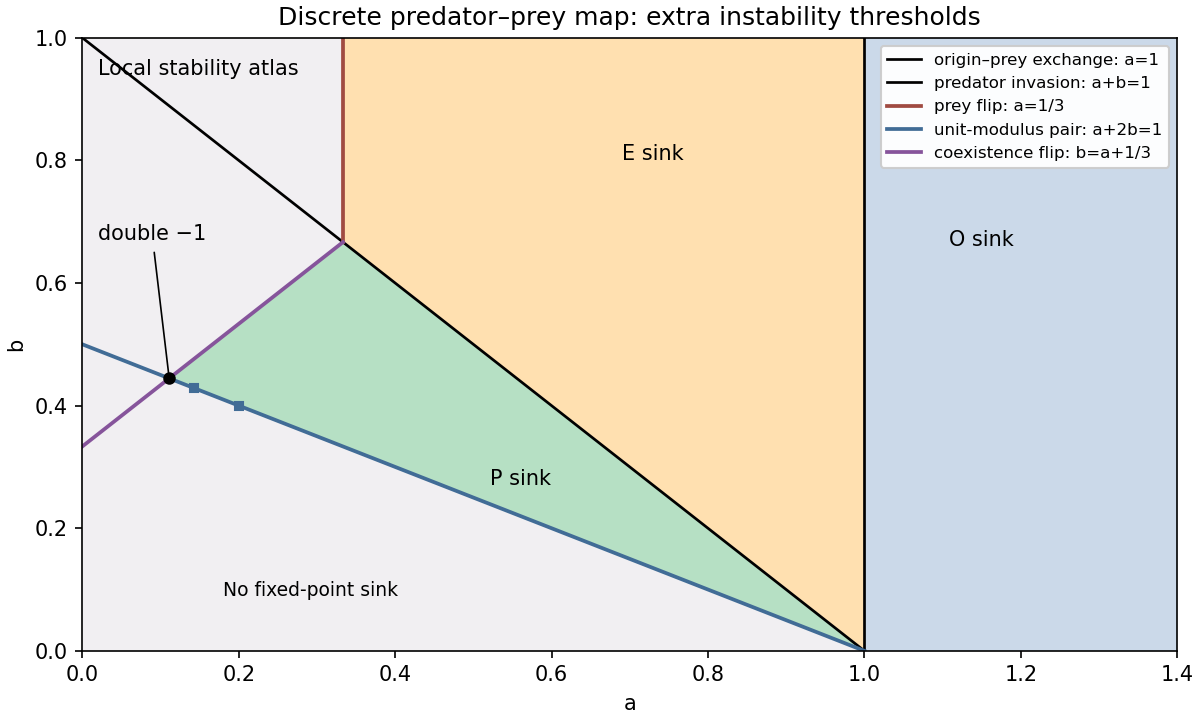


On the coexistence fixed point hasFor these give a nonreal conjugate pair on the unit circle. Nearby, while the pair remains complex, its modulus is ; increasing through one changes the modulus from greater than one to less than one. This is the candidate Neimark–Sacker bifurcation, and a nonlinear coefficient is needed to decide its direction.
Here that coefficient can be calculated explicitly. Let , , and normalize the right eigenvector and complex projection byFor deviations , the quadratic derivative isThus , and are the quadratic coefficients in . The quadratic coordinate change hasSubstitution into the map and collection of yieldsUsing and simplifies the cubic radial coefficient of a quadratic planar map toConsequently, away from strong resonances of a planar map, the bifurcation is supercritical: on coexistence is attracting, whereas on a small attracting invariant closed curve surrounds the unstable coexistence fixed point. If , its leading radius is , and its radial multiplier is . Motion on the curve can be quasiperiodic or frequency-locked into periodic motion; stability of the curve alone does not imply an irrational rotation.
Two interior values need qualification: is a 1:3 resonance, and is a 1:4 resonance. At the former is singular and the quadratic term must be retained. At the latter a cubic term remains. The resonant terms can be displayed explicitly in the same normalization. At , . The third iterate, near the resonance and after removing nonresonant quadratics, hasHere is the angular detuning. Its nonzero stationary solutions have and three phases; they constitute a saddle three-cycle. Indeed the two leading real exponents at these solutions are , of opposite signs. Therefore no ordinary attracting-circle conclusion follows arbitrarily close to the exact 1:3 point.
At , the cubic resonant normal form isThe extra coefficient follows from and . Its radial cubic damping is uniform since . The slow angular equation is , so fourfold phase locking must be considered. For example, varying at fixed gives . The locked branches satisfy and . For they form one attracting and one saddle four-cycle; the two branches alternate in phase. This is a resonant alternative to quasiperiodic motion on an invariant curve. The endpoints also fail the simple-complex-pair assumptions. This distinguishes the generic nearby dynamics from unjustified claims about every point on the printed interval.
Articles by others on the same topic
There are currently no matching articles.