In the hydrogen–helium approximation, take helium to be helium-4, and assume essentially all neutrons remaining at the onset of efficient nuclear burning enter it. Each helium-4 nucleus contains two neutrons and two protons, henceHere count constituent nucleons, not just free particles after burning. Neglecting the small nucleon mass difference and nuclear binding-energy correction, the helium mass is and the total baryon mass is . Thus neutron-limited helium synthesis givesFor , this yields and the hydrogen mass fraction is . The assumptions require and negligible free neutrons, deuterium and helium-3: the phrase hydrogen and helium must here mean predominantly hydrogen-1 and helium-4, not an arbitrary mixture of helium isotopes.
For a moderately faster cosmic expansion that still permits efficient nuclear burning, the hydrogen mass fraction is smaller, since cooling from cosmological weak freeze-out to helium formation takes less time, fewer free neutrons decay into protons, and more surviving neutrons enter helium-4. If the change also affects cosmological weak freeze-out, its higher freeze-out temperature leaves a larger initial neutron-to-proton ratio and reinforces the helium increase. The conclusion assumes efficient neutron-limited helium synthesis: an unspecified arbitrarily rapid expansion could instead outrun the nuclear reactions, so the nuclear-burning qualification of the helium expansion-rate response prevents an unconditional assertion.
True as a major quantitative test of the hot Big Bang, with a significant lithium qualification. Big Bang nucleosynthesis predicts several abundances from one main baryon-density parameter using measured nuclear and weak rates, rather than fitting a separate primordial composition for every species. Comparisons involve distinct observing environments and an independent cosmic microwave background determination at a much later epoch. Their overall agreement is powerful; it is not a claim that every light-element measurement is mutually consistent without stellar or observational corrections. The cosmological lithium problem must be included in that assessment.
The main abundance parameter is the baryon-to-photon ratio , often expressed as . For the measured mean cosmic microwave background temperature, . Standard Big Bang nucleosynthesis also depends on the expansion rate, the effective number of neutrino species, the neutron lifetime and the nuclear reaction rates.
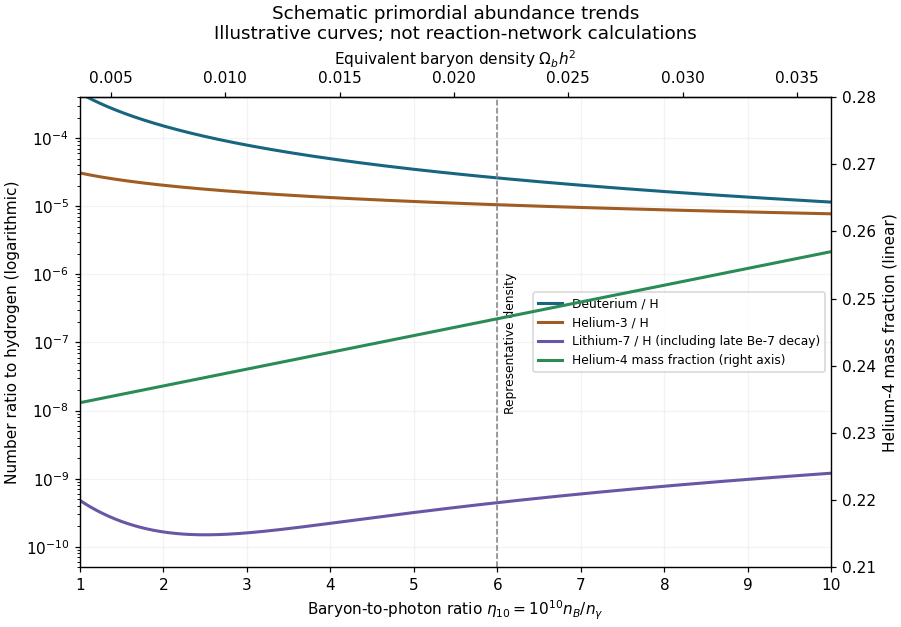
Schematic primordial deuterium, helium-3, helium-4 and lithium-7 abundance trends versus baryon-to-photon ratio
. Details. 
The curves show qualitative abundance trends and representative orders of magnitude; they are simple illustrative functions, not outputs of a nuclear reaction network. Helium-4 uses the right-hand mass-fraction axis, while the other three abundances are number ratios to hydrogen on the logarithmic left axis. The lithium valley and its rising high-density branch are important and must not be replaced by a monotone curve.
At higher , two-body reactions proceed more rapidly relative to cosmic expansion and burn deuterium more efficiently, so D/H falls strongly, approximately as near the favored density. Helium-3 decreases more gently. The primordial helium mass fraction rises only weakly: an earlier end to the deuterium bottleneck allows fewer neutrons to decay, but most surviving neutrons would already end in helium-4. Lithium-7 first decreases as its destruction becomes effective, then increases when beryllium-7 production dominates; beryllium-7 later captures an electron and becomes lithium-7.
A faster expansion changes both freeze-out and the time available for reactions. In units , weak neutron–proton conversion has rate , whereas ; consequently . Since the equilibrium neutron-to-proton ratio is , additional radiation raises it; the shorter subsequent decay interval also raises . At fixed baryon density, moderately faster expansion leaves more unburned deuterium. A longer neutron lifetime similarly increases neutron survival. These trends assume ordinary efficient burning and no independent modifications of the nuclear or weak rates.
Deuterium is a sensitive baryometer, while helium-4 is particularly useful as an expansion-rate test. Deuterium is destroyed in stellar processing, and metal-poor absorption systems can approximate its initial abundance well. Helium's weak dependence on limits its precision as a baryometer, and its spectroscopic corrections matter. Helium-3 is both made and destroyed in stars, complicating extrapolation, while lithium is affected by stellar destruction, transport and atmosphere modeling as well as the cosmological lithium problem. Accurate comparisons therefore require nuclear-rate and astrophysical uncertainties, not merely narrow instrumental error bars. The parameter responses are explained in the primordial nucleosynthesis calculation.
The primordial light-element abundance determination uses minimally processed material and estimates its residual processing rather than directly observing the universe at a few minutes old.
For deuterium, high-redshift, low-metallicity quasar absorption systems resolve isotope-shifted D I lines from the H I Lyman series. The deuterium feature is displaced by about from hydrogen; fitting several transitions and the velocity components distinguishes genuine deuterium from an unrelated hydrogen blend. The ratio of the inferred columns estimates D/H after the ionization and component structure are checked. Low metallicity minimizes stellar destruction, giving a representative primordial ratio of roughly .
For helium-4, helium and hydrogen recombination-emission lines in metal-poor H II regions of nearby dwarf galaxies give a mass fraction. Several lines constrain temperature, electron number density and corrections for collisional excitation, ionization structure, radiative transfer and underlying stellar absorption. Extrapolation of helium enrichment against metallicity towards zero metallicity estimates , approximately –, corresponding to helium/hydrogen by number near .
For helium-3, the approximately GHz hyperfine line of in Galactic H II regions probes the abundance, with ionization and nebular structure corrections. Stellar production and destruction make its primordial value hard to extract; a characteristic abundance near relative to hydrogen is compatible with standard nucleosynthesis but is not a comparably clean primordial measurement.
For lithium-7, the approximately Å Li I absorption doublet in warm, old, metal-poor halo stars gives a photospheric abundance after stellar-atmosphere and effective-temperature corrections. The Spite plateau suggests an initial number ratio of order if depletion is small; transport below the photosphere, nuclear destruction and atmosphere systematics can lower the measured value relative to the birth abundance. Standard Big Bang nucleosynthesis at the deuterium- and microwave-background-favored baryon density instead predicts several , roughly in exam-era calculations. This discrepancy is the cosmological lithium problem, not a measurement of an independently adjustable primordial lithium parameter.
The approximate values deliberately represent exam-era orders of magnitude rather than a claim of current precision; the contemporary abundance assessment discusses the inference and tensions.
Deuterium and helium-4 broadly favor the same baryon-density range in standard Big Bang nucleosynthesis, after systematic and reaction-rate uncertainties are allowed. Near the illustrative value , the baryon-density consistency between nucleosynthesis and the microwave background givesDeuterium constrains this particularly sharply; helium-4 gives a weaker baryon-density constraint and a useful test of the expansion rate. Helium-3 observations do not supply an equally precise independent consistency test because of stellar processing. Lithium inferred directly from the metal-poor stellar plateau is lower than the standard prediction at this density by a factor of a few. Thus broad concordance is real, but complete four-element concordance without qualifications is false.
An independent baryon density comes from the cosmic microwave background acoustic pattern, especially the relative odd and even peak heights set by baryon loading of the photon–baryon fluid. For a numerical comparison appropriate to this paper's era, the 2003 microwave-background and large-scale-structure analysis obtained , consistent with the density inferred from deuterium. This comparison spans the first minutes and the much later recombination epoch, and tests the thermal history and conservation of baryon number relative to photon entropy between them; it is more substantial than comparing several abundance fits sharing the same nuclear model.
Ionization-corrected Lyman-alpha forest gas inventories and baryon fractions in galaxy clusters provide further checks, with their own radiation, gas-physics and total-mass uncertainties. A total matter fraction of order is much larger than , so the abundance result also supports a predominantly nonbaryonic matter component. The lithium discrepancy and abundance systematics motivate continued tests; they do not erase the agreement between two physically distinct baryon-density determinations.
Articles by others on the same topic
There are currently no matching articles.