On the sphere, both cosmic time and the comoving coordinate are constant. The positive spatial induced metric obtained from the FLRW metric is therefore . Its area element is the square root of its determinant:Integrating over the spherical coordinates givesThus is the areal radius. In a curved spatial slice it need not equal the proper radial distance ; the angular part of the FLRW metric, rather than a Euclidean radial-distance assumption, establishes the surface area.
For a radial null geodesic, the FLRW metric givesTwo successive wave crests traverse the same comoving path between comoving observers. Subtracting their path integrals, to first order in their short emission and reception periods, gives . Since cosmic time is each observer's proper time and the frequency is the reciprocal period,This neglects peculiar velocities and local gravitational redshift contributions.
For B's light passing through A on its way to Earth, with the comparison event at A being that passage, cosmological redshift factors multiply:This is the intended numerical answer with that reception-event specification. The reception-event dependence of intergalactic redshift is essential: Earth's two redshifts by themselves neither specify the A–B separation nor identify the emission event at B whose light A receives at a chosen time. For arbitrary directions or a different reception time at A, the general answer is , with the emission time fixed by the A–B null geodesic; it cannot be deduced from the two supplied numbers alone.
Introduce the radial comoving distance . A photon travels , so a finite comoving particle horizon since a big-bang origin at requiresTo relate this geometric criterion to a mass density, use the Friedmann equation as well as the FLRW metric. For an early epoch dominated by , with negligible curvature and cosmological constant in the leading balance,Equivalently . Its integral at converges precisely when , henceAt the divergence is logarithmic, and at it is a power divergence. If spatial curvature dominates a bang instead, and the integral again diverges; also ensures that this curvature term, which scales as , is subdominant near the bang. This argument assumes the ordinary expanding big-bang branch of the Friedmann equation; a metric alone imposes no density law, and a universe with a different past boundary needs its own lower integration limit.
During radiation domination, conservation of energy gives : dilution contributes and the cosmological redshift of each photon contributes another . Thus and in the flat radiation-dominated approximation. The particle horizon measured as proper radial distance on a constant-time slice isEvery local comoving observer measures the speed of light to be . However, the spatial separations traversed earlier have expanded by the time the final distance is measured; the present separation from the earliest accessible comoving worldline is not the integral of local path lengths measured at their different traversal times. Indeed in this era, explicitly separating cosmic expansion from local propagation. Curvature or a later transition to matter domination changes the exact formula; is the radiation-dominated result.
The Lyman-alpha forest is the large collection of narrow Lyman-alpha absorption features in the spectrum of a distant quasar. Neutral hydrogen in foreground gas absorbs at its own redshifted resonance, so an absorber at places its feature atOrdinary intervening absorbers have , putting their Lyman-alpha lines blueward of the quasar's own broad Lyman-alpha emission. Many different absorbing patches along the same line of sight make the forest; they are not different transitions of one cloud. At sufficiently short wavelengths higher Lyman-series transitions can overlap the forest, so an actual analysis identifies these blends rather than treating every dip as isolated Ly-alpha.
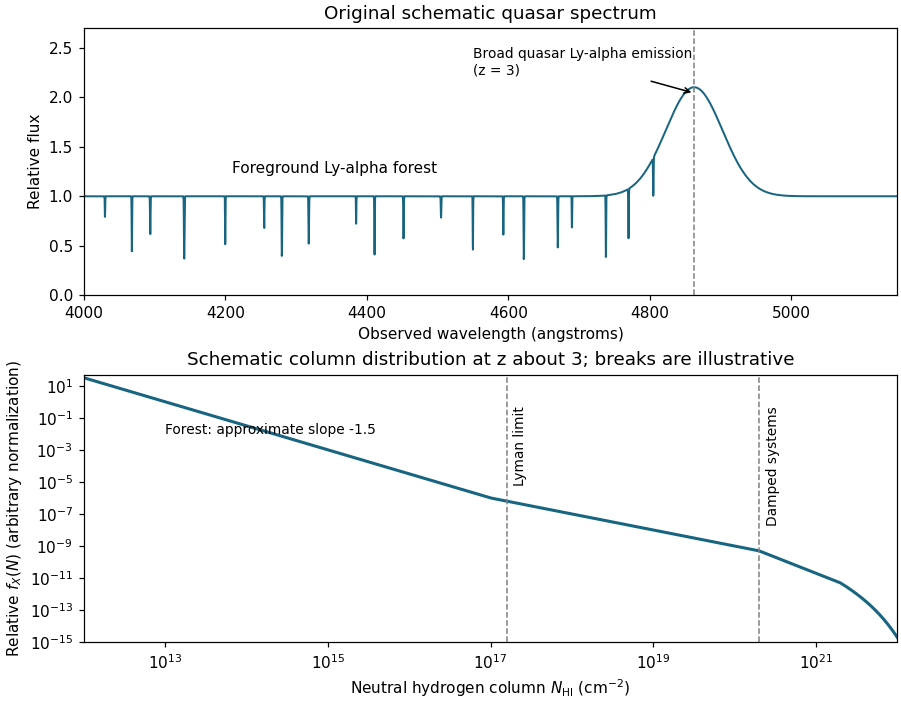
Schematic quasar Lyman-alpha forest and neutral-hydrogen column-density distribution at redshift three
. Details. 
The upper panel is an original schematic spectrum for , with absorption features at smaller cosmological redshifts and a broad emission feature near Å. The lower panel anticipates the column-density discussion: both curves are teaching sketches, not measured spectra or fitted survey distributions. The ordinary Lyman-alpha forest mainly traces the fluctuating, photoionized intergalactic medium, rather than a collection of identical isolated, neutral clouds.
Hydrogen is the most abundant element, and its Lyman-alpha line is a strong resonance from the ground state. Very small neutral fractions in an otherwise ionized intergalactic medium therefore produce detectable Lyman-alpha absorption. A long quasar sightline samples a great many modest density enhancements in the cosmic gas, with a much larger covering area than the compact high-column regions that produce damped Lyman-alpha systems.
Heavy-element absorption additionally requires metal enrichment and enough ions in the relevant ionization state. Many weak Lyman-alpha forest absorbers contain too few such ions to produce detectable metal lines at the same sensitivity, while high-column Lyman limit systems and damped Lyman-alpha systems are intrinsically rarer. Thus abundant hydrogen, a sensitive resonance and the large interception area of diffuse gas together explain the forest's numerical dominance. The comparison is between absorber classes at specified observational sensitivity; it does not mean that a metal-rich system has only one spectral transition.
Typical weak Lyman-alpha forest absorbers have neutral hydrogen column densities roughly –, with stronger forest absorption extending towards . Common Doppler broadening parameters are a few tens of , consistent with gas at approximately K together with bulk velocity gradients. The thermal contribution isA line width is consequently a temperature upper bound if all other broadening is neglected, not a unique thermometer. The gas commonly lies in diffuse sheets and filaments at modest density contrast; only the strongest systems need substantial self-shielding or a galactic environment.
For optically thin gas illuminated by the cosmic ionizing background, photoionization equilibrium requireswhere the last approximation uses almost complete hydrogen ionization. For example, , and give . A kpc path then has despite its tiny neutral fraction. This illustrates the Lyman-alpha forest photoionization scaling: low density makes the two-body radiative recombination rate weak relative to the one-body photoionization rate, but a long path and a strong resonance still produce measurable absorption.
Independent information is important because a column density alone is not a volume density. Similar absorption in close pairs of quasars indicates substantial transverse coherence, while an ionizing optical depth shows that these weak systems do not shield themselves from the background. The continuum-shielding threshold is . Together with the observed line widths and ionization balance, these facts favor extended, low-density, highly ionized gas over small cold neutral clouds. The physical interpretation and characteristic scales are consistent with Rauch's forest analysis and the measured column and line-width distributions.
Specify the path convention before integrating the neutral-hydrogen column-density distribution. Write and , with absorption distance satisfyingThe lower panel of the preceding sketch shows the approximate decrease of with near . Ordinary forest columns are roughly described by , , but the slope changes through partially shielded Lyman limit systems and high-column damped Lyman-alpha systems. No single slope should be extrapolated through all these regimes. In logarithmic bins the number is , whereas their neutral mass contribution is proportional to ; confusing these two weightings would give a wrong baryon inventory.
To derive the neutral gas density from an absorption distribution, a redshift interval has proper light-path length . The sum of neutral hydrogen columns per path length estimates the mean proper number density:The proper mass density is ; division by converts it to a comoving mass density. Thus, with today's critical density ,A representative finite-sample estimator replaces the last integral by , with completeness and selection corrections. This defines a comoving inventory divided by today's critical density; a fraction of the instantaneous critical density has a different normalization. Neutral gas including accompanying helium is obtained by multiplying by a specified mass correction, approximately ; hydrogen-only must not silently include it.
At the observed neutral inventory is of order , far below the cosmological baryon density of order – for . High-column damped Lyman-alpha systems contribute most of this neutral mass although weak forest lines dominate the counts; for the mass per logarithmic column interval increases as in the forest regime. The small neutral inventory therefore does not imply a small total gas inventory: the intergalactic medium contains a large ionized baryon reservoir invisible to a neutral-only count. Recovering that reservoir requires an ionization correction and a gas-density model. The survey normalization and high-column contribution are described in the neutral-gas inventory analysis.
For a fixed column density or rest-equivalent-width threshold, the number of ordinary Lyman-alpha forest features per unit redshift generally increases towards higher redshift. Over much of –, a rough description is with an index of order –, dependent on selection; the evolution is much slower at low redshift. Near reionization, blending and widespread opacity make a decomposition into individually detected lines increasingly inappropriate.
First separate physical evolution from geometrical path length. For comoving absorber density and proper interception area , absorber incidence and comoving number density givesEven a non-evolving population is not constant per unit redshift. Using absorption distance removes this particular geometrical effect.
The remaining redshift evolution of the Lyman-alpha forest reflects several competing processes. Cosmic expansion dilutes the gas; at fixed overdensity, photoionization equilibrium gives , so dilution can move many features below a fixed threshold. The cosmic ionizing background evolves as quasars, stellar sources and ionizing-photon absorption evolve; a decline of its intensity at late times partly offsets dilution. Photoheating changes temperature and radiative recombination, while gravitational instability redistributes gas into denser structures and hot shocked phases and changes its velocity field. Thus evolving line counts are not a direct count of conserved clouds; the density, thermal state, radiation field, geometry and observational selection must all be accounted for. The high-redshift increase and its physical interpretation are documented in the forest observations and models.
Near the background quasar, the quasar proximity effect typically reduces the number and strength of Lyman-alpha forest features relative to regions farther along the sightline. It is an ionization effect, not evidence that the quasar lies in an empty region. At fixed gas density and temperature, photoionization equilibrium givesIf the unperturbed neutral-hydrogen column-density distribution is , , detecting a column above now requires its unperturbed column to exceed . Integrating that distribution shows that the number above threshold is reduced by . This supplies an explicit model for the decline of line counts.
The known quasar luminosity estimates its photoionization rate at proper separation :These expressions assume unattenuated, steady, isotropic quasar emission and a specified ionizing spectrum. Fitting the measured suppression as a function of separation determines the ratio and hence constrains the cosmic ionizing background. A weaker background gives a larger region in which the quasar dominates. For fixed background spectral shape, this constrains its specific intensity near the Lyman limit system ionization edge, not an arbitrary spectral function. The proximity-effect estimator of the ionizing background is biased if the host gas is overdense, the quasar's past luminosity differs from its observed luminosity, its radiation is anisotropic, or systemic-redshift errors distort the inferred separation; absorption between source and gas also changes . These effects explain why the method needs environmental and source modeling, as discussed in the proximity-effect measurements.
A superhorizon density contrast is gauge dependent. The stated growth laws describe the growing adiabatic mode in the comoving-gauge density contrast (and the corresponding usual synchronous growing mode), not an arbitrary coordinate density perturbation. Work with a flat, single-fluid background with constant , negligible anisotropic stress, , and a comoving Fourier wavenumber .
Here is a derivation from the linear gravitational constraints and evolution equation. For an adiabatic mode, the scalar gravitational potential obeysPrimes denote conformal time derivatives. The Friedmann equation gives and , so the bracket vanishes. On superhorizon scales, , the leading solutions are a constant potential and a decaying solution proportional to . Keeping the growing adiabatic branch therefore makes time independent to leading order.
Combining the time-time and time-space linear Einstein constraints eliminates the coordinate velocity and gives the comoving density constraintThis is the relativistic comoving constraint, not a subhorizon Newtonian approximation. Since , it implies . Also in cosmic time, whenceBoth epochs here mean their respective leading growing solution; matching through matter-radiation equality requires the full two-component evolution. The constant superhorizon curvature or potential is consistent with this growth because the comoving density perturbation carries the additional factor .
For statistical homogeneity and statistical isotropy, with the paper's finite-volume Fourier normalization,The angular integral is . In particular , confirming the stated dimensionless power spectrum normalization.
For the scale-free matter power spectrum , set to obtainAt zero the integrand behaves as , requiring ; at infinity its oscillatory integral converges for . Thus in the ordinary convergent range , the scale-free density correlation transform hasThe gamma function expression follows by introducing , evaluating the complex Laplace integral where it converges absolutely at zero, and continuing within the convergent oscillatory range; its removable singularity at is handled by the limit. Absolute convergence of the original correlation integral requires the smaller range .
The exponent relation is a useful scaling statement beyond that interval, but a pure primordial spectrum over all wavenumbers has no ordinary unsmoothed Fourier correlation integral. Physical transfer functions, cutoffs or smoothing must be specified, and a distributional extension need not yield a positive power law. Even within the convergent interval, the point variance is ultraviolet divergent without smoothing; the finite result here is at nonzero separation.
For a representative present-day ordinary galaxy sample over roughly –, the familiar approximate fit iswhere . These are empirical galaxy clustering parameters, not universal matter-spectrum constants; luminosity, color, selection and scale change the fit, as shown in the galaxy correlation measurements. A formal power law of that slope corresponds to on those scales, not to the nearly scale-invariant primordial spectral index.
A useful decomposition of the linear matter power spectrum, absorbing the Fourier normalization into its amplitude, isHere is the cold-dark-matter transfer function and the linear growth factor. On scales entering the horizon after matter-radiation equality, , so with near one. Modes entering during radiation domination undergo suppressed growth relative to later entrants, producing a turnover near the equality scale and, well above it, . Thus the linear spectrum asymptotes approximately to . Baryon acoustic oscillations superpose a weak oscillatory pattern. At sufficiently short scales nonlinear gravitational instability invalidates this linear extrapolation.
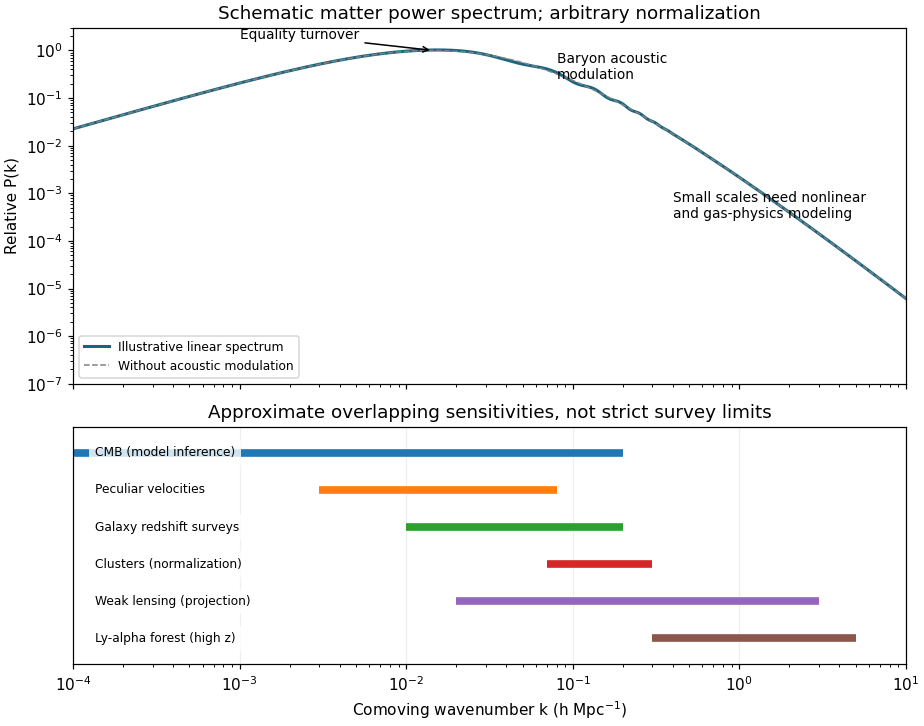
Schematic matter power spectrum with equality turnover, baryon oscillations and approximate observational scale ranges
. Details. 
The plotted curve illustrates the shape rather than a precision cosmological fit; the bands are overlapping approximate scale sensitivities, not sharp experiment boundaries. Cosmic microwave background anisotropies constrain primordial amplitudes and transfer physics on very large through acoustic scales; converting them to a late-time matter spectrum requires a cosmological model. Galaxy redshift surveys constrain approximately –, with galaxy bias and redshift-space distortions modeled. Peculiar velocities constrain large-scale mass fluctuations; cluster abundances constrain the fluctuation normalization near cluster scales. Weak gravitational lensing measures projected matter on intermediate and smaller scales. The Lyman-alpha forest extends constraints to roughly –a few at high redshift, requiring gas, temperature and ionizing-background modeling. These are complementary measurements of the underlying spectrum rather than interchangeable direct Fourier measurements.
The matter fraction controls the equality turnover. From and the Friedmann equation at equality,The measured background radiation fixes , so the physical turnover scale measures approximately . In units its location mainly constrains ; independent knowledge of is needed to extract . Standard radiation content gives the useful estimate , approximately for , .
The cosmological baryon density sets the inertia of the pre-decoupling photon–baryon fluid and changes its sound horizon and the oscillation pattern. The oscillation contrast and broadband suppression depend on the baryon fraction ; the acoustic positions depend on the sound horizon and the distance conversion. The cosmic microwave background peak-height pattern independently constrains . Combining these with the equality scale and a distance or Hubble constant determination permits estimates of both requested density fractions. Spectral tilt, neutrino free streaming, galaxy bias and nonlinear evolution must be fitted rather than assigning every shape change to baryons. The acoustic signature was already observed in the 2005 galaxy correlation measurement; the first-year microwave-background parameter analysis demonstrates the complementary parameter constraints.
In the hydrogen–helium approximation, take helium to be helium-4, and assume essentially all neutrons remaining at the onset of efficient nuclear burning enter it. Each helium-4 nucleus contains two neutrons and two protons, henceHere count constituent nucleons, not just free particles after burning. Neglecting the small nucleon mass difference and nuclear binding-energy correction, the helium mass is and the total baryon mass is . Thus neutron-limited helium synthesis givesFor , this yields and the hydrogen mass fraction is . The assumptions require and negligible free neutrons, deuterium and helium-3: the phrase hydrogen and helium must here mean predominantly hydrogen-1 and helium-4, not an arbitrary mixture of helium isotopes.
For a moderately faster cosmic expansion that still permits efficient nuclear burning, the hydrogen mass fraction is smaller, since cooling from cosmological weak freeze-out to helium formation takes less time, fewer free neutrons decay into protons, and more surviving neutrons enter helium-4. If the change also affects cosmological weak freeze-out, its higher freeze-out temperature leaves a larger initial neutron-to-proton ratio and reinforces the helium increase. The conclusion assumes efficient neutron-limited helium synthesis: an unspecified arbitrarily rapid expansion could instead outrun the nuclear reactions, so the nuclear-burning qualification of the helium expansion-rate response prevents an unconditional assertion.
True as a major quantitative test of the hot Big Bang, with a significant lithium qualification. Big Bang nucleosynthesis predicts several abundances from one main baryon-density parameter using measured nuclear and weak rates, rather than fitting a separate primordial composition for every species. Comparisons involve distinct observing environments and an independent cosmic microwave background determination at a much later epoch. Their overall agreement is powerful; it is not a claim that every light-element measurement is mutually consistent without stellar or observational corrections. The cosmological lithium problem must be included in that assessment.
The main abundance parameter is the baryon-to-photon ratio , often expressed as . For the measured mean cosmic microwave background temperature, . Standard Big Bang nucleosynthesis also depends on the expansion rate, the effective number of neutrino species, the neutron lifetime and the nuclear reaction rates.
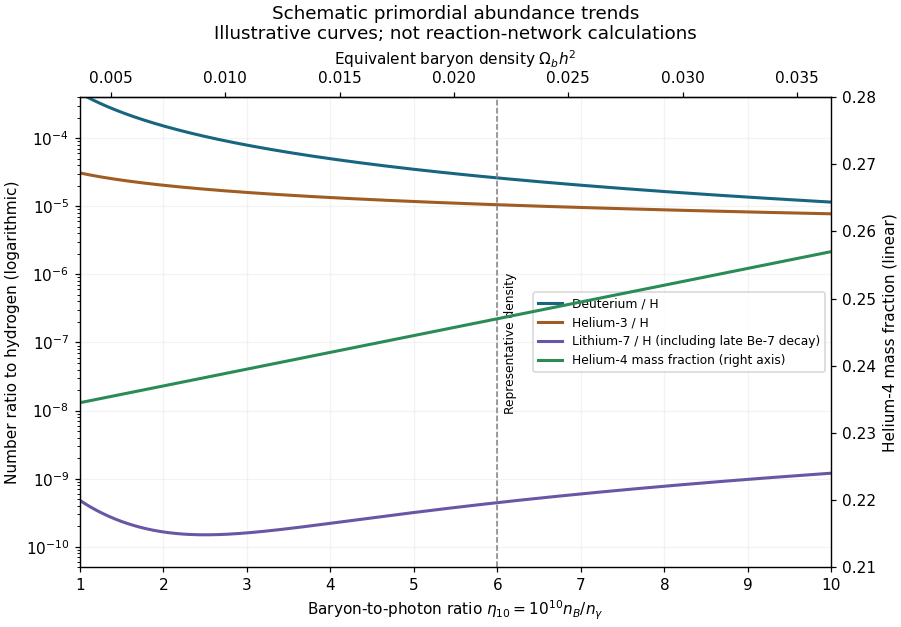
Schematic primordial deuterium, helium-3, helium-4 and lithium-7 abundance trends versus baryon-to-photon ratio
. Details. 
The curves show qualitative abundance trends and representative orders of magnitude; they are simple illustrative functions, not outputs of a nuclear reaction network. Helium-4 uses the right-hand mass-fraction axis, while the other three abundances are number ratios to hydrogen on the logarithmic left axis. The lithium valley and its rising high-density branch are important and must not be replaced by a monotone curve.
At higher , two-body reactions proceed more rapidly relative to cosmic expansion and burn deuterium more efficiently, so D/H falls strongly, approximately as near the favored density. Helium-3 decreases more gently. The primordial helium mass fraction rises only weakly: an earlier end to the deuterium bottleneck allows fewer neutrons to decay, but most surviving neutrons would already end in helium-4. Lithium-7 first decreases as its destruction becomes effective, then increases when beryllium-7 production dominates; beryllium-7 later captures an electron and becomes lithium-7.
A faster expansion changes both freeze-out and the time available for reactions. In units , weak neutron–proton conversion has rate , whereas ; consequently . Since the equilibrium neutron-to-proton ratio is , additional radiation raises it; the shorter subsequent decay interval also raises . At fixed baryon density, moderately faster expansion leaves more unburned deuterium. A longer neutron lifetime similarly increases neutron survival. These trends assume ordinary efficient burning and no independent modifications of the nuclear or weak rates.
Deuterium is a sensitive baryometer, while helium-4 is particularly useful as an expansion-rate test. Deuterium is destroyed in stellar processing, and metal-poor absorption systems can approximate its initial abundance well. Helium's weak dependence on limits its precision as a baryometer, and its spectroscopic corrections matter. Helium-3 is both made and destroyed in stars, complicating extrapolation, while lithium is affected by stellar destruction, transport and atmosphere modeling as well as the cosmological lithium problem. Accurate comparisons therefore require nuclear-rate and astrophysical uncertainties, not merely narrow instrumental error bars. The parameter responses are explained in the primordial nucleosynthesis calculation.
The primordial light-element abundance determination uses minimally processed material and estimates its residual processing rather than directly observing the universe at a few minutes old.
For deuterium, high-redshift, low-metallicity quasar absorption systems resolve isotope-shifted D I lines from the H I Lyman series. The deuterium feature is displaced by about from hydrogen; fitting several transitions and the velocity components distinguishes genuine deuterium from an unrelated hydrogen blend. The ratio of the inferred columns estimates D/H after the ionization and component structure are checked. Low metallicity minimizes stellar destruction, giving a representative primordial ratio of roughly .
For helium-4, helium and hydrogen recombination-emission lines in metal-poor H II regions of nearby dwarf galaxies give a mass fraction. Several lines constrain temperature, electron number density and corrections for collisional excitation, ionization structure, radiative transfer and underlying stellar absorption. Extrapolation of helium enrichment against metallicity towards zero metallicity estimates , approximately –, corresponding to helium/hydrogen by number near .
For helium-3, the approximately GHz hyperfine line of in Galactic H II regions probes the abundance, with ionization and nebular structure corrections. Stellar production and destruction make its primordial value hard to extract; a characteristic abundance near relative to hydrogen is compatible with standard nucleosynthesis but is not a comparably clean primordial measurement.
For lithium-7, the approximately Å Li I absorption doublet in warm, old, metal-poor halo stars gives a photospheric abundance after stellar-atmosphere and effective-temperature corrections. The Spite plateau suggests an initial number ratio of order if depletion is small; transport below the photosphere, nuclear destruction and atmosphere systematics can lower the measured value relative to the birth abundance. Standard Big Bang nucleosynthesis at the deuterium- and microwave-background-favored baryon density instead predicts several , roughly in exam-era calculations. This discrepancy is the cosmological lithium problem, not a measurement of an independently adjustable primordial lithium parameter.
The approximate values deliberately represent exam-era orders of magnitude rather than a claim of current precision; the contemporary abundance assessment discusses the inference and tensions.
Deuterium and helium-4 broadly favor the same baryon-density range in standard Big Bang nucleosynthesis, after systematic and reaction-rate uncertainties are allowed. Near the illustrative value , the baryon-density consistency between nucleosynthesis and the microwave background givesDeuterium constrains this particularly sharply; helium-4 gives a weaker baryon-density constraint and a useful test of the expansion rate. Helium-3 observations do not supply an equally precise independent consistency test because of stellar processing. Lithium inferred directly from the metal-poor stellar plateau is lower than the standard prediction at this density by a factor of a few. Thus broad concordance is real, but complete four-element concordance without qualifications is false.
An independent baryon density comes from the cosmic microwave background acoustic pattern, especially the relative odd and even peak heights set by baryon loading of the photon–baryon fluid. For a numerical comparison appropriate to this paper's era, the 2003 microwave-background and large-scale-structure analysis obtained , consistent with the density inferred from deuterium. This comparison spans the first minutes and the much later recombination epoch, and tests the thermal history and conservation of baryon number relative to photon entropy between them; it is more substantial than comparing several abundance fits sharing the same nuclear model.
Ionization-corrected Lyman-alpha forest gas inventories and baryon fractions in galaxy clusters provide further checks, with their own radiation, gas-physics and total-mass uncertainties. A total matter fraction of order is much larger than , so the abundance result also supports a predominantly nonbaryonic matter component. The lithium discrepancy and abundance systematics motivate continued tests; they do not erase the agreement between two physically distinct baryon-density determinations.
Articles by others on the same topic
There are currently no matching articles.