Use the nonnegative convention for the Laplace-Beltrami operator. For a smooth function on a Riemannian manifold , three intrinsic definitions areHere is the exterior derivative, its formal adjoint for the Riemannian volume density, the Riemannian gradient, and the Levi-Civita connection. The bilinear form is the Riemannian Hessian. The equally common nonpositive convention negates all three definitions simultaneously.
In local coordinates let be the inverse metric matrix and . By the defining relation ,The divergence of a Riemannian vector field can be defined by . Differentiating the coordinate volume density gives . Thus the second definition becomesFor compactly supported smooth , coordinate integration by parts showsSince this holds for every such , the first and second definitions agree. This argument also works on a nonorientable Riemannian manifold, using its volume density; no global orientation is needed.
For the third definition,The Christoffel symbols satisfy . This follows by tracing their formula and using . Metric compatibility givesSubstitute both identities into the coordinate divergence expression to obtainThis proves all three definitions equivalent. In geodesic normal coordinates at a point , the common value is . Finally, on a closed manifold,confirming the chosen positive Laplace-Beltrami operator sign convention.
We construct the two domains explicitly from seven congruent triangles. Let a scalene reference triangle have sides opposite its three labelled vertices. Choose its three side lengths in a small open neighbourhood of , with a fixed strict ordering. Thus the three angles are distinct and lie between and . Each copy keeps these side labels.
For the first assembly glue the following tile pairs, reflecting across the indicated side:Each coloured adjacency graph is a tree with central tile and three two-tile arms. Place tile in the plane and obtain every other tile by the prescribed reflections. At the equilateral reference shape the copies have disjoint interiors and form a polygonal disk; the same holds throughout a sufficiently small neighbourhood, since the only contacts between tiles are the prescribed edges and their incident vertices. In particular each assembly is a bounded connected planar domain.
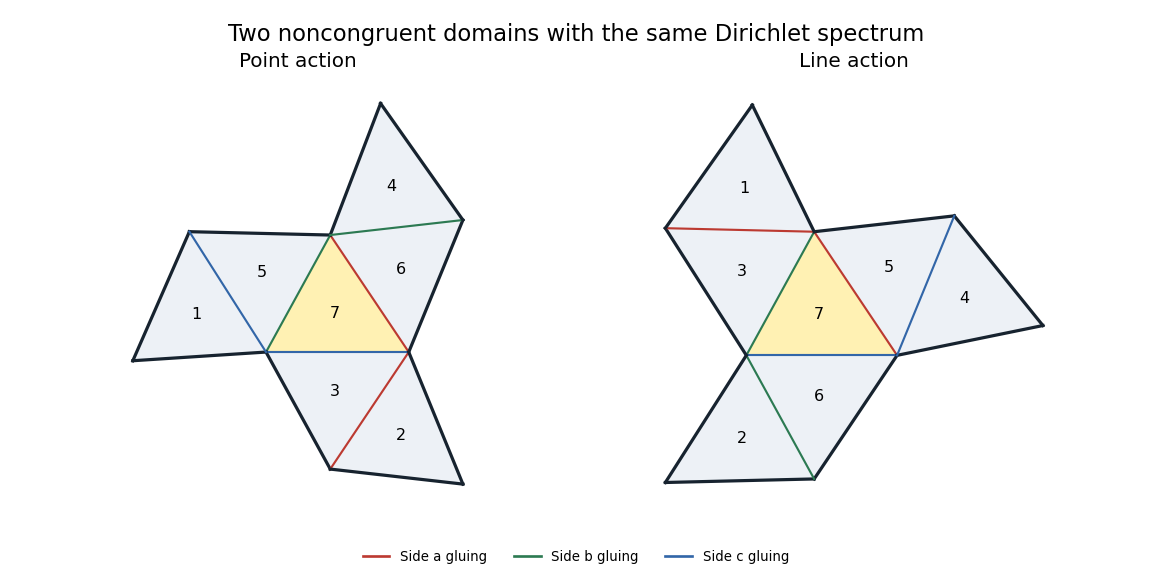

To prove equality of spectra, index tiles by the seven nonzero vectors , using with label . LetThese involutions act on points by and on nonzero covectors by . Their swaps are exactly the two columns of the table. Write for the corresponding permutation matrices. The Fano plane incidence matrixsatisfies , since incidence is preserved by a linear transformation and its inverse transpose. Each point lies on three lines, while two different points have one common line. Thereforewhere is the all-ones matrix, proving that is invertible.
For the Dirichlet boundary condition, a glued side has a positive swap and an exposed side has diagonal entry . Both trees have the same bipartition, with sign matrixTheir signed reflection matrices are and . On a glued edge its endpoint signs are opposite, so the off-diagonal entries are ; on an exposed edge the entry is . Consequently the invertible matrix satisfies
We spell out why this gives isospectrality. Pull each function back from the seven tiles to the reference triangle. Its seven boundary values along side form a vector satisfying : this imposes equal values at glued edges and zero values at exposed edges. Outward normal derivatives of a smooth eigenfunction satisfy , giving opposite normal derivatives on glued edges. The identities above preserve both conditions under . Since is constant, it also commutes with the scalar Laplacian on each triangle.
One can include all weak eigenfunctions without any corner regularity issue by orthogonalization of a transplantation matrix. The matrix commutes with the symmetric , so is orthogonal and still intertwines . On the disjoint tiles, preserves the norm and the sum of the Dirichlet energies; it maps the trace-matching form domain bijectively to . Thus it is a unitary equivalence of the Dirichlet Laplacians, proving equality of every eigenvalue with its multiplicity.
Finally, the only reentrant vertices of either polygon are the three vertices of tile , with interior angles four times the corresponding reference-triangle angles. All other boundary angles are less than . These three distinct angles force any hypothetical isometry to map each labelled central vertex to its counterpart. An isometry between connected open planar domains is a restriction of a rigid motion: its derivative is orthogonal, and preservation of the flat Levi-Civita connection makes that derivative constant. After aligning the two central triangles, this rigid motion fixes three noncollinear points and is the identity. But the two domains do not coincide: the tile beyond side of the central triangle has its next attachment along in the point assembly and along in the line assembly. These occupy different open regions. This contradiction proves nonisometry.
Therefore the three freely varying side lengths give a three-parameter family of nonisometric Dirichlet-isospectral bounded planar domains. The parameters include scale; no congruence normalization removes it.
On a closed compact Riemannian manifold, the heat kernel for the positive Laplace-Beltrami operator is the smooth kernel of for . It solves and tends to the delta kernel as , so thatFor an orthonormal eigenbasis with eigenvalues repeated according to multiplicity,The exponential factors and elliptic regularity ensure smooth convergence for positive time. If a boundary is present, the same construction uses a specified boundary condition preserved by the covering; the closed-manifold case is the one needed below.
Let be the finite normal locally isometric covering map. The heat equation for on is the lift of the one for on . Integrate the lifted solution over a fundamental domain for the deck transformation group , splitting the integral over into its translates. This givesThere is no averaging factor in this kernel formula: each translate accounts for one lift of the integration variable. To verify it directly, the sum solves the lifted heat equation and its integral against converges to ; uniqueness of the heat solution identifies the kernel. Replacing either lift or only permutes the sum, since isometries preserve the heat kernel.
Integrating the diagonal and using the covering degree gives the heat trace formulaSuppose is contained in a finite group of isometries of . For , change variables and use invariance of both volume and the heat kernel. ThenThus is a class function on , and for its conjugacy classes ,
Consequently, if are Gassmann equivalent and act freely, their orders are equal and the displayed class-by-class sums give for every . Equal heat traces determine equal eigenvalues with multiplicities: the least eigenvalue at which the multiplicities differed would give a nonzero leading exponential in their trace difference as , a contradiction. Hence the two smooth quotient manifolds are isospectral. This proves the Sunada theorem, with the free-action hypothesis ensuring that the quotients are manifolds rather than orbifolds. The theorem alone makes no nonisometry claim.
Let . Since and the scalar centre is trivial,Choose to stabilize a nonzero vector and to stabilize a two-dimensional subspace. There are seven choices of either object, so both subgroups have index and order .
Their coset permutation characters agree. The number of nonzero vectors fixed by is . A two-dimensional subspace is the kernel of a unique nonzero covector, so its stabilizer action is the dual action . Its fixed-point count isusing equality of the matrix ranks of a matrix and its transpose. For a subgroup , counting the representatives of fixed cosets givesThus the equal characters and subgroup orders give equal intersection counts with every conjugacy class. This proves are Gassmann equivalent.
They are not conjugate. For example, the stabilizer of contains every matrix with and . An invariant plane containing would give an invariant line in , impossible for the full action. An invariant plane not containing would be a complement to that line, but the arbitrary shears do not preserve any such complement. Hence a point stabilizer preserves no plane, whereas every conjugate of does. The two subgroups are nonconjugate.
We now use a cone-torus construction of genus-four Sunada surfaces. Let be a hyperbolic torus with one cone point of angle . Its orbifold fundamental group has presentationMap to the supplied generators of . Their commutator has exact order , so this gives a surjection with torsion-free kernel : every finite-order element of is conjugate to a power of the cone generator, and no nonidentity such power lies in . Thus is a smooth closed hyperbolic surface with a -action. Its quotients by are smooth too, since order- subgroups contain no element of order and therefore meet no cone stabilizer.
The orbifold Euler characteristic of is . Each quotient cover has degree , soThe Sunada theorem proved in Question 3 makes isospectral for every choice of the base hyperbolic metric.
Here is an explicit supply of base metrics. A hyperbolic trirectangle has three right angles and a fourth angle . If its sides adjacent to the opposite right-angle vertex have lengths , the trirectangle identity is . Thus varies freely, with . Reflecting four copies about their two perpendicular centre lines gives a quadrilateral with four angles and opposite sides of equal length. Identifying opposite sides produces a cone torus: all four corners give total angle . Its two centre-line geodesics intersect once and have lengths . Cut along the shorter chosen geodesic and reglue with a small twist ; this retains the cone angle and allows an additional metric parameter. The remaining cut surface has two equal-length geodesic boundaries and the cone point.
We give a concrete intersection test for nonisometric finite covers, rather than relying on subgroup nonconjugacy alone. Choose sufficiently small. The trirectangle geometry gives an embedded collar of width about . The shortest perpendicular joining the two boundary components after cutting has length . At zero twist it closes to , the unique shortest closed geodesic crossing once. Uniqueness follows from uniqueness of the shortest perpendicular; all other once-crossing classes have a positive length gap, since only finitely many closed geodesics have bounded length. For sufficiently small twists, the same marked class remains the unique shortest once-crossing geodesic. A geodesic crossing at least twice traverses the collar at least twice, so for small its length is greater than .
Geodesics disjoint from remain entirely in the cut surface and have twist-independent lengths. In a bounded window around they supply only finitely many possible length values, including lengths of iterates. Meanwhile varies nontrivially with by the hyperbolic seam identity: its hyperbolic cosine has a positive multiple of . Choose a small twist away from those finitely many coincidences. Then the only base geodesic of length is , up to orientation. By taking smaller if necessary, the only base geodesics of length at most are powers of : those crossing are long, and the nonperipheral geodesics of the limiting two-cusped cone pair of pants have lengths bounded away from zero.
In each cover, primitive lift components of a base geodesic are indexed by cycles of its monodromy permutation, with length equal to the cycle size times its base length. The permutation of has a unique singleton in each action, so each has a uniquely length-identified primitive lift of length . The permutation of has one two-cycle: it is for and for . Hence each has a unique primitive lift of length ; the iterate of the singleton lift is not primitive. At the single base intersection of , intersections of their lifted components are exactly their common sheet labels. ThereforeAn isometry would have to preserve the uniquely identified primitive lengths and their geometric intersection numbers. This contradiction proves that and are not isometric, even allowing orientation reversal.
Finally, let range over a sufficiently small positive interval, choosing a permissible twist for each value. The singleton cycle of makes the hyperbolic systole of each cover equal to . Distinct values therefore give distinct isometry classes. We obtain uncountably many pairs of nonisometric, isospectral genus-four Riemann surfaces.
Throughout the hyperbolic discussion take curvature and . A Y-piece is a pair of pants with a hyperbolic metric and three geodesic boundary components. Three labelled positive boundary lengths determine it up to isometry. To see existence and uniqueness, cut along the three shortest perpendicular seams. The two resulting right-angled hyperbolic hexagons have alternating side lengths , which determine each hexagon. Conversely, any three positive alternating lengths produce such a hexagon, and doubling along the other sides produces the desired Y-piece. In particular the seam opposite satisfies
An X-piece is a four-holed hyperbolic sphere with geodesic boundaries, obtained by joining two Y-pieces along one pair of equal-length boundaries. For a chosen separating curve, it is determined bywhere is the common gluing length and is the relative arclength twist, measured between chosen seam endpoints. The identification reverses boundary orientation so that the surface is oriented. For an unmarked gluing, is periodic modulo ; a marking retains , because a full Dehn twist changes the marking. These six parameters describe the X-piece with its chosen separating curve; different curve choices or boundary symmetries can describe the same unmarked surface.
Choose a pants decomposition of a closed oriented genus- surface. Each Y-piece has Euler characteristic , and gluing boundary circles does not change the total Euler characteristic. Thus there are pieces. Their boundary circles are paired, giving gluing curves. Choose their disjoint geodesic representatives, then prescribe each cuff length and its relative twist. The Fenchel–Nielsen coordinates areThey determine the marked hyperbolic surface and hence its unmarked isometry class, with real parameters. One must also fix the combinatorial gluing pattern of the chosen pants decomposition. Full twists and other changes of marking identify some parameter sets in unmarked moduli space of Riemann surfaces. The genus restriction matters: a sphere and a torus do not admit a closed curvature- metric or such a decomposition into geodesic Y-pieces.
For a fixed oriented topological surface , Teichmüller space consists of marked Riemann surfaces . Two markings represent the same point when a conformal isomorphism between the surfaces carries one marking to the other up to homotopy. By the uniformization theorem, for these are equivalently marked curvature- metrics. The displayed Fenchel–Nielsen coordinates identify with a cell of real dimension ; the mapping class group quotient gives the unmarked moduli space of Riemann surfaces.
The spectral version of the Wolpert generic spectral rigidity theorem says that outside a closed proper real-analytic exceptional subset of , the Laplace spectrum determines the hyperbolic surface up to isometry. The exceptional subset has positive codimension and is invariant under changes of marking. Orientation reversal must be allowed, since the Laplacian cannot detect orientation. Equivalently, a generic surface is determined by its unmarked length spectrum, counted with multiplicities. This is a generic uniqueness statement, not a claim that every isospectral pair is isometric; the construction in Question 4 lies in the exceptional locus.
Three major ingredients and their roles are as follows.
- The Selberg trace formula converts the Laplacian spectrum into the lengths and multiplicities of closed geodesics, and conversely. It moves the problem from eigenvalues to geometric length data, where pants and twists can be used.
- Finite length coordinates for hyperbolic surfaces and real-analytic length functions reduce candidate spectral matchings to finitely many local analytic systems. The cuff lengths fix the Y-pieces; two transverse curves at each cuff fix its twist, giving labelled length functions. Hyperbolic holonomy gives , so these lengths obey analytic trace relations. Discreteness of bounded length data, compactness in the thick part, and finite determination of those trace relations control the locally possible unlabelled matchings. A matching that is not an identity therefore lies in a proper analytic zero set.
- Geometric decoding of the persistent identities uses the collar lemma and variations of Fenchel–Nielsen coordinates. Pinching a cuff makes crossing curves long while disjoint ones remain bounded; twisting controls the transverse length relations. These behaviours recover the pants incidence and the twist data, and show that a matching persisting on an open parameter set comes from a change of marking, possibly with orientation reversal. Thus any genuinely nonisometric matching is confined to the lower-dimensional exceptional analytic locus.
For completeness, a related finiteness statement sometimes grouped with this theorem is that a fixed closed hyperbolic surface has only finitely many isospectral isometry classes. Its short proof uses three particularly concrete tools: a common discrete length spectrum; Mumford's compactness theorem, applied to the common positive systole; and finitely many determining marked lengths. Compactness would give an accumulation point if an isospectral family were infinite. Nearby markings make each determining length converge, while discreteness of the fixed spectrum makes it eventually constant. The determining lengths then force eventual equality of the marked surfaces, a contradiction. This finiteness of isospectral hyperbolic surfaces statement does not replace the stronger generic uniqueness assertion above.
Articles by others on the same topic
There are currently no matching articles.