Assume a steady, incompressible, inviscid flow with a nearly uniform velocity across each water section. The channel varies slowly enough for vertical accelerations to be negligible, pressure to be hydrostatic and the water surface to be nearly horizontal across the width. Atmospheric pressure is uniform; neglect surface tension, wall friction and energy losses. The hydraulic equations apply away from jumps and short nonhydrostatic regions.
The Euler equation for horizontal momentum, with hydrostatic pressure, givesIntegrating gives a constant Bernoulli equation head . Conservation of mass gives the constant volume discharge . Thus the shallow-water specific energy, measured above the local bed, isDefine the Froude number by for the positive flow direction. ThenAt fixed discharge and width, energy tends to infinity at both zero and infinite depth. It has a unique minimum atIndeed . Above the minimum there are two depth branches: the shallower one is supercritical flow and the deeper one is subcritical flow.
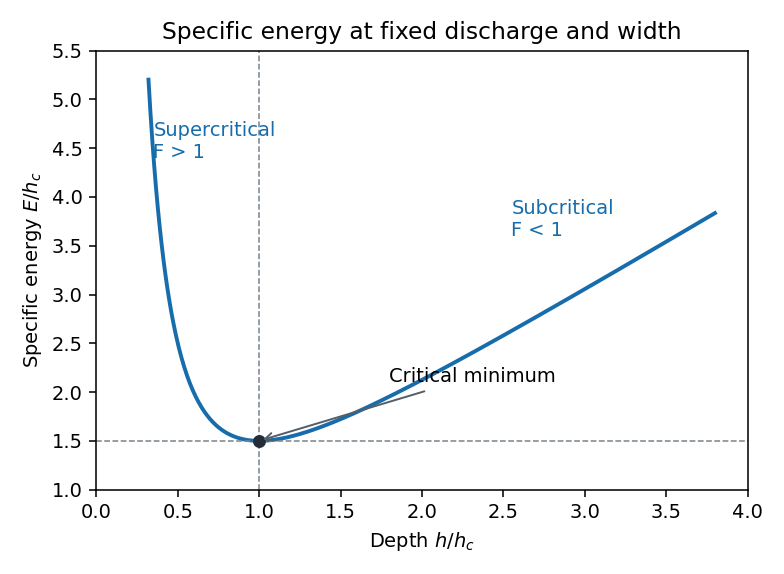
Specific-energy minimum and the subcritical and supercritical depth branches
. Details. 
The local long-wave propagation speeds from the shallow water equations are . In subcritical positive flow, one wave family travels upstream and one downstream. In supercritical flow both travel downstream. At critical flow the upstream-directed speed is zero, so the flow can provide hydraulic control separating upstream adjustment from downstream conditions. This statement concerns long waves in the slowly varying hydraulic approximation, rather than all short-wave disturbances.
For a smooth positive discharge on the flat bed, differentiate the constant specific energy. With ,At a regular critical point, and , so . Since is constant, this requires . The given width has , proving that a regular hydraulic control can occur only at .
The throat is the unique width minimum and hence the maximum of the critical-energy envelopeA steady positive-depth flow must have its conserved energy at least as large as every local minimum energy. To be controlled smoothly at the throat it must satisfyEquivalently the controlled discharge at a prescribed head is . If the head is larger than this critical value at fixed , the two depth branches remain separate everywhere and the flow need not be controlled. If it is smaller, no smooth steady solution carrying that discharge through the throat exists; upstream head or discharge must adjust.
Boundary conditions must also select the appropriate connected branches. A local expansion about the throat givesAt the controlled head, . The usual accelerating positive-discharge connection uses the negative slope: deep subcritical flow upstream becomes shallow supercritical flow downstream. The throat is a maximum of the critical-head envelope, as required for a real smooth transcritical connection in hydraulic control in a variable-width channel.
Let denote volume loss per unit downstream length and take . Mass balance gives , soAssume fluid is removed carrying its local axial velocity, with no additional axial force on the retained flow. Under this inviscid seepage approximation, the horizontal momentum equation and its Bernoulli head are unchanged. On the flat bed, hydraulic control with prescribed seepage therefore usesThe calculation applies on a reach with positive remaining discharge. Constant loss cannot be extended indefinitely past while preserving this positive-flow model.
At a regular control, and the same differentiated energy condition requires , where . Differentiating givesWrite . The two algebraic roots are . At the plus root , so it is outside the stipulated positive-flow branch. The admissible control candidate isIt lies upstream of the geometric throat. At this point andIt is a maximum of positive : differentiating the numerator of at gives . ConsequentlyA control exists only if the reach includes this point and boundary conditions supply the critical conserved head and a suitable transcritical connection. Merely prescribing and does not force that head. At the limiting location is zero and the usual throat depth is recovered.
In the same idealized momentum model, write . The discharge now increases downstream. The admissible maximum of moves to , beyond the geometric throat, because added discharge initially offsets the widening channel. The formula remains valid, and the critical depth depends on through . The positive-flow reach is now restricted upstream by , rather than downstream by exhaustion of the discharge. The same critical-head and boundary-connection conditions are still needed.
Actual injection introduces a further physical issue: newly added fluid need not have the stream's axial velocity. Let its axial velocity be and let . The momentum correction for lateral mass addition isRemoval at the local velocity, or ideal co-moving addition, gives the conserved-head analysis above. Addition at rest instead accelerates new fluid and decreases the head. It cannot be modeled solely by changing the sign of in a constant-head calculation.
For example, flat-bed addition at rest gives . Its regular-control compatibility is , rather than the co-moving condition ; in the parabolic channel it gives the different candidate . Thus the sign reversal moves the ideal control downstream, but its quantitative prediction depends on the momentum carried by the injected water. The source specifies the volume rate only, so an injection-velocity assumption must accompany any definite constant-energy answer.
Articles by others on the same topic
There are currently no matching articles.