For a finite-dimensional Lie algebra, write for its Adjoint representation. The Killing form is the symmetric bilinear formThe Jacobi identity gives . Using the cyclic property of the trace,Thus it is an invariant bilinear form on a Lie algebra. If , the adjoint matrix has entries . Its trace product yields the structure constants of a Lie algebra formulaA semisimple Lie algebra has zero solvable radical, equivalently no nonzero solvable ideal. In characteristic zero, the Cartan criterion for semisimplicity characterizes it by nondegeneracy of its Killing form. A real compact Lie algebra is the Lie algebra of a compact Lie group, equivalently one admitting a positive-definite invariant inner product. For a real semisimple algebra, the compactness criterion from the Killing form says compactness is equivalent to negative-definiteness of . An abelian compact-type algebra has zero Killing form, so this last characterization specifically concerns the semisimple case.
In the ordered basis , the three Adjoint representation matrices areTheir cross-product traces vanish, while their squared traces are , and . ConsequentlyThis is the Killing form for cyclic three-generator brackets with constants .
For , the form is nondegenerate and negative-definite. The algebra is semisimple and compact, isomorphic to the SU(2) Lie algebra. For , it is nondegenerate with signature , so the algebra is semisimple and noncompact, isomorphic to .
For , the only nonzero bracket is , with central. This is the Heisenberg Lie algebra, which is nilpotent and neither semisimple nor compact. Compactness is ruled out even though the Killing form is merely degenerate: is nonzero and nilpotent, whereas in a compact Lie algebra every adjoint map is skew-adjoint for a positive inner product. Skew-adjoint nilpotent operators vanish.
Let and . Matrix multiplication givesThus is a semidirect product of the translation plane by the one-parameter Lorentz boost group. Differentiating left multiplication at the identity gives the left-invariant vector fieldsThey obey , and .
Their dual coframe is , , and . The Haar measure from a left-invariant coframe is their absolute wedge product. Since ,One can also check this directly: left multiplication has Jacobian determinant one. Right multiplication has a block triangular Jacobian with determinant one too, so the same measure is both left and right Haar measure.
The commuting Hermitian operators admit a weight-space decomposition. The six root vectors shift their simultaneous eigenvalues byor their negatives. Put , and . The supplied relations giveThese are three sl2 triples, coming from the complexifications of the three SU(2) Lie algebra root-pair subalgebras. They act through homomorphisms into . For a nontrivial representation, simplicity of the SU(3) Lie algebra makes its kernel zero, so these images are actual subalgebras; a trivial representation gives zero actions. The real compact generators can be taken as , and .
Decomposing under any one of these subalgebras gives finite weight strings in its root direction. The two simple-root highest weights must be nonnegative integers. In the SU(3) highest-weight coordinates used here, this condition isHere are the Dynkin labels; are the eigenvalues of . An irreducible representation is determined by these labels and has dimension . An arbitrary finite-dimensional anti-Hermitian representation is a direct sum of such representations: the orthogonal complement of an invariant subspace remains invariant.
The weight diagram has Weyl group symmetry, namely reflections and rotations by degrees. Its convex boundary is a hexagon with alternating side lengths , degenerating to a triangle when one label vanishes. Generic representations need not have -degree symmetry. Boundary weight multiplicities are one. Moving inward through hexagonal layers increases multiplicity by one, up to ; triangular inner layers retain that maximum. An exact version of this rule is the dominant weight multiplicity formula for sl3: move a weight by the Weyl group to dominant Dynkin coordinates and setIts multiplicity is zero unless are integers, and otherwise is . These rules construct the diagram while counting coincident weights correctly.
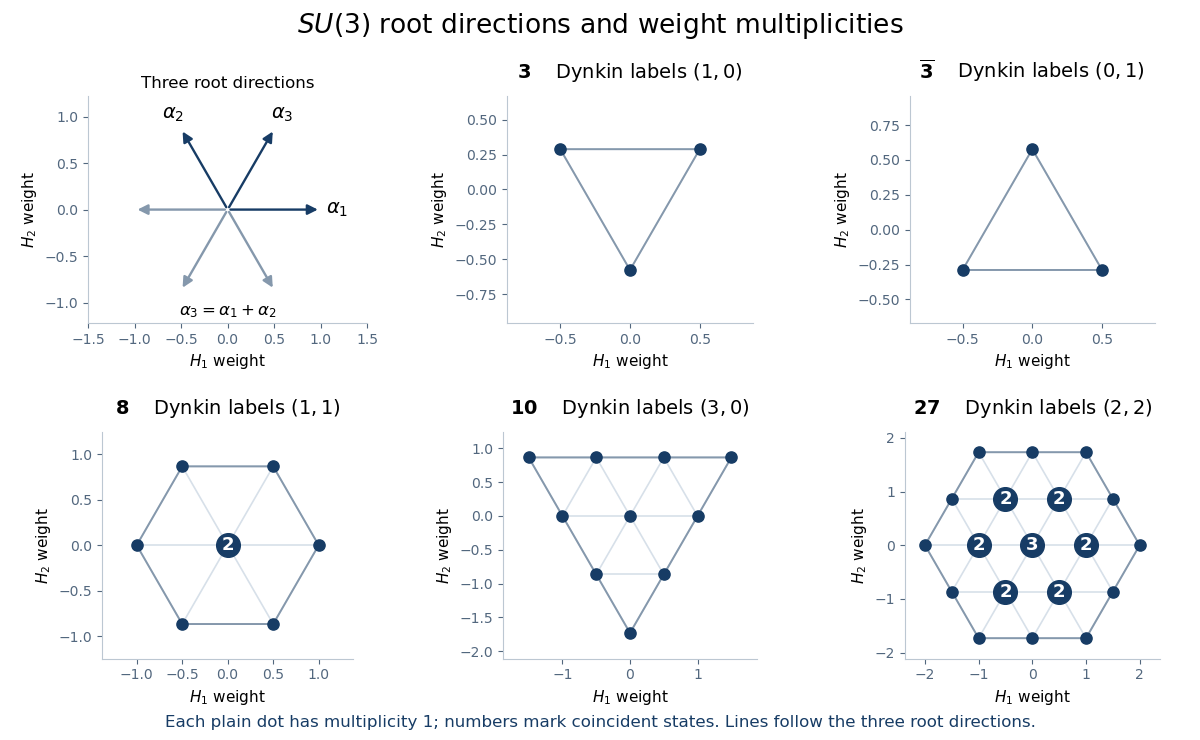

For the Casimir calculation, set , , and for each root pair use and . In the defining representation these eight generators satisfy . Their summed squares are precisely the question's . The invariant trace form makes their structure constants of a Lie algebra antisymmetric, sothe antisymmetric coefficient contracts a symmetric anticommutator. Thus is a quadratic Casimir operator and is scalar on an irreducible representation by the Schur lemma.
Let be a highest-weight vector, annihilated by all . On , each vanishes and each reduces to the root commutator. Summing those three commutators gives . Henceand therefore the SU(3) quadratic Casimir eigenvalue isFor a reducible representation the same calculation applies separately to its irreducible blocks.
For light-hadron flavour symmetry, the up quark, down quark and strange quark form , and antiquarks form . Conventional mesons have . Conventional three-quark baryons haveobtained from , and . Their Dynkin labels are , and , respectively. Thus the conventional meson octet, baryon octet, baryon decuplet and singlet multiplets give , with the same values for conjugate antibaryon multiplets. More generally, the zero flavour triality of a light-quark hadron imposes on multiplets constructed entirely from light quarks, antiquarks and gluons. Their Casimir values are given by the same formula for these labels. Higher multiquark representations can therefore have other eigenvalues; the illustrated , of labels , has .
Choose the convention for a field in the defining representation and . Requiring gives the Yang-Mills gauge transformationThe gauge field strength is the curvature , soFor an adjoint field , the adjoint covariant derivative is , and direct substitution gives . Consequently transforms by conjugation too.
The Killing-form invariance under a Lie-group adjoint action gives . Its proof is that the adjoint matrices are conjugated by the same invertible map, leaving their trace product unchanged. With , both and are therefore gauge invariant.
For their field equations, take a compactly supported variation . Curvature varies byThe invariant form permits gauge-covariant integration by parts, because . Antisymmetry of givesIntegrating, the power of the Yang-Mills invariant gives the equationFor this recovers the Yang-Mills equations. For larger , keep the displayed product form, including at .
For the derivative-squared action, write . Varying the derivative as well as the curvature givesIts first variation isIntegrate the first term once, substitute , and integrate again. It becomes , where . Invariance converts the second term into . Nondegeneracy of the Killing form and arbitrary variations yield the derivative-squared Yang-Mills action equationThe derivative order matters because covariant derivatives generally do not commute. In an abelian limit the commutator term vanishes and the equation reduces to , a useful check on the fourth-order equation for the potential.
Consider positive-energy unitary irreducible representations of the proper orthochronous Poincaré group, allowing its double cover for physical half-integer spin. Use metric and define the Pauli-Lubanski pseudovector byThis overall sign gives at rest. The antisymmetric tensor and commuting translation generators give . The given commutators say commutes with translations and transforms as a Lorentz vector. Hence both and commute with the Poincare algebra; they are Casimir operators.
The commuting Hermitian translation generators admit generalized joint momentum eigenstates. A Lorentz transformation maps a state at to a state at , so an irreducible representation has momentum support on a single Lorentz orbit. Choose a standard momentum . Its little group consists of the transformations fixing and acts on the internal states there. Transport those internal states over the orbit by chosen transformations . This gives the construction underlying Wigner's classification.
For timelike future-directed momenta, with and . The massive particle little group is SO(3), or SU(2) on the double cover. Write . The rotation commutators give , so the irreducible little-group representation hasAt rest, and . Thus the massive Pauli-Lubanski Casimir isThe rest spin space has dimension . All occur for the double cover; only integer spin descends to an ordinary single-valued representation of the proper orthochronous Poincare group.
For the detailed representation, choose a Lorentz boost from to every point of the positive-energy mass shell. With invariant normalization, states transform asThe matrix fixes , so it is the Wigner rotation in the little group. Its cocycle identityproves the representation law. Translations give phases; with the convention , this extends to the massive induced representation of the Poincare double cover onThe invariant measure and unitary spin matrices give unitarity. A closed invariant subspace restricts at fixed momentum to a little-group invariant spin subspace; irreducibility of that spin representation and transitivity over the mass shell force the full representation to be irreducible. Conversely the momentum-orbit construction recovers every massive positive-energy irreducible representation. The labels are therefore .
For a nonzero future null momentum choose . The massless particle little group is . With , its massless little-group generators arewith , and . Evaluating the Pauli-Lubanski vector gives .
In a finite-dimensional unitary little-group representation, the joint spectrum of the commuting Hermitian is finite and invariant under continuous planar rotations. Its only possible values are zero. Thus finite-dimensional unitary representations of the massless little group have trivial translations. Irreducibility then leaves a one-dimensional rotation character of helicity , givingHelicity supplies an additional label that the two zero Casimirs cannot distinguish. It is integer for the ordinary group and may be half-integer on its physical double cover. Nontrivial little-group translations instead lead to an infinite-dimensional continuous-spin representation with ; the Poincare algebra by itself allows these too. This completes the timelike and nonzero null cases of physical interest.
Articles by others on the same topic
There are currently no matching articles.