Assume small-amplitude motion, a thin uniform elastic plate, no prestress, and inviscid, irrotational deep water. Write the upward displacement as , the ice mass per unit area as , and its flexural rigidity aswhere is Young's modulus and is Poisson's ratio. The plate equation is , where is the perturbation of upward water pressure.
Let the water velocity potential be below the mean surface , with . This solves the Laplace equation and decays at depth. For , the kinematic boundary condition gives . The linear Bernoulli equation givesEliminating proves the dispersion relation of a floating elastic plate:Thus the desired wavenumber is the positive root ofFor positive and , this root is unique: the polynomial is negative at zero and positive eventually; if its derivative starts negative, that derivative crosses zero only once, at a negative-valued minimum before the positive root. If a finite water depth is required, the corresponding relation is .
Put and . Differentiation gives the group velocityFor long periods, the surface gravity wave limit gives . At sufficiently short periods, plate inertia and bending dominate, and . Consequently the curve has a group-velocity minimum of a flexural-gravity wave between branches that rise toward both long and short periods, within the formal deep-water plate model. Very short waves eventually fall outside the thin-plate approximation.
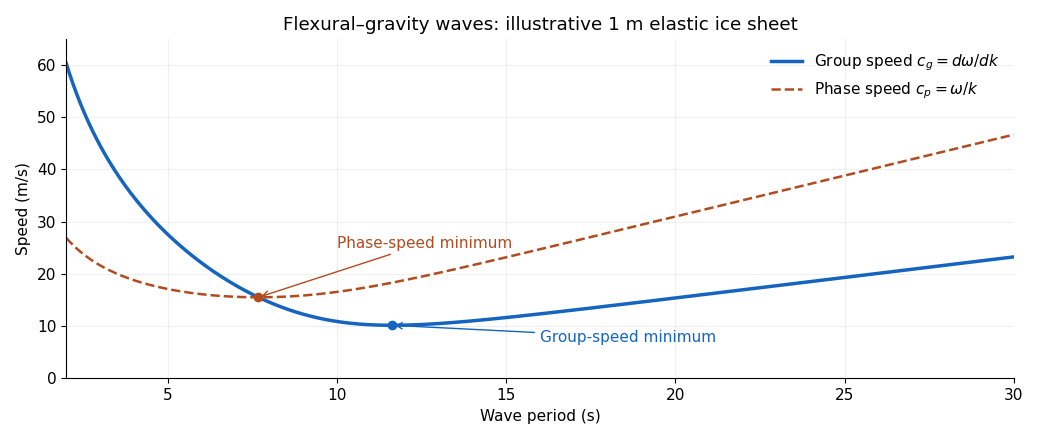

The plot is an original model illustration with , , , , , and . Its two minima occur at different periods.
A wave packet near the group-speed minimum carries energy away relatively slowly, so sustained forcing can concentrate energy in that period band. However, wind generation cannot be decided from alone. A steadily translating pressure pattern resonates through its phase velocity ; it must reach the minimum phase speed of a flexural-gravity wave. Actual wind-wave growth also requires suitable pressure coupling and enough energy input to overcome damping. A coherent cover suppresses ordinary free-surface wave generation, while incoming ocean swell can still excite bending and break the cover.
For disconnected pancake ice or frazil ice, remove the assumption of coherent elastic bending and retain the effective mass loading as a first conservative approximation. Setting gives . To describe damping as well, replace the elastic layer by a viscous suspension and match velocity and stress to the water beneath: the resulting viscous layer model of frazil-pancake ice has complex , whose real part gives dispersion and imaginary part gives attenuation. Keller's 1998 two-layer model implements this replacement. Effective viscosity and connectedness must reflect the particular cover; zero rigidity alone does not model attenuation.
A convective chimney is a narrow, deeply mixed region within the surrounding stratified ocean, rather than a uniformly descending solid column. Greenland Sea observations around 2001 found features roughly ten kilometres wide with winter mixing extending to about km. Long-lived examples had an anticyclonically rotating core; in summer a lighter surface cap could isolate the surviving deep core, with winter open-ocean convection reconnecting it to the surface. Wadhams's 2005 observations describe this structure. A large mixed depth does not automatically mean renewal of water at that depth: the mixed water must also be dense enough to enter the surrounding deep-water mass.
Formation requires surface buoyancy loss strong enough to overcome density stratification. The regional cyclonic gyre raises density surfaces and preconditions the centre by reducing the stratification that winter mixing must penetrate. Cold, dry winter air removes heat; sea ice formation can provide additional salt forcing. Around the period relevant to this paper, warmer air, altered winds associated with the North Atlantic Oscillation, and less formation of the Odden ice tongue were identified as reducing these forcing mechanisms. Fresh surface water also resists deep mixing. Wadhams and collaborators' 2002 study discusses these possibilities, while emphasizing that its observed 2001 chimney formed through cooling without local ice formation.
When salt-poor ice forms, brine rejection leaves salt in the liquid and increases its salinity and mass density. Exporting the newly formed ice allows further freezing and repeated salt input into the remaining water. Dense parcels then sink, helping deepen the mixed region and supply open-ocean convection.
For the numerical comparison, let the liquid specific heat capacity be and initial salinity be . These are not supplied by the question: take the usual approximate values and psu for a numerical estimate. The ice heat capacity cannot replace during liquid cooling. Per unit area of a m column,The stated thermal density response givesExtracting the same at the freezing point converts a liquid mass fraction into salt-free ice. Conservation of salt during freezing givesUsing the stated salinity-to-density conversion,The first-order approximation gives psu and a factor . Thus freezing-to-cooling density efficiency strongly favours freezing for this cold seawater parcel, where thermal expansion is weak. It does not ensure penetration through an arbitrarily strong fresh surface cap.
The mechanisms affect surface energy input, heat supply from below, and the transport and thickness of sea ice. They reinforce one another: atmospheric warming and ocean heat thin the cover; circulation can export old ice; thinner ice melts earlier, increasing open-water absorption and strengthening ice-albedo feedback. Heat below the cold halocline matters only to the extent that mixing delivers it upward. Consequently the seven effects cannot be assigned independent percentages from the information given; their importance varies by region and year.
In a forward-looking answer from the paper's 2009 context, sustained warming would be expected to produce continued Arctic sea ice decline, a longer summer open-water season, less multi-year sea ice, and potentially nearly ice-free late summers within coming decades. Winter darkness permits new first-year sea ice to form, so loss of summer ice does not imply immediate year-round disappearance. Winter ice would tend to become thinner, more seasonal, and slower to recover after enhanced ocean heating. A precise date requires a forcing scenario and model, and internal variability causes year-to-year departures. Wang and Overland's 2009 projection is a contemporary example of such a conditional summer outlook.
Warmer air increases surface melt during the warm season, lengthens the melt season, and reduces the accumulated freezing degree-days available for winter growth. Enhanced downward heat transfer can therefore thin the cover even without extra ocean heat. It provides a broad thermodynamic influence on Arctic sea ice decline, while regional winds and cloud conditions determine part of the local response.
Warmer Atlantic water increases the reservoir of heat beneath the Arctic surface layer. However, stable density stratification across the cold halocline often prevents that heat from directly reaching the ice. The effect on sea ice depends on upward mixing and ocean heat flux, with greater direct access in some Atlantic-influenced regions; a temperature increase at depth alone is insufficient to quantify basal melting.
Erosion or displacement of the cold halocline weakens the barrier separating sea ice from warmer water below. It can therefore increase the upward ocean heat flux without requiring a large new warming of that deeper water. Wind-driven mixing, changes in shelf-water supply, and freshwater redistribution can alter the halocline. This mechanism couples the Atlantic heat reservoir to atmospheric and circulation changes.
Pacific inflow carries seasonally warm water through the Bering Strait into the western Arctic. Much of this heat lies higher in the water column than the warm Atlantic layer, making it more accessible to the ice in the Pacific sector. Its path, timing, temperature and volume transport affect basal melting and delayed freeze-up. Shimada and collaborators' 2006 observations associate warm Pacific summer water with regional ice loss; they do not imply that it explains all Arctic loss.
The Arctic Oscillation changes pressure patterns and winds, redistributing sea ice and altering export through Fram Strait. Removing thick old ice and replacing it with thinner new ice preconditions greater summer loss; winds also open leads and change ocean circulation. This is an important dynamic contributor and source of variability, rather than a universal one-to-one relation between the oscillation index and total summer ice extent.
Long-term thinning lowers the latent heat inventory that must be supplied before a patch of sea ice disappears. Thin ice is also more mobile and vulnerable to mechanical breakup. A smaller fraction of multi-year sea ice therefore increases susceptibility to a warm or windy summer. Thin ice grows relatively rapidly in winter because it conducts heat more readily, giving a stabilizing response that partly opposes continued thinning without cancelling sustained warming.
Open water absorbs more sunlight than bright sea ice, and melt ponds also lower the surface albedo. More absorbed heat promotes further melt and can be stored in the upper ocean, delaying autumn freezing. This ice-albedo feedback amplifies an initially forced loss during the sunlit season. Perovich and collaborators' 2008 measurements identify solar heating of the upper ocean as the main heat source for enhanced bottom melting in their observed Beaufort Sea case. Feedback is especially important locally after open water develops; it does not supply solar heat during polar winter.
Invert the Lebedev ice-growth law to obtain the original accumulated freezing degree-days:The average cold over days is therefore approximately below the reference. Assuming the warmed days remain below the freezing-degree-day threshold, a increase removes degree-days. HenceThe estimated end-of-winter thickness falls by about m, or . This applies the same empirical growth law to the altered temperature forcing; it does not add changes in snow, winds or ocean heat.
The extra ocean heat flux supplies energy per unit areaIn a fixed heat-removal estimate, this offsets the latent heat of fusion that would otherwise form thickness . Using a standard ice mass density , an additional material assumption,For any other assumed ice density, retain metres. This is the latent-heat equivalent of the added energy, not an exact coupled growth calculation. Thinner ice conducts heat more readily, so the atmospheric heat-removal budget can respond; a full sea ice thermodynamics model, such as the single-category sea-ice thermodynamic model, includes that compensation.
Let be horizontal iceberg velocity, the wind and the current. Air and water drag forces act on the relative velocities, typically with magnitudes proportional to their squares. Their exposed and immersed areas and drag coefficients differ. For iceberg mass , the horizontal balance can be written schematically aswhere is the Coriolis parameter and the sea-surface elevation. The last term represents the large-scale pressure gradient; contact with pack ice and grounding require additional forces. Iceberg free drift neglects such contact constraints, not the water drag or Coriolis force.
In still water with a fixed wind force , a transparent transient model linearizes water drag as . Put . ThenThe damped free drift of an iceberg isThus an initially resting berg accelerates under the wind, turns under the Coriolis force, and approaches a balance of wind, water drag and rotation through damped inertial oscillations. Its equilibrium drift is to the right of the wind in the Northern Hemisphere and to the left in the Southern Hemisphere. With quadratic drag, the drag coefficient in the equilibrium balance depends on speed; the linear formula illustrates the turning and relaxation rather than prescribing an exact percentage of wind speed.
For a moving ocean, the background pressure gradient associated with geostrophic balance must also be included. Large tabular icebergs have substantial submerged area and respond strongly to currents; smaller bergs can have a larger wind-driven velocity relative to the water. Near Antarctica, the mainly westward Antarctic Coastal Current can carry bergs along the continental margin. Export into offshore gyres and then the eastward Antarctic Circumpolar Current changes their trajectories; bathymetry, winds, fronts and evolving size all matter. Gladstone and Bigg's Weddell Sea tracking illustrates the contrast between coastal and offshore drift. The Antarctic Convergence separates colder Antarctic surface water from warmer water farther north, where an exported iceberg can encounter enhanced melting. No single wind direction determines the complete route.
Measure downward from the iceberg surface. Its mass density is for m and below that. The mass per unit horizontal area isBy Archimedes' principle, the draft is m. The iceberg freeboard is therefore m. The specified snow-to-ice density is reached atThe more porous snow and firn are consequently above water: atmospheric warming, meltwater infiltration, compaction and refreezing can modify them. At the waterline and below, dense ice is exposed to oceanic heat transfer and wave erosion, which can undercut the berg and cause breakage. If the porous transition were submerged, water infiltration and ocean heat could act directly on that material, changing the erosion and collapse mechanisms.
The horizontal area is and the total mass from part (a) is . The iceberg melt heat budget includes warming to followed by fusion. With temperature in the upper m and below,The two integrals are and , so using the stated ice specific heat capacity,The latent heat of fusion contribution isThereforeThis produces liquid water at ; warming the meltwater further would require additional heat.
For such bergs per year, the rate of heat absorption north of the Antarctic Convergence isRelative to the specified oceanic polar heat flux,The bergs themselves move equatorward carrying a thermal deficit; their melting removes heat from warmer water. This is equivalent to poleward heat transport by equatorward iceberg drift, explaining the sign of the inferred poleward contribution. The estimate includes the sensible and latent terms from part (b), and does not include the separate effects of released freshwater on density stratification or ocean circulation.
Articles by others on the same topic
There are currently no matching articles.