Use metric signature and the parity matrix . If a Dirac field transforms as , the chain rule changes the spatial derivatives' signs. Covariance of its Dirac equation therefore requiresThe Clifford algebra gives precisely these identities for . In an irreducible Dirac representation any other solution differs by a scalar phase, because its ratio with commutes with all gamma matrices. With , the Dirac mass bilinear and kinetic term consequently obeyThe factor compensates the sign reversal of spatial derivatives. A transformation containing only the argument change would not preserve the massive Dirac equation. This establishes parity symmetry of the free or vector-coupled Dirac theory; it does not make a chiral weak interaction parity symmetric.
For charge conjugation, transpose the adjoint Dirac equation to obtain . Multiplying by gives the original Dirac equation for ifOne may choose unitary; in four dimensions a conventional choice in a standard Dirac or chiral basis is , with . Its overall phase and do not affect the following bilinear transformation. Reordering the Grassmann fermion fields gives, for a color matrix commuting with the gamma matrices,Thus a vector color current changes sign and transposes its color generator under charge conjugation.
Write the Hermitian color connection as . The interaction coming from is . Its charge-conjugation symmetry requires . Parity acts on the Lorentz index as on a vector connection, so combining the two givesIn components, and . The transpose is a color-space transpose, independent of the spinor matrix . Intrinsic fermion phases cancel between a field and its adjoint.
Define the matrix gauge field strength unambiguously byThe derivative terms transform with the expected parity factors and a minus transpose. For the commutator, the crucial identity is , so the nonlinear term has the same transformation as the derivative terms. This is the CP transformation of non-Abelian field strength:For example, while . With , the color sum in the theta operator is twice a trace of two field strengths. The two charge-conjugation minus signs cancel, and transposition reverses the trace factors without changing their trace. The four parity matrices contracted with the Levi-Civita symbol contribute . HenceThe theta operator is CP odd; a generic fixed nonzero coefficient violates CP. Setting the coefficient to zero removes this term. Although the density is locally a total derivative, nontrivial gauge topology means that it need not be irrelevant to the quantum theory. If a properly normalized theta angle is identified periodically, invariance at special values equivalent to their negatives is a separate global question; it does not change the CP odd transformation of the local operator.
A stable symmetry-breaking minimum requires and . Put . The common scalar potential can then be written, up to a constant, asIts minima form the sphere . Choose the vacuum direction . If instead with positive , the minimum is at the origin and the assumed nonzero vacuum expectation value is not a stable vacuum of these models.
In the ungauged theory, the internal symmetry is global ; its connected part is . Constant orthogonal transformations preserve both the kinetic term and the potential. The chosen vacuum is invariant under acting on its first two components, so the continuous breaking is with two broken generators. The vacuum orientations are genuinely different degenerate global vacua.
The global triplet scalar symmetry breaking is visible directly in the fluctuation masses. Write . The potential Hessian isThe quadratic Lagrangian is thereforeThere is one radial scalar of mass and two massless Goldstone bosons. The two Goldstone modes describe motion tangential to the vacuum sphere. They remain physical, since a global rotation has only constant parameters and cannot remove arbitrary spacetime-dependent fluctuations. All three original real-scalar degrees of freedom remain. Interactions persist: the shifted potential is , containing cubic and quartic terms. Masslessness of the angular modes is protected by the exact continuous symmetry through Goldstone's theorem.
In the gauged theory, the three-component real field is the vector representation of local , equivalently the Adjoint representation of . The center of acts trivially on this field, so both descriptions have the same local field content and perturbative spectrum. Take , for which . The covariant kinetic term and the gauge kinetic term are invariant under local transformations with the associated connection transformation. The scalar inversion , with the gauge field unchanged, is also a discrete invariance of the displayed action.
The vacuum leaves rotations about its third axis unbroken. The residual gauge group is , or the corresponding subgroup in the description. Expanding the covariant kinetic term about givesThus the gauge-boson mass matrix is . The third generator annihilates the vacuum, while the first two do not. The masses are , , and .
The quadratic derivative mixing displays what happens to the Goldstone fields. With the generator convention just chosen,Local rotations can set the two angular fields to zero in unitary gauge. Then andThe two Goldstone modes supply the longitudinal polarizations of the two massive vector bosons. They do not survive as additional physical massless scalars. The radial scalar is still physical, and retains only two transverse polarizations. This adjoint triplet Higgs spectrum realizes the Higgs mechanism; the gauge group is only partially broken, so one massless gauge boson remains.
The degree-of-freedom check isIn contrast, the global theory has just the three scalar modes, including its two physical Goldstone bosons. A vacuum expectation value in the local theory is a choice of gauge-fixed description: the direction can be changed by gauge transformations and is not itself an observable. Gauge-independent masses and the physical degree count express the actual effect. Both theories retain Lorentz symmetry in the constant scalar vacuum.
Put and . The left-handed doublet haswhile the right-handed charged-lepton singlet has and . There is no weakly coupled right-handed neutrino in the stated field content. For a fermion , write and , with here. Since and similarly for ,Consequently the neutral-current vector and axial couplings in the specified overall normalization areThese coefficients accompany . A convention with uses twice these vector and axial coefficients; mixing the two conventions would make the widths wrong by a factor of four. For the neutrino, , so the chiral projection is already built into the vertex.
For either massless final pair with momenta , , the invariant amplitude is, up to an irrelevant overall phase,The spin-summed fermion tensor isThe symmetric part, using the four-gamma trace, isThe vector-axial interference is antisymmetric in , so it drops out of the symmetric polarization sum. Also for massless external fermions, by their Dirac equations; hence the part contributes zero. Using givesThe massive-vector spin average supplies the factor for the three spin states of the massive . The massless two-body Lorentz-invariant phase space is , and so . The spin-averaged amplitude above is angle-independent in the rest frame, givingThe massless leptonic Z decay widths for one charged-lepton flavor and one active neutrino flavor respectively areThere is no color factor for leptons and no extra final-state identical-particle factor for a particle-antiparticle pair. The neutrino projectors already exclude sterile helicity states, so no additional factor of two is needed. These are tree-level massless widths; electroweak radiative corrections and charged-lepton masses have not been included. If desired, using and converts the common prefactor to .
The flavor content is and . A charged-current box diagram changes strangeness by two units. The two internal quark lines can contain any up-type flavors , connected by two charged propagators. One allowed topology is shown below; its crossed counterpart also contributes to the full mixing amplitude.
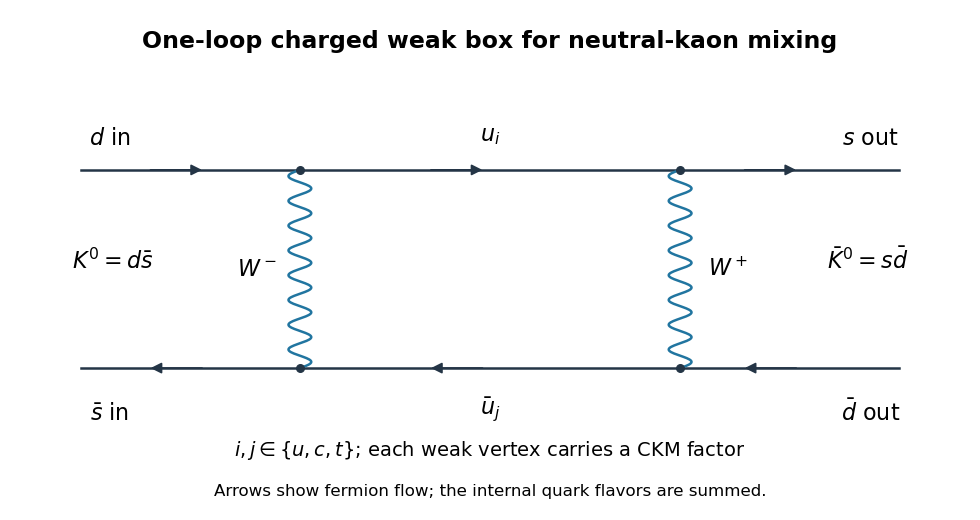

Each charged-current vertex contains the appropriate CKM matrix element. The flavor sum has combinations , with , multiplying mass-dependent loop functions. CKM matrix unitarity gives , illustrating the GIM cancellation of flavor-independent loop terms. The diagram is at order and second order in the weak interaction.
Let be the antiunitary CPT operator. It interchanges the neutral-kaon flavor states up to phases. For a Hermitian Hamiltonian invariant under CPT,since the diagonal expectation is real. Therefore CPT gives . More generally an effective decay Hamiltonian has , where both and are Hermitian. CPT gives and , hence the same equality of the complex diagonal entries. It does not require ; that is a CP condition. Nor is true for the full decay matrix in general.
Choose the CP convention and . Then CP acts as on the flavor basis. Invariance of means , and thereforeWith a different flavor-state phase convention this relation carries the corresponding phase factors; equality is the relation in the convention adopted here. For a Hermitian mass matrix it makes the off-diagonal element real.
For the requested production-time mass eigenstates, discard the absorptive part. From now on denotes the Hermitian part , so its entries have the formIf the original matrix already was Hermitian no replacement is needed. The neutral-kaon mass matrix diagonalization gives eigenvalues , since . Write , . Use the kaon mixing square-root branch conventioncontinuously from the CP-conserving convention in which . Independent unrelated root signs would interchange the eigenvalue labels. Direct multiplication gives and . Assigning the larger mass to giveswith mass shifts and respectively. A common strong-interaction mass may simply be added to both. Their norms are one and their inner product is zero. A Hermitian mass-only calculation determines the lighter and heavier combinations; it does not determine their different lifetimes.
In the CP-conserving limit, the chosen lighter and heavier combinations areThey are CP eigenstates with eigenvalues and in the convention above. The sign of the real off-diagonal entry and the flavor-state convention are chosen together so that the stated limit is the lower-mass state.
Changing to this CP basis givesConsequently, provided , defineAbsorbing the common phase of into the definitions of the mass eigenstates and normalizing now yieldsFor this Hermitian approximation, is purely imaginary, so . The phase convention matters for the kaon CP mixing parameter. Physical kaon decay eigenstates instead diagonalize the generally non-Hermitian matrix , for which the mixing parameter can have a real part and the eigenstates need not be orthogonal. The formula here is the requested mass-only result, not a calculation of that full decay dynamics.
Articles by others on the same topic
There are currently no matching articles.