For the optical trap, use the trap-frame coordinate and the force-induced speed . Then . The particle first enters the support at and exits at . Thus the actual support width is . The printed difference is inconsistent with those endpoints and would give zero width for the symmetric example; below use the geometrically correct .
A sufficient escape condition for a translating trap isFor a bounded continuous force this makes the relative velocity strictly negative and bounded away from zero, ensuring finite passage. For an ordinary smooth well, a root of met from the incident side instead prevents passage: the trajectory approaches a trap-frame equilibrium. At the limiting maximum-speed equality, the passage time can diverge. Under the strict condition, passage through a translating optical trap givesThe time is the support-crossing time; gaps where the force vanishes inside that interval are included.
There is an essential qualification to the direction claim. Compact support of alone does not imply positive displacement. For example, throughout the support gives and satisfies the strict passing condition. A smooth negative bump is also a counterexample. The intended optical trap is a localized conservative well with and equal outside potential values. This additional assumption gives . NowIt is strictly positive for a nonzero force on a set of positive measure. This is forward displacement from a translating localized potential. During motion in the trap direction, the relative passage is slower, so the positive-force side acts longer; opposite motion speeds passage through the negative-force side. A complementary energy argument makes the sign transparent:The moving well must supply the viscous energy loss.
For the high-speed passage expansion of a localized trap, require . Expanding the denominator uniformly givesTherefore the localized conservative well hasFor a symmetric well the force is odd, the cubic moment vanishes, and the displacement remainder improves to . For an arbitrary compact force without equal outside potential levels, its signed area instead gives the leading displacement.
For circular motion, let and use the local arclength model, with nonoverlapping support . In each encounter the relative position traverses , while the particle advances . Outside the support the particle is stationary and the trap must traverse the remaining relative arclength . Hence the time between kicks and the repeated kicks from a circular optical trap response areThe last equality uses the single-passage identity. Equivalently, kicks arrive at the relative lap frequency .
The precise small-correction condition for the large-speed approximation for circular-trap kicks is . A sufficient high-speed regime for a localized well is , with fixed: writing , the positive-displacement integral bounds . ThusThe locally straight force profile on a real circular track also presumes a trap width small relative to the radius; supplies the particle-size part of that approximation.
For the triangular optical-trap response, put , and . In the passing regime , the two constant-force halves giveSubstitution into the circular formula yieldsFor , the particle remains locked to the trap and . At the ideal triangular cusp this is understood as sticking, or as the limit of a rounded well; it is not a finite passing kick. The passing branch tends continuously to one at , while at large it behaves as . The zero-speed limiting response is zero. These branches apply to separated kicks, .
For the elastic filament, apply a variation . Two integration by parts operations giveAt a free endpoint both and are arbitrary. The free-end bending boundary conditions and the unloaded Euler-Lagrange equation are thereforeHere is the bending moment and the transverse shear-force convention. The equilibrium shapes are affine, reflecting free translation and tilt.
On define on functions obeying those endpoints. The self-adjoint endpoint conditions for filament bending annul the boundary formThis proves symmetry. To establish actual self-adjointness, the adjoint-domain boundary form must vanish for every free-end . The endpoint values can be varied independently, forcing at both ends. The regular fourth-order expression then gives the same domain for the adjoint. Thus the domains coincide and is self-adjoint. Also .
A positive-eigenvalue normal mode satisfies . Solving the constant-coefficient equation gives the sine, cosine, hyperbolic sine and hyperbolic cosine family. To avoid confusing modal coefficients with the filament bending modulus, write those coefficients as .
The free conditions at zero require and . With , the remaining conditions areIts determinant is . Therefore the free-free bending spectrum isA convenient corresponding eigenfunction iswhere gives unit norm. The stable characteristic equation for free-free bending modes is . Intersections or numerical bracketing giveFor the entire positive sequence, let . Expanding near its zero and using givesThere are also two zero-energy filament modes, not captured by substituting into the finite-coefficient trigonometric expression. Solving with free endpoints gives the affine kernel. An orthonormal basis of that kernel isThe positive normal modes are orthogonal to both. Including these two rigid-motion modes is essential for completeness; the regular self-adjoint operator on a finite interval has a complete discrete eigenbasis.
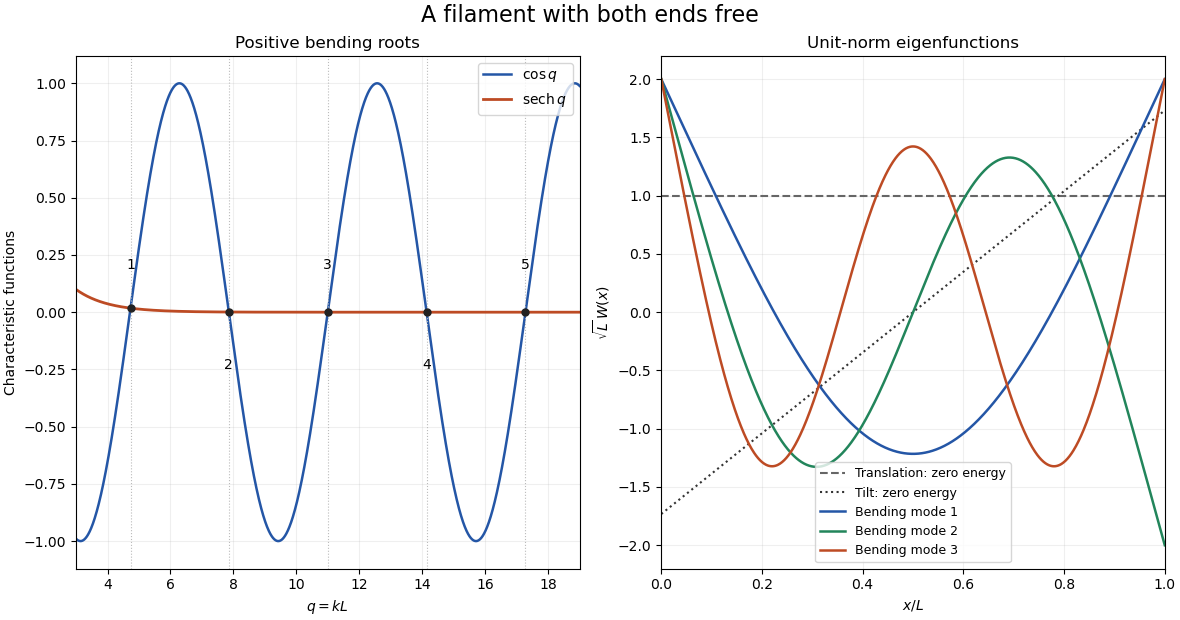

Choose real normalized eigenfunctions, including the two zero-energy filament modes. The expansion isIntegration by parts with the natural endpoints gives . HenceFor each positive mode, the equipartition theorem givesDistinct modal amplitudes are independent centered Gaussian random variables in the canonical bending ensemble.
The rigid translation and tilt amplitudes have no energy cost. Their integrals in the canonical ensemble are unbounded, so a completely free filament has no normalizable equilibrium height distribution and no finite height variance determined by this energy alone. This is a physical qualification of the requested variance, not a reason to omit the bending fluctuations.
Fixing translation and tilt, for example by imposing , leaves the rigid-motion-projected thermal covariance of a free filament:For unnormalized modes, divide each summand by . Any prescribed independent variance of the two rigid amplitudes must be added separately; equipartition theorem does not assign it.
The free-filament variance with fixed translation and tilt also has a closed form. Integrate a white noise curvature field twice, and subtract its affine least-squares projection. With , , the dimensionless kernel isIt has zero mean and first spatial moment, while its second derivative is the delta source. Since the covariance is , integrate its squared kernel to obtainThis conditional profile is symmetric about the midpoint: , with endpoint value and midpoint value . It refers to removing the free rigid motion, not to clamping either end.
The functional derivative is , so the overdamped filament bending equation is with the free-end conditions from (a). Expand the initial shape in the complete orthonormal basis:The overdamped relaxation of a free filament isEach bending mode relaxes on time ; the two zero modes remain constant. Consequently the long-time shape is the affine projection of ,The total displacement and its first moment are conserved: integrate and , using at the ends. This also checks why the final affine part cannot generally be set to zero. The series defines the solution for arbitrary square-integrable initial data; a classical solution at time zero additionally requires compatible boundary values.
Adding the two homogeneous reaction rates gives , so the unique positive Brusselator equilibrium isThe reaction Jacobian matrix at that state isA real two-dimensional linear system has strict asymptotic stability exactly when and : the eigenvalues solve . Real eigenvalues then have positive product and negative sum; a complex conjugate pair has real part . Conversely, stable eigenvalues require those signs.
Since , the Brusselator is homogeneously stable precisely forAt , the linear eigenvalues are , so strict decay is lost through a homogeneous Hopf bifurcation threshold. For larger the equilibrium is unstable. The source's matrix label is here written to distinguish it from the filament modulus in the preceding question.
For linear stability analysis of a general stable two-species reaction–diffusion system, take Fourier modes proportional to . Their matrix is . Put , , and . ThenThe full system is stable precisely when and for every allowed mode. If the homogeneous state is stable, the trace already decreases with ; only the determinant can change sign. If , its minimum for is at zero. If , it is at . Thus the two-species Turing criterion for instability on a continuum of wavenumbers isStrict stability has together with the homogeneous conditions. Equality at positive marks a stationary neutral mode. At that first onset,Beyond threshold, the growing band lies between the positive roots , as long as the homogeneous trace stays negative.
For the Brusselator, . Write . The stationary determinant threshold gives the Turing threshold of the Brusselator in dimensional diffusivities:For this to be a genuine diffusion-driven loss of stability, it must occur before the homogeneous Hopf bifurcation threshold. The Brusselator Turing-before-Hopf diffusivity condition isIndeed is equivalent to . With this strict inequality, contains a spatially unstable but homogeneously stable interval. If the ratio condition fails, the first linear instability as increases is homogeneous at , rather than a Turing instability; equality gives simultaneous neutral homogeneous and finite-wavenumber modes. Equal diffusivities cannot produce a Turing instability.
These continuum formulas assume the onset wavenumber is available. On a finite domain with a specified discrete mode set, the discrete-mode Turing threshold for the Brusselator isprovided this minimum is below . The question supplies no boundary geometry, so the continuous-mode onset above is the usual answer; this last expression states how a finite-size restriction changes it.
Articles by others on the same topic
There are currently no matching articles.