We take algebras to be unital and modules to be unital. A finite-dimensional semisimple algebra over the complex numbers is one whose regular left module is a semisimple module, that is, a direct sum of simple modules. We use the basic finite-dimensional equivalences: this is equivalent to a zero Jacobson radical, and the Jacobson radical of any finite-dimensional algebra is a nilpotent ideal.
The Artin–Wedderburn theorem here says that there are positive integers withThe nonisomorphic simple modules are the standard column modules of the factors, of dimensions , and the factor sizes are unique up to reordering.
Here is a proof. Decompose the regular left module as with pairwise nonisomorphic simple modules . These are all the simple modules: any simple module is generated by a nonzero vector and is therefore a quotient of the regular module. The Schur lemma gives for and . For the latter assertion, an endomorphism has an eigenvalue over , and the kernel of its difference from that scalar is a nonzero submodule, hence the whole simple module. ConsequentlyEvery regular-module endomorphism is right multiplication by its value at , so . Taking opposite algebras and using matrix transposition gives the asserted decomposition with .
For a matrix algebra , the matrix units show that its only simple module is : the spaces are isomorphic through , and a nonzero vector in one of them generates one copy of the column module. Simplicity makes that copy all of . In a product algebra, the mutually orthogonal central idempotents decompose every module into its factor modules; a simple module uses exactly one factor. This proves the module assertion and also uniqueness, since the primitive central idempotents and the dimensions of their simple modules determine the factors.
Assume first that , as required for the irreducible-module conclusion. If is surjective, any nonzero invariant subspace contains every image of one of its nonzero vectors under all endomorphisms, hence is all of . Thus is irreducible.
Conversely an irreducible -module is finite dimensional: for , is a quotient of the finite-dimensional vector space . Let be the image of in . It acts faithfully and irreducibly. The subspace is a submodule, so is zero or all of . The latter alternative would imply for every , contradicting nilpotence of the Jacobson radical. Therefore , and faithfulness gives .
The Artin–Wedderburn theorem makes a product of matrix algebras. A faithful simple module forces there to be just one factor, because all other factors would annihilate that module. Thus and , so the action is the full endomorphism algebra. This is the Burnside matrix-algebra theorem.
For nonzero , surjectivity is equivalent to irreducibility. The zero module is a literal exception if it is admitted: its endomorphism algebra is zero, so the action map is surjective, whereas the zero module is not irreducible.
Maschke's theorem makes the group algebra semisimple, since is a finite group and the ground field has characteristic zero. By the Artin–Wedderburn theorem, write . Its simple modules give exactly the nonisomorphic irreducible complex group representations.
The center of each matrix algebra consists of scalar matrices, so . On the other hand, an element is central precisely when its coefficients are constant on conjugacy classes. The sums of the elements in the separate conjugacy classes are therefore a basis of the center. Hence the number of irreducible complex representations equals the number of conjugacy classes.
For an integer tuple , the monomial alternant isNegative exponents require nonzero coordinates; all exponents in the character expansion below are nonnegative. The power-sum symmetric polynomial is . Put , so is the Vandermonde determinant.
Let a conjugacy class of have cycles of length , with , and put . The product is an alternating polynomial homogeneous of degree . In an alternating polynomial, a monomial with two equal exponents has zero coefficient, since interchanging those variables fixes the monomial and reverses its sign. Grouping the remaining monomials by their permutation orbits gives a unique expansion in alternants with .
Such tuples of the indicated total degree are exactly for partitions of an integer of with at most parts. Define the class functionThe displayed monomial occurs with coefficient in and in no other ordered alternant, soThis proves the expansion and explicitly defines its coefficients. They depend only on the cycle counts and hence are class functions. Identifying these coefficients with Specht module characters is the Frobenius alternant character formula, which the remaining parts allow us to assume.
Take and , so . A transposition in has one singleton cycle and one two-cycle. The Frobenius alternant character formula therefore givesIn the coordinate permutation representation on , a transposition fixes one basis vector, so its character is . This representation is the direct sum of the invariant line of constant vectors and the standard representation of the symmetric group, whose vectors have coordinate sum zero. Subtracting the trivial character gives , as required.
The Young permutation module has a basis of tabloids, equivalently ordered row sets of sizes . A tabloid is fixed by precisely when every cycle of lies entirely in one row. Assigning a length- cycle to row contributes . Distinct cycles can be assigned independently, so the character isPadding to variables with zero row sizes gives exactly the same coefficient. Explicitly, the character of a Young permutation module isHere counts the length- cycles assigned to row . Rows remain distinguished even when their sizes are equal, so there is no further division by permutations of equal rows.
For a Young tableau , let permute the entries within its rows and within its columns. We use the Young symmetrizer conventionReversing the order gives another usual realization of the same irreducible polynomial module. On the tensor power , the actions areThey commute because applying to every factor commutes with permuting the factors.
We state the permitted combinatorial input explicitly. A Young symmetrizer satisfies , where is the nonzero hook product of a partition. Thus is a primitive idempotent. The standard-tableau decomposition of the right regular module is . Tensor this right-module direct sum with the left module . The map sending to is an isomorphism, with inverse . Therefore the Young-symmetrizer tensor decomposition isThis is a direct sum of -modules; individual summands need not be -invariant.
We also state the allowed Schur algebra result, namely Schur–Weyl duality: the two actions are mutual commutants, andwhere the are pairwise nonisomorphic irreducible homogeneous polynomial representations of degree . We also use the standard Schur algebra equivalence between its modules and homogeneous degree- polynomial representations, so these exhaust the irreducibles in that category. A primitive idempotent has one-dimensional image on and zero image on the other simple factors, so . This identifies the requested irreducibles. They classify the polynomial degree- representations in this tensor power, not all rational representations of every degree.
The length bound for a Schur module is if and only if . A column of length greater than antisymmetrizes more than vectors and gives zero. Conversely, for , fill every tensor position in row with the th basis vector of . Row symmetrization multiplies it by , and column antisymmetrization is nonzero because the vectors within each column are distinct basis vectors.
A rational representation of an algebraic group is a regular morphism into the general linear group of its representation space. For , its matrix entries belong to ; rational here permits determinant denominators but not arbitrary poles on . A one-dimensional rational character of is a Laurent polynomial with and . Comparing Laurent coefficients shows that just one monomial occurs and its coefficient is , hence for .
Restrict a one-dimensional rational character of to its diagonal torus. The same argument in several variables gives . Conjugation by permutation matrices makes all equal. On every diagonalizable invertible matrix it consequently agrees with . The allowed Zariski-density statement, and equality of regular functions on a dense subset, giveThese are the one-dimensional rational characters of the general linear group.
For complete reducibility of rational GL and SL representations, use the compact-group averaging argument. Average any positive definite Hermitian inner product over using normalized Haar measure. The orthogonal complement of an invariant subspace is then -invariant. Differentiating makes it invariant under and therefore under its complex span . The elementary unipotent matrices generate , so the complement is -invariant. This proves complete reducibility. Averaging over similarly gives complete reducibility for rational representations.
Here is an explicit rational extension from SL to GL. Decompose the representation space by the finite scalar center of into subspaces on which acts as , with and . These subspaces are invariant. For , choose with , set , and defineChanging to changes to , so the two factors cancel. It is a homomorphism, since scalar roots multiply up to the same harmless factor, and it restricts to on .
It is rational as well. Every matrix coefficient of has a polynomial representative on . Averaging that representative over the finite scalar center selects its homogeneous parts with . Substitution in the extension gives , a regular function on . Each -invariant subspace decomposes into its parts, and the extension acts on each part by a scalar times an action. Thus these subspaces are also invariant under the chosen extension. Consequently is irreducible if and only if this is irreducible. For , is trivial and the trivial extension supplies the same conclusion.
For a decreasing integer tuple , let . Then is a partition and the highest-weight classification of rational GL representations definesThis is a determinant twist of a Schur module. Every irreducible rational representation becomes polynomial after multiplication by a sufficiently large positive determinant power, which clears all matrix-entry denominators. The polynomial degree decomposition and Schur–Weyl duality then identify it with a Schur module. Undoing the twist gives exactly one decreasing integer tuple . Distinct tuples have distinct highest torus weights, so these are the complete pairwise nonisomorphic irreducible rational representations.
The Weyl character formula specializes toIt is a symmetric Laurent polynomial in the eigenvalues. Equality extends from the dense set of diagonalizable matrices to all invertible matrices: both the character and the expression in the characteristic-polynomial coefficients are regular functions on . For a polynomial representation this also extends to every endomorphism of . For a general rational representation, the printed claim at singular endomorphisms needs this qualification: for example is undefined at a singular matrix. The displayed formula is valid on , and on all of when .
To compute the degree, set with distinct and take . For and , the leading coefficient of an exponential alternant isIndeed, expand every exponential in powers of . The first nonzero determinant uses the distinct powers ; its coefficient is the product of the two Vandermonde determinants divided by . Taking the same expansion in the denominator cancels the powers and the factors, giving the Weyl dimension formulaThis proof works for negative as well, since determinant twists have dimension one.
Every finite-dimensional rational module is completely reducible. The characters of its irreducible constituents are linearly independent: each Schur Laurent character has its highest dominant monomial with coefficient , and only lower weights besides it. In a finite relation, choose a lexicographically highest remaining weight; its coefficient must vanish, and iterate. Therefore equal characters give equal multiplicities of every irreducible constituent, proving rational modules with the same character are isomorphic.
Finally the symmetric algebra of has the formal torus characterEach factor sums the symmetric powers of a one-dimensional weight space; the exterior square has weights for . The permitted Schur identity makes this . In each fixed scalar degree there are only finitely many terms, so complete reducibility and character independence apply degree by degree without a convergence assumption. Thus the multiplicity-free symmetric-algebra model for polynomial GL representations contains each irreducible polynomial representation exactly once. The word irreducible is necessary: arbitrary reducible polynomial modules, such as two copies of the trivial module, do not each occur once in a multiplicity-free sum.
For a box of a Young diagram, its hook of a Young diagram contains that box, all boxes to its right in its row, and all boxes below it in its column. Its hook length is . The hook graph of a partition is the diagram with each box labeled by its hook length. Write for the hook product of a partition. The hook-length formula is
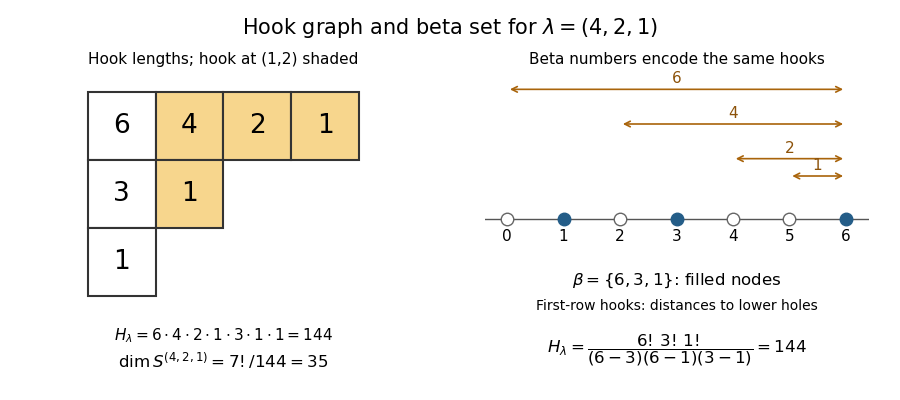

Pad to rows and use the beta set of a partition , so and , where . We prove the beta-set hook-product identity row by row. For , put ; then . The are distinct integers in , and none equals a beta number. Indeed, if then , whereas if then . Exactly beta numbers lie below , so the remaining integers in that interval are precisely these . ThereforeThis gives the equivalent Specht module dimension expression .
The standard Young tableaux of shape form the dimension count for the Specht module. The largest entry must occupy a removable corner. Deleting it bijects tableaux with the disjoint union of standard tableaux of the shapes obtained by deleting a corner, provingSet a term to zero whenever is not a partition: this includes equal adjacent rows and an attempted deletion from a zero row. The empty diagram has dimension .
For an algebraic proof that the proposed formula has the same recurrence, establish the Vandermonde shift identityIts left side is an alternating polynomial in the , because permuting the variables permutes the summands and changes the sign of every Vandermonde factor. It is therefore divisible by . The quotient is symmetric in and homogeneous of total degree one in , so has the form . At , . Differentiating in at zero and using the Euler theorem for homogeneous functions gives , so . This proves the identity as a polynomial identity, including repeated coordinates.
Take and . Since , it gives . For , this is exactlyThe summand is the proposed dimension for ; if two beta numbers collide its Vandermonde is zero, and if its coefficient is zero, so no negative factorial is needed. For the empty partition, and , giving initial value . Induction now proves the hook-length formula from the tableau recurrence.
For the final sum, tuples with repeated coordinates contribute zero. Sorting each distinct nonnegative tuple with sum gives one beta set of a partition of size , since subtracting the staircase removes from the sum. Conversely every partition of , padded to rows, supplies exactly ordered tuples, with the same squared summand. Hence the square-sum identity for shifted partition coordinates isThe middle equality uses the Artin–Wedderburn theorem for the group algebra and the complete classification of its simple modules by Specht modules. It explains why the last identity is a representation-dimension count rather than an accidental cancellation.
Articles by others on the same topic
There are currently no matching articles.