A central force has no component in the angular direction. The angular component of the acceleration in polar coordinates therefore gives , orFor unit mass, is the signed angular momentum perpendicular to the orbital plane, so its magnitude is conserved. Equivalently, the torque vanishes, which also fixes that plane.
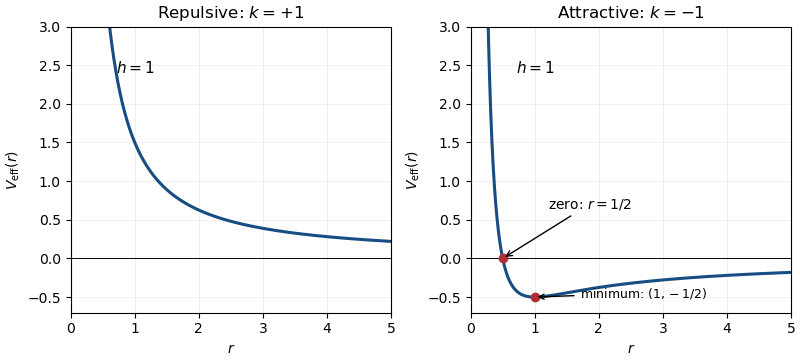
The given potential energy is , whose radial force is : positive is repulsive and negative attractive. The kinetic energy in polar coordinates is , so conservation of energy givesFor and , the effective potential is positive, strictly decreasing from to , and has no stationary point. For , it still tends to at zero, crosses zero at , and has its unique minimum atIt then approaches zero from below. The minimum corresponds to a stable circular orbit. If , the centrifugal barrier disappears; the attractive effective potential is simply and has no minimum.
Interpret projection from very far away as the asymptotic incoming state at . For and impact parameter , conservation of energy and conservation of angular momentum give and . At the closest approach the radial velocity vanishes. With , the central-force radial turning point equation isOnly the positive root is physical. Put . The pericentre distance and the purely tangential speed there areThus and : attraction bends the path inward and increases the speed. With positive energy, the Kepler orbit is a hyperbola. Measured from the pericentre direction, its polar coordinates satisfy with .
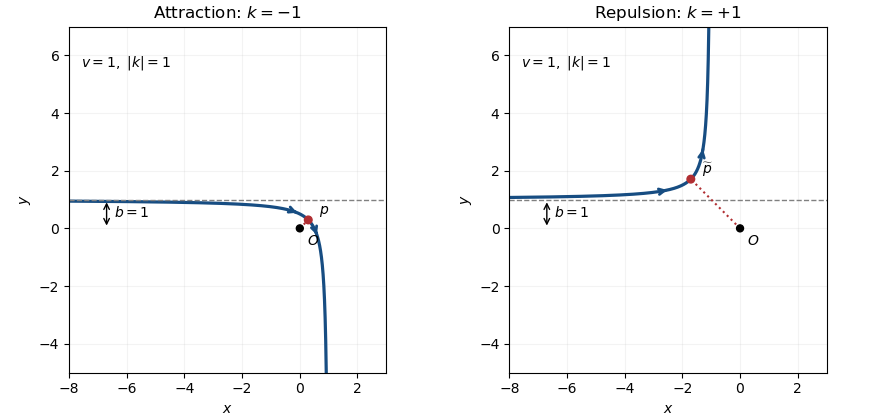
The hyperbola shown has a nonzero impact parameter. For , the attractive radial orbit instead reaches the singular origin; there is no regular turning point with a finite closest-approach speed.
For , the same asymptotic data give and . At the central-force radial turning point,The positive root and the tangential speed, again with , areFor , and . The repulsive inverse-square force bends the trajectory away from the origin, as in the right-hand sketch. Its polar equation of a repulsive inverse-square orbit is , with and measured from closest approach.
For , the regular radial turning point is and its speed is zero; the particle reverses direction there. The formula still gives zero, while its rationalized form containing should be interpreted only by a limit.
For equal in the two cases, their closest distances are conjugate roots expressed with the same . ConsequentlyAt either central-force radial turning point, the velocity is tangential and conservation of angular momentum gives . ThusThese attractive and repulsive inverse-square closest approaches pair a shorter, faster attractive passage with a longer, slower repulsive one. The speed-product conclusion assumes ; at , the attractive orbit hits the singular centre with unbounded speed, so the formal product with the repulsive zero speed is not defined.
Articles by others on the same topic
There are currently no matching articles.