The gradient of the given polynomial isIts second component vanishes when or . The first component then gives exactly three critical points:The Hessian matrix and its determinant areAt the Hessian matrix is , whose positive definiteness proves a strict local minimum by the second-derivative test. At its determinant is , so both points are saddle points of a scalar function. Their values and classifications areThere are no local maxima.
At a regular point of the optimization constraint, meaning , the necessary Lagrange multiplier condition isIndeed, every allowed tangent vector to the level set satisfies . At a constrained extremum, the directional derivative must vanish too. Thus both gradients are normal to the same tangent line and are parallel. This includes . At a singular point with , the displayed condition need not be necessary; those points require a separate examination.
For , the gradient never vanishes on the circle. The Lagrange multiplier equations areIf , the two possibilities are . If , then , and the first equation gives . Combining this with yieldsPutBoth and are positive, giving the other four points and . To classify all six, restrict to the circle by eliminating :Its derivatives are and . In the interior, and . At either endpoint ; along the circle, has a strict local minimum at the left endpoint and a strict local maximum at the right endpoint. Consequently the six constrained extrema areThe circle is a compact set, so the extreme value theorem guarantees that its global minimum and global maximum occur among these six points. Their values give the corrected sharp boundThe printed lower bound is false. A particularly short counterexample isThe sole local minimum in part (a), , has value , larger than values on this circle; it is therefore not a global minimum. In fact , so has no global minimum on the plane.
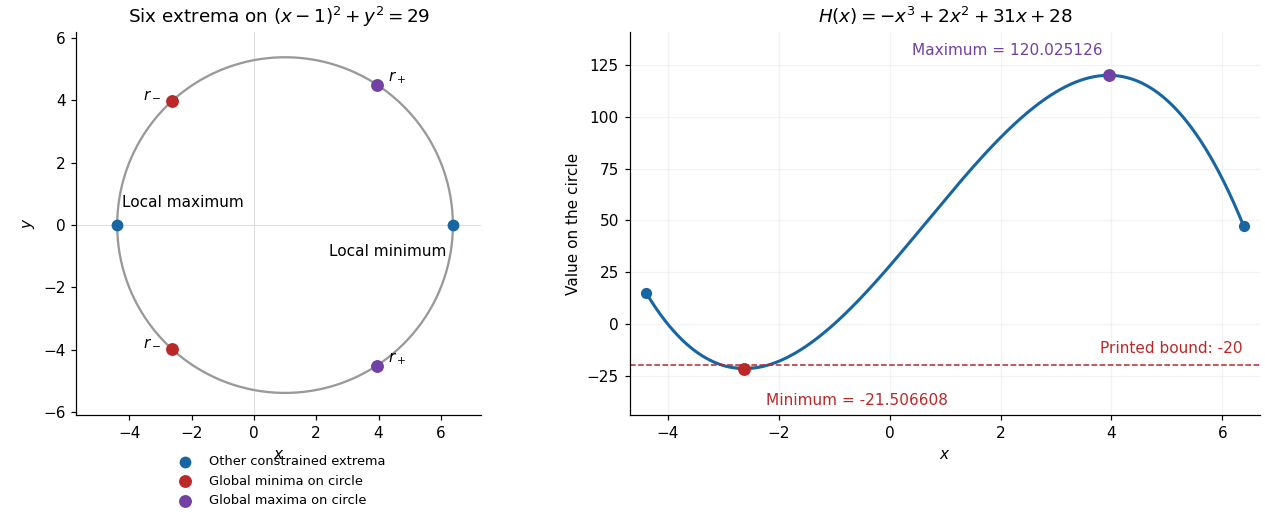
All six extrema on the constraint circle and the corrected minimum of the restricted polynomial
. Details. 
Articles by others on the same topic
There are currently no matching articles.