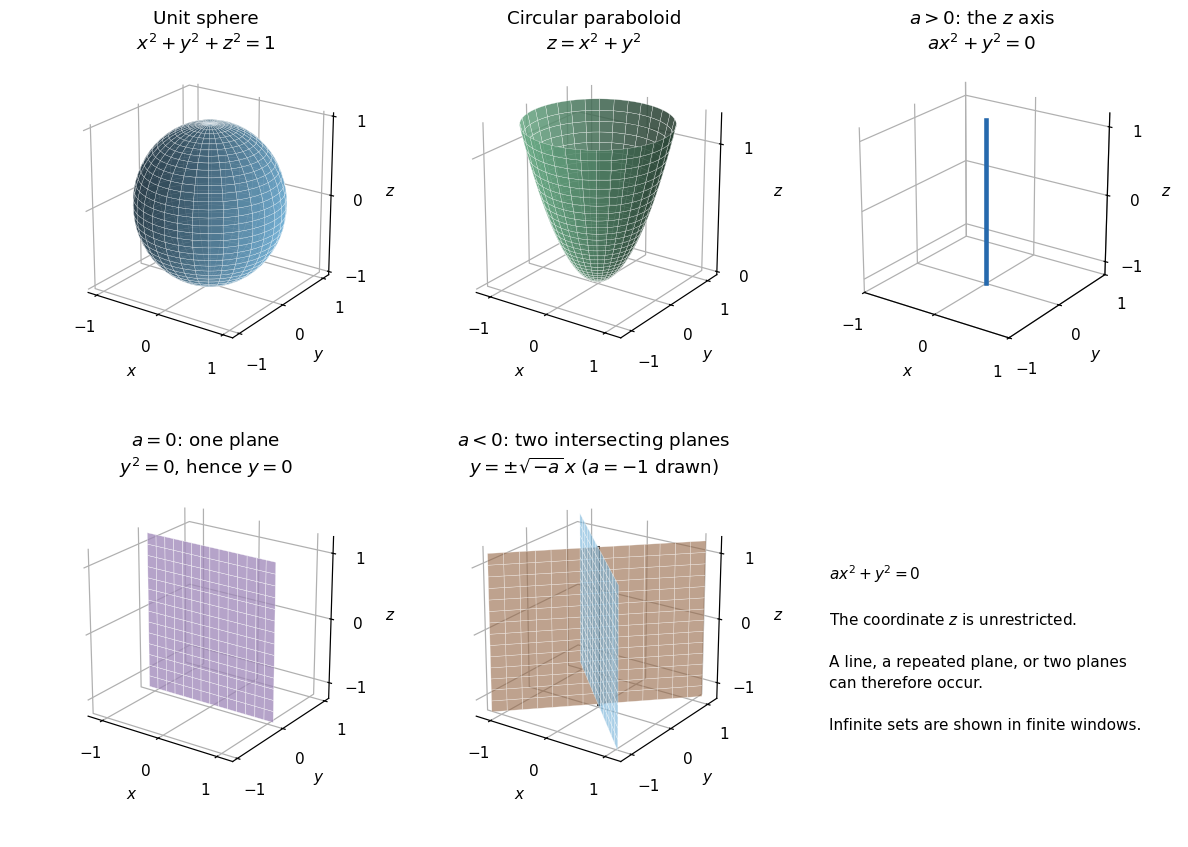
The quadric surface is the unit sphere centered at the origin. Each section , for , is a circle of radius .
The quadric surface is a circular elliptic paraboloid, opening in the positive direction with vertex at the origin. Its horizontal sections are circles of radius , and its vertical sections through the axis are parabolas.
For , is unrestricted. If , both nonnegative terms must vanish, so the locus is the axis, a straight line. If , it is the plane , represented by the repeated factor . If , factorization givesso the locus is two distinct planes, , meeting along the axis. These are degenerate quadrics, not ordinary curved cylinders.

Choose the rotated Cartesian coordinatesTheir inverse is , . Consequently and , giving the canonical form of a quadricThe orthogonal diagonalization identifies the eigenvalues of the symmetric matrix of the quadratic form.
For , all three coefficients are positive: the surface is an ellipsoid with semiaxes . At it is a sphere.
For , the equation is , an elliptic cylinder parallel to the axis. For , it is , an elliptic cylinder parallel to the axis. The absent coordinate is unrestricted; its disappearance does not turn the surface into an ellipse.
For , the negative coefficient is that of : this is a one-sheet hyperboloid with axis . For , the negative coefficient is that of : it is a one-sheet hyperboloid with axis . This gives the signature transition from an ellipsoid to an elliptic cylinder and a one-sheet hyperboloid, including both transition values.
Write . Restriction to the plane givesThis is an equation of degree at most two in two Cartesian coordinates, the general algebraic form of a conic, with possible degenerate conics and an empty set of real points. No determinant hypothesis is needed for this substitution.
For an arbitrary plane, choose a point and an orthonormal basis of its direction linear subspace. Put and , where . With , the symmetric part of a matrix, the restricted equation isThis proves the plane-section result whenever “conic” allows the appropriate degeneracies. A rigid motion taking the chosen plane to gives the same argument.
The source's assumption does not guarantee a nondegenerate conic. Even with and , the section is a single point, and has no real points. With the nonsingular symmetric matrix giving , the section is the repeated straight line .
There is a further literal omission: the source does not assume is symmetric. Forone has but . Thus the section is the entire plane, rather than a conic. Only controls the quadratic form; invertibility of an arbitrary cannot remove this exception. If the intended hypothesis is that is symmetric and nonsingular, the quadratic restriction to a plane cannot vanish identically: otherwise , so would map a two-dimensional linear subspace injectively into its one-dimensional orthogonal complement, which is impossible. Degenerate and empty sections still remain possible.
Articles by others on the same topic
There are currently no matching articles.