An matrix is diagonalizable over a chosen field exactly when it has a basis of linearly independent eigenvectors. Equivalently, is diagonal for some invertible . Distinct eigenvalues suffice but are not necessary. For example,is not diagonalizable: its only eigenvalue is and its eigenspace is the one-dimensional span of . It is a nontrivial Jordan block.
A Hermitian matrix satisfies , where the dagger denotes conjugate transpose. If with , thenThe denominator is positive real, soFor and , Hermiticity also givesThusThis is the necessary qualification to the PDF's orthogonality wording: arbitrary eigenvectors belonging to a repeated eigenvalue need not be orthogonal. Within each repeated eigenspace, Gram-Schmidt orthogonalization produces an orthonormal basis; together the eigenspaces give an orthonormal eigenbasis by the finite-dimensional spectral theorem. For example, and are nonorthogonal eigenvectors of the identity matrix.
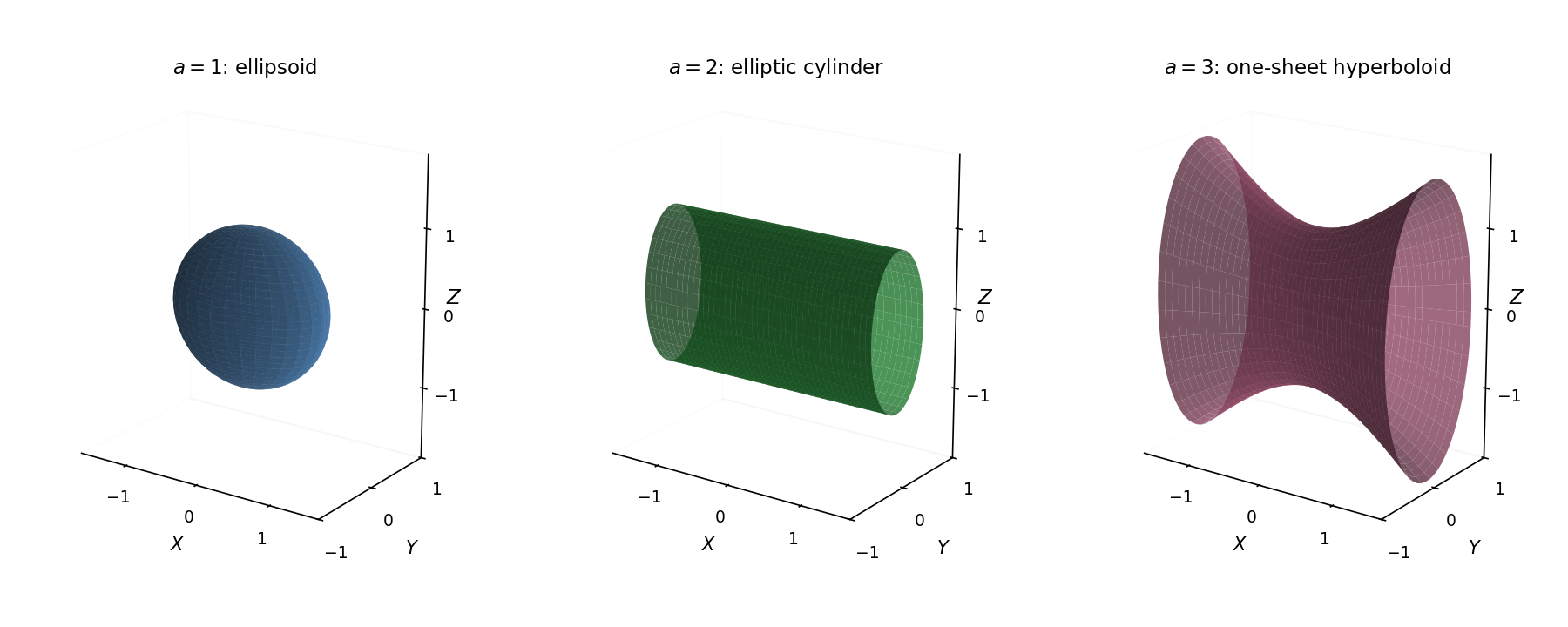
The block has characteristic polynomial . A convenient orthonormal eigenbasis for the full real symmetric matrix iswith eigenvalues , , and , respectively. Hence its orthogonal diagonalization isFor repeated eigenvalues, every nonzero combination within the corresponding eigenspace is also an eigenvector; the displayed basis remains valid. Introduce principal axes coordinatesThe quadratic form becomesThe principal-axis reduction of a quadric therefore has three regimes.
For , all coefficients are positive: the surface is an ellipsoid centred at the origin, withFor , the term disappears. The surface is an elliptic cylinder, unbounded along , whose cross-section is :For , there is one negative coefficient, so the surface is a one-sheet hyperboloid:Its waist at is an ellipse with semiaxes and . At other , both waist radii are multiplied by . There is no intercept on its longitudinal axis. Its asymptotic cone is . If positive eigenvalues coincide, the corresponding choice of principal axes is not unique, reflecting a rotational symmetry of the surface.

Articles by others on the same topic
There are currently no matching articles.