Use the bead angles as generalized coordinates. The straight-line spring length between two beads follows from the law of cosines:The hoop is horizontal, so the gravitational potential energy is constant and can be omitted. The kinetic energy is , giving the LagrangianAt , every spring has its natural length, so the potential energy is zero and its first derivatives vanish. This is an equilibrium for every constant . It is stable against relative displacement because each spring energy is nonnegative; the overall rotation is a neutral direction.
Put . Differentiating the spring length givesThe springs are unextended at equilibrium, so the quadratic potential energy contains only the squares of these first-order extensions:The linearized Euler-Lagrange equations are thereforeThe stiffness matrix is . Its eigenvector has zero eigenvalue, and every vector whose components sum to zero has eigenvalue . One convenient orthonormal set of normal modes isAny orthonormal basis of the sum-zero plane is equally valid for the two degenerate normal modes. The general small motion isThe linear drift in the zero mode describes a slow uniform rotation. These are angular frequencies; the ordinary frequencies of the two vibrational modes are .
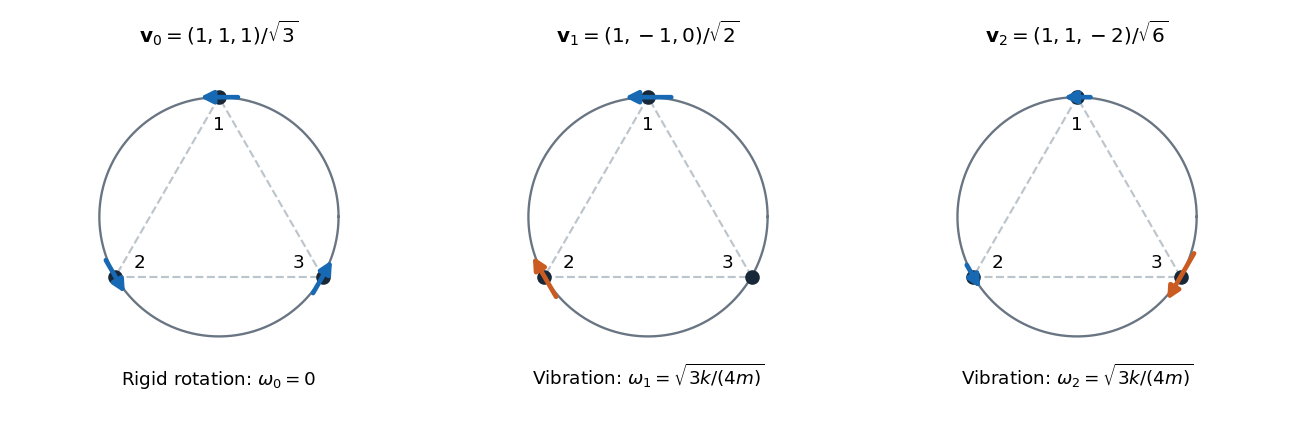

A common shift of all three angles leaves every spring length unchanged. This continuous rotational symmetry gives the zero mode: there is no restoring force against rigid rotation.
The equilateral equilibrium also has the dihedral group symmetry . Its action on the three angular displacements preserves the uniform one-dimensional subspace and the two-dimensional sum-zero subspace. The latter is an irreducible representation over the real numbers; a reflection may reverse all angular signs as well as exchange bead labels, which does not change these invariant subspaces. The symmetric stiffness matrix must act as a scalar on the sum-zero subspace, explaining the equal vibrational angular frequencies. Directly, each sum-zero vector satisfies . This is an example of degenerate normal modes from permutation symmetry, and of normal modes of three equal masses with a symmetric gap potential.
Articles by others on the same topic
There are currently no matching articles.