Substitution into the diffusive flux givesThe continuity equation for this drift-diffusion equation with a potential therefore reduces, after cancelling the nonzero exponential, toThe reflecting boundary conditions become at both endpoints. Thus each solution of this eigenvalue problem supplies a separated solution of the original diffusion equation.
The product rule makes the drift term cancel:Consequently the transformed eigenvalue problem isBoth and the weight are positive, as required for this Sturm-Liouville problem.
For sufficiently smooth functions satisfying the same boundary conditions, integration by parts gives the boundary formThe stated endpoint relation annihilates this expression. This proves the required self-adjoint differential operator identity; for the usual regular Sturm-Liouville problem, separated real boundary conditions give a self-adjoint realization on its domain.
In this problem the transformed diffusive flux is . Thus the physical boundary conditions areequivalently when the endpoint values of are positive. In particular at the endpoints, which makes the boundary form vanish directly. The inner product used here is the ordinary integral; the weight enters the generalized eigenvalue problem, not this boundary-form calculation.
Apply the identity from (c) to the two real eigenfunctions. The equations of their Sturm-Liouville problem giveSince the eigenvalues differ,This is orthogonality in the weighted inner product.
For an admissible nonzero real trial function, integration by parts and the zero-flux boundary conditions reduce the Rayleigh quotient toA nonzero constant trial function attains zero. Positivity of also shows that equality requires . HenceIf the conserved total amount is , the normalized stationary solution isIts diffusive flux vanishes everywhere. The Boltzmann distribution fixes the spatial profile, while the diffusivity affects the relaxation toward it. Boundedness of makes the normalization finite on this finite interval.
For the harmonic extension in a circular sector, write a separated harmonic function as . The Laplace equation in polar coordinates yieldsThe angular Dirichlet boundary conditions select the Fourier sine basisIndeed, the angular equation has no nonzero solution with nonpositive : multiplying by and integrating gives . The radial Cauchy-Euler equation has solutions and . Boundedness at the vertex excludes the latter, so superposition gives
The Fourier orthogonality relation on this angular interval isProjecting the outer boundary condition onto each angular eigenfunction givesThe solution is unique in the class of bounded harmonic functions with the prescribed boundary trace. For continuous boundary data, the difference of two solutions is zero on the boundary and bounded at the vertex, so the maximum principle for harmonic functions makes it zero throughout the sector. Equivalently all its Fourier sine series coefficients vanish. The usual convergence interpretation applies if the data are only piecewise smooth.
Reflecting the solution across preserves its Dirichlet boundary conditions and outer boundary data, so uniqueness makes the solution reflection-symmetric. Sinceonly odd angular Fourier modes survive. Put and . On the symmetry axis , comparison of the convergent power series givesThusThis is the imaginary part of , so a useful closed form isAt either straight edge , while on the symmetry axis the formula is . Every term is harmonic in the sector, and the factorial denominator gives convergence up to , verifying the full solution.
A fundamental solution of the Laplace equation satisfies in the sense of distributions, without a boundary condition. Choose it rotationally symmetric about the source. Away from the source, with , the radial Laplace equation is , giving .
Integrating over a small disc around the source and using the divergence theorem fixes the normalization:ThereforeThe additive constant is arbitrary; adding other entire harmonic functions is also possible if rotational symmetry is not imposed. The positive sign here follows from the convention .
The Dirichlet Green function is the solution, with the source point held fixed, ofIts singularity is the logarithmic one found in (a); subtracting that fundamental solution leaves a harmonic function. An unbounded region also requires a condition at infinity, here boundedness.
Green's second identity, with the outward normal derivative, isSet and , interpreting the logarithmic singularity by a small excised disc or distribution theory. The volume integral is because and . On the boundary and , leavingFor the exterior problem below, apply the identity first in a large truncated region. For bounded harmonic functions the extra circle at infinity contributes zero: tends to a constant, its radial derivative is , and a bounded exterior harmonic function also has radial derivative . This is the condition under which the same boundary representation applies there.
Let and . For , expanding both squared Euclidean distances givesTaking nonnegative square roots provesThis is the distance identity behind inversion in a circle and the method of images for a circular boundary.
For a source in the exterior, its inverse point lies strictly inside the excluded disc. The method of images construction of the bounded exterior disk Green function therefore allows an opposite logarithmic source there without adding a singularity to the domain. The candidate Dirichlet Green function isIts Laplacian in the exterior is exactly , since the image singularity is outside that domain. The identity in (d) makes on the unit circle. Moreoverso it obeys the required boundedness condition. These checks establish the stated logarithm-of-a-ratio expression with . Bounded exterior Dirichlet uniqueness for the Poisson equation follows by inversion in a circle and removal of the bounded singularity at the origin.
The outward normal of the exterior region points into the excluded disc, so it is on the unit circle. Differentiating the Dirichlet Green function from (e), and writing and , givesHere was used. The concentrated boundary data have unit integral, so the boundary representation evaluates this exterior Poisson kernel at . Thus the bounded solution on either part of the exterior -axis isIt is positive on both intervals, diverges as at the boundary source, and tends to as . Boundedness at infinity selects this solution; otherwise one could add an arbitrary multiple of without changing the circle's boundary data.
Write and . For a positively oriented, piecewise smooth simple closed contour bounding a region where have continuous first partial derivatives, Green's theorem givesThe Cauchy-Riemann equations are and , so both integrands vanish:This proves Cauchy's integral theorem under the standard regularity assumptions for Green's theorem. More general admissible contours follow by subdivision; every enclosed region must be free of singularities.
A simple pole at means that is holomorphic in a punctured neighbourhood and extends holomorphically to a nonzero value at . Equivalently its Laurent series begins with and has no higher negative powers. The residue isIn particular, if with , and , this becomes . The associated residue theorem isfor a positively oriented simple contour with no poles on it.
The exponential numerator is entire and never zero. The denominator vanishes precisely when , givingAt these points , so every zero of the denominator is simple and hence every singularity is a simple pole. Using the residue formula in (b),
Use the counterclockwise rectangular contour with vertices . It encloses just the simple pole , whose residue is . Let . The identitymakes the top edge, traversed right to left, contribute . On either vertical edge,Thus the sum of the vertical integrals tends to zero, with absolute value at most . The residue theorem and now giveThe argument works for every fixed real , including zero and negative values, and gives the Fourier transform of the hyperbolic secant with the convention .
Use the Fourier transform conventionThe convolution is . For integrable , Fubini's theorem and the substitution giveHence the convolution theorem is
Take the causal solution, extending the input and output by zero before the device starts at . The two zero initial conditions ensure that this extension adds no impulsive terms to the first two distributional derivatives. The Fourier transform of a derivative is multiplication by , soFactoring the quadratic and taking partial fraction decomposition yieldsThe inverse Fourier transform follows directly by integrating decaying exponentials:where is the Heaviside step function. This damped-oscillator impulse response has and , as required for a unit impulse.
The convolution theorem gives the causal responseDefine the integrated impulse response, for , byDirect differentiation gives and . ThusIn particular, after switch-off the answer isThe response and its first derivative are continuous at both switching times, and the post-pulse motion is a freely decaying damped harmonic oscillator. The expression described as valid for in the paper is understood for ; before the pulse the causal output is zero.
Use the same Fourier transform convention, now in the sense of tempered distributions, since the homogeneous oscillations are not integrable. Transforming givesSince , the two roots are distinct. A distribution annihilated by this polynomial is a linear combination of Dirac delta distributions at its roots:Fourier inversion therefore givesThe constants may be complex. Differentiating the factor also verifies that the original ordinary differential equation reduces to for .
For a Cartesian coordinate change with an orthogonal matrix, a rank- tensor obeyswith repeated indices summed according to Einstein notation. A tensor is isotropic if for every proper rotation matrix . Under proper rotations the Levi-Civita symbol is an isotropic third-rank tensor; if reflections are included, it is a pseudotensor. The convention using proper rotations is the one relevant to the rank-three classification here.
Under a proper rotation matrix , the product of coordinates transforms as a rank- tensor. The unit ball is unchanged by the substitution , whose Jacobian determinant is one. HenceThus is an isotropic tensor. An isotropic second-rank tensor has the form . Taking the trace and using spherical coordinates,Therefore the isotropic second moment of a ball isAn isotropic third-rank tensor has the form , but is symmetric in every pair of indices, forcing . Alternatively, makes its integrand odd on the ball. Thus
Choose an orthonormal basis with . A half-turn about kills all mixed axial-transverse components. Commutation with a quarter-turn makes the transverse block a scalar identity matrix plus an antisymmetric matrix. The resulting oriented-axis invariant Cartesian tensor, in coordinate-free form, iswith real constants . The Kronecker delta, the outer product , and the displayed Levi-Civita symbol contraction are invariant under every proper rotation about , so this form is also sufficient. In the chosen basis,The antisymmetric part must be retained unless further symmetry is imposed.
Decompose the electric field as , where . The electric current density isFor a nonzero real electric field, the alignment of current and field in an axisymmetric conductor gives the complete classification of collinearity:
- If , then , with no additional symmetry required.
- If , then . Within this family is exactly the condition that the conductivity tensor is symmetric; then . An additional half-turn symmetry about a transverse axis is one way to force .
- If both components are nonzero, then . These conditions give the isotropic second-rank tensor , and then for every direction.
For completeness, if and , taking the dot product with forces . The transverse equation then gives , while a nonzero axial component gives . This proves there are no missing directions. Zero current is included as the zero scalar multiple; if “parallel” requires a direction for , exclude cases where that scalar is zero. For a strictly anisotropic crystal the last possibility is absent.
An axial electric field produces , so the observation sets and imposes no restriction on the transverse or antisymmetric parts. ThusA symmetric conductivity tensor would further require , but axial rotational invariance alone does not require this.
Use the bead angles as generalized coordinates. The straight-line spring length between two beads follows from the law of cosines:The hoop is horizontal, so the gravitational potential energy is constant and can be omitted. The kinetic energy is , giving the LagrangianAt , every spring has its natural length, so the potential energy is zero and its first derivatives vanish. This is an equilibrium for every constant . It is stable against relative displacement because each spring energy is nonnegative; the overall rotation is a neutral direction.
Put . Differentiating the spring length givesThe springs are unextended at equilibrium, so the quadratic potential energy contains only the squares of these first-order extensions:The linearized Euler-Lagrange equations are thereforeThe stiffness matrix is . Its eigenvector has zero eigenvalue, and every vector whose components sum to zero has eigenvalue . One convenient orthonormal set of normal modes isAny orthonormal basis of the sum-zero plane is equally valid for the two degenerate normal modes. The general small motion isThe linear drift in the zero mode describes a slow uniform rotation. These are angular frequencies; the ordinary frequencies of the two vibrational modes are .
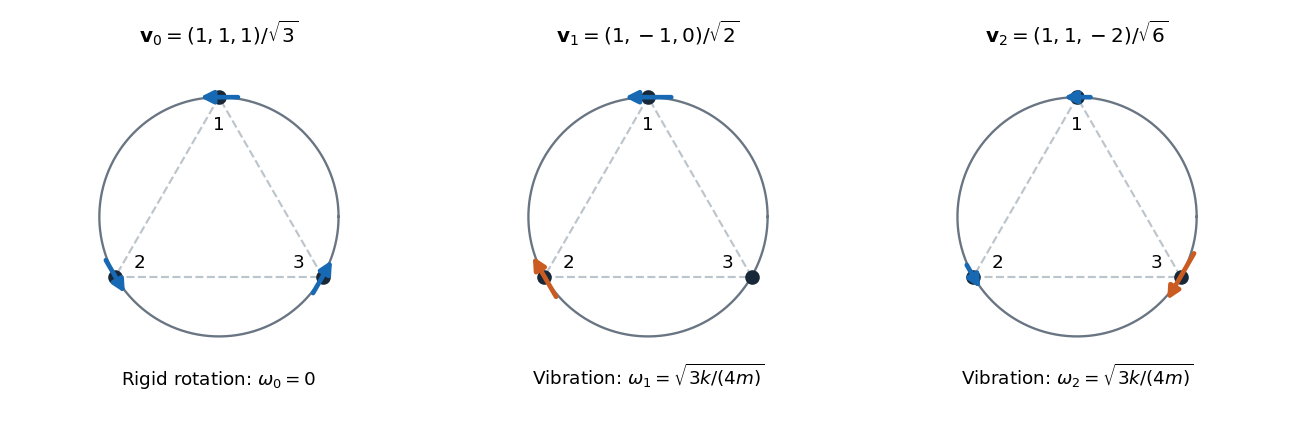

A common shift of all three angles leaves every spring length unchanged. This continuous rotational symmetry gives the zero mode: there is no restoring force against rigid rotation.
The equilateral equilibrium also has the dihedral group symmetry . Its action on the three angular displacements preserves the uniform one-dimensional subspace and the two-dimensional sum-zero subspace. The latter is an irreducible representation over the real numbers; a reflection may reverse all angular signs as well as exchange bead labels, which does not change these invariant subspaces. The symmetric stiffness matrix must act as a scalar on the sum-zero subspace, explaining the equal vibrational angular frequencies. Directly, each sum-zero vector satisfies . This is an example of degenerate normal modes from permutation symmetry, and of normal modes of three equal masses with a symmetric gap potential.
The group order is its cardinality, . The order of a group element iswhere is the identity element. In a finite group such an always exists, since two nonnegative powers of must coincide.
Lagrange's theorem states that for a subgroup of a finite group ,The left cosets of partition , and multiplication by a coset representative is a bijection from onto that coset, explaining the formula. If is prime, then is either or , so or . Thus the correct conclusion is no proper nontrivial subgroup. The trivial subgroup is proper for every group of prime order, so the wording in the question needs this qualification.
Let . The powersare distinct: equality of two with exponents between and would give a smaller positive power equal to . Reducing exponents modulo proves closure and supplies inverses, so this is a cyclic subgroup of group order . Lagrange's theorem now gives
Choose in a group of prime group order . Its order of a group element divides by (c) and is not , hence equals . Consequently its cyclic subgroup already contains all elements of :Thus every nonidentity element is a group generator.
By (d), every group of group order three is a cyclic group. Writing its elements as , every product is determined by ; the multiplication table isThe map is a bijective group homomorphism to addition modulo three. Thereforeso there is exactly one such group up to isomorphism.
Closure of the componentwise operation follows from closure in each factor. For three pairs, associativity holds coordinatewise:The identity element is and the inverse element of is . These verify all group axioms for the direct product of groups. Counting independent choices givesThe subset contains the identity and is closed under products and inverses, so it is a subgroup. For any in the product and ,Conjugation by gives the reverse inclusion, and henceThis is the definition of a normal subgroup.
Both subgroups contain the identity element, so is nonempty. If , then and , so . Similarly belongs to both subgroups and hence to their intersection. Associativity is inherited from . ThusThis verifies the group axioms; finiteness is unnecessary.
In additive notation every element obeys . Its order of a group element therefore divides four, whereas has order eight. A group isomorphism preserves element orders, soFor the second product, define the group homomorphismIt is well-defined because multiples of six are divisible by both two and three. Its kernel contains only zero: simultaneous divisibility by two and three implies divisibility by six. Thus is injective, and equal finite group orders make it surjective. Explicitly the six images areThereforeFor general positive integers , the order of a direct-product element is the least common multiple of its component orders. Hence every element order divides , while attains this order. It generates the whole product precisely when are coprime:This is the cyclicity of a product of two finite cyclic groups, with the explicit isomorphism furnished by the Chinese remainder theorem.
The center of a group contains . If lie in the center, then for every ,It is therefore closed under the group operation and inverse elements, and inherits associativity, proving it is a subgroup. Each of its elements commutes with every element of , in particular with every other central element. HenceThus the center is an abelian subgroup.
A group homomorphism preserves multiplication:It automatically sends the identity element to the identity and sends inverse elements to inverses. A group isomorphism is a bijective group homomorphism. For finite groups this requires equal group orders, and, once those orders agree, either injectivity or surjectivity of the group homomorphism is sufficient. Equal orders alone do not suffice.
Here , and , so is a cyclic group of order four. Its multiplication table isWrite the specified image of as . Direct matrix multiplication givesA group representation is a group homomorphism to a general linear group, so the images of all powers of are forced:All four images are invertible. Defining is well-defined modulo four because , and verifies every product in the table. These observations prove both existence and uniqueness of this representation with the prescribed image.
Distinguish the quaternion group generators from the complex scalar . Denote their proposed image matrices byDirect multiplication givesFor example and . Sending to and each negative quaternion element to the negative of its positive image now reproduces every quaternion product. The matrices all have determinant one and are invertible, so this is a group representation in .
The eight matrices are distinct. Therefore the group homomorphism is injective, and the representation is faithful; equivalently its kernel is .
The character of a representation is the trace of its representing matrix. ConsequentlyThese are constant on the five conjugacy classes , , , , .
The complete list of subgroups isTo see completeness, Lagrange's theorem allows only orders . The only element of order two is , which fixes the order-two subgroup. Every noncentral element has order four and generates the corresponding listed cyclic subgroup. Any order-four subgroup contains such an element, because there are only two central elements; it must equal the cyclic subgroup generated by that element. This accounts for all possibilities.
Articles by others on the same topic
There are currently no matching articles.