Use the normal boiling point as the reference, and . At ,This is approximately 0.0795 atmosphere. It uses the supplied constant enthalpy of vaporization approximation across a 60 K interval; it should not be presented as an exact tabulated vapor pressure. Absolute temperature, rather than Celsius values, belongs in the exponential.
The Young–Laplace equation is with signed principal curvatures positive for a convex liquid droplet. A wetting bridge between plates has a strongly concave meridional curvature. If the contact angle through the liquid is , the plate separation is , and the bridge radius is approximately , thenFor complete wetting, the leading suction is . The neglected azimuthal curvature is of order . A numerical pressure cannot be specified without the separation, surface tension and wetting condition. The full signed-curvature expression remains valid when the narrow-gap approximation is unsuitable.
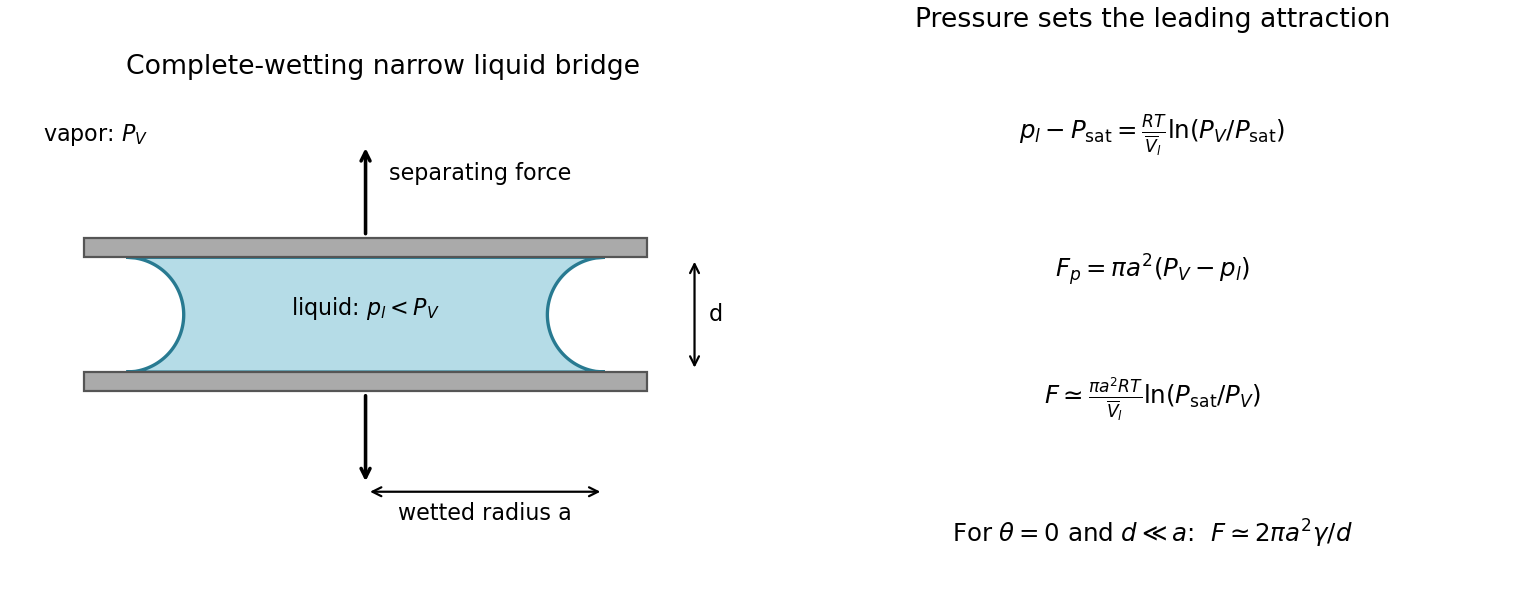

Let denote the flat-interface saturation pressure at the same temperature, the surrounding equilibrium vapor pressure, and the incompressible liquid molar volume. Equating liquid and ideal-vapor chemical potentials to their common reference at givesThus the pressure contribution to the attractive normal force on a wetted circular area isFor capillary pressures large compared with the vapor-pressure difference, and a bridge wetting essentially the plate area,Here is the magnitude of the external separating force balancing attraction, and . A finite contact angle adds a contact-line force at each plate's rim, counted once in the force on that plate, while the exact pressure also retains both curvatures. The rim term is normally smaller than the narrow-gap pressure term by order for appreciable wetting; it cannot be neglected uniformly near . For complete wetting the leading equivalent expression is . The corresponding equilibrium humidity is .
These are quasistatic, equilibrium expressions for an existing bridge, neglecting viscous suction, contact-angle hysteresis, disjoining forces and deformation of the plates. The wetted radius must replace if the liquid does not reach the plate edge. During actual separation a bridge can shrink, depin or break, so this local force balance is not a promise of a constant force for arbitrary travel.
Articles by others on the same topic
There are currently no matching articles.