In a sufficiently supersaturated vapor, making liquid lowers bulk Gibbs free energy, but making a small droplet creates a costly liquid-vapor interface. The volume contribution scales as and the interfacial cost as . Identifying a positive bulk driving force density and interfacial tension gives and . In the supplied notation,At , : this is the barrier summit. Subcritical droplets tend to shrink, whereas supercritical droplets can grow by reducing Gibbs free energy. Fluctuations must cross the barrier before bulk condensation proceeds, especially in a clean vapor without effective sites for heterogeneous nucleation. A temperature just below 100 °C implies a supersaturated vapor only with a suitable pressure, such as a vapor maintained near one atmosphere; temperature alone does not specify the driving force. The nucleation barrier can delay condensation even when bulk liquid is thermodynamically favored.
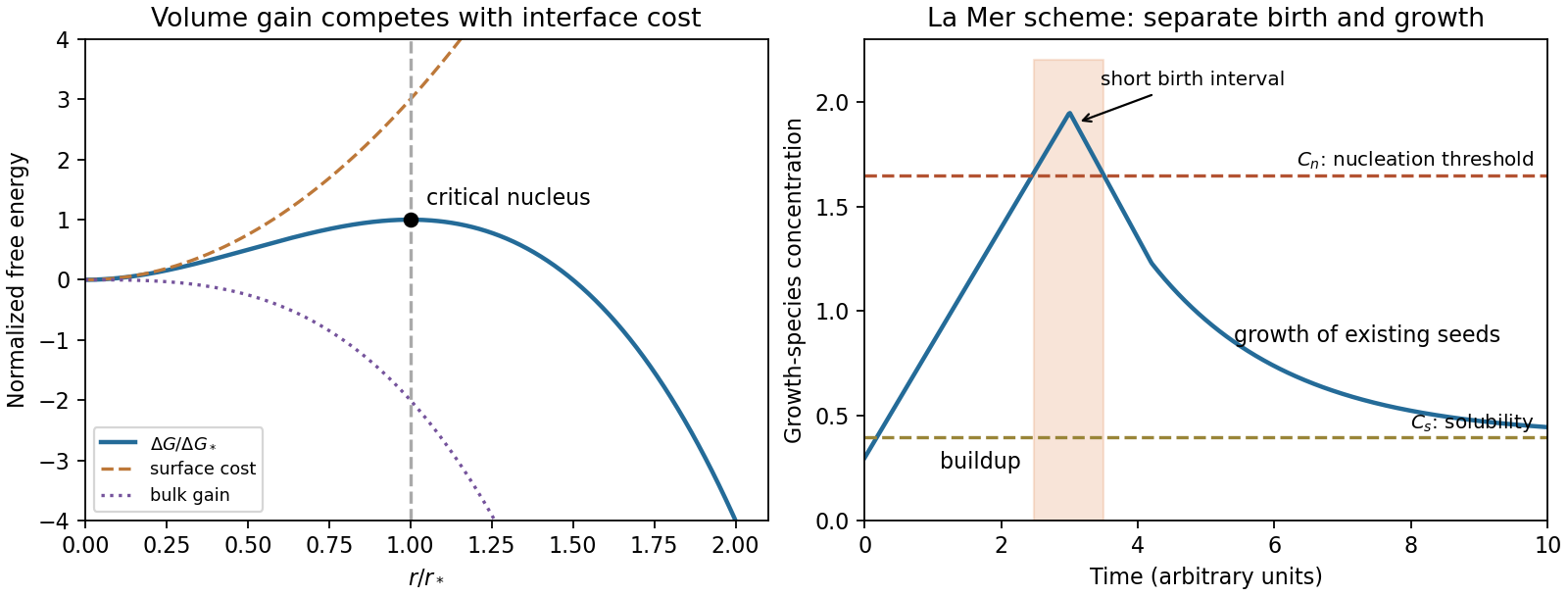
A La Mer diagram plots the concentration of growth species against time. Label the equilibrium solubility and a higher effective nucleation threshold . Generate growth species until the concentration briefly exceeds ; a short burst nucleation interval then creates seeds. Consumption brings the concentration below while leaving it above , allowing existing particles to grow without substantial continuing nucleation. Rapid mixing, a short seed-formation interval and a common growth period help produce a narrow particle size distribution. Suppress secondary nucleation and aggregation, then quench or consume the remaining growth species when the desired size is reached. The threshold is an operational kinetic scale, not a sharp new equilibrium phase boundary.
Reducing the solid-liquid interfacial tension lowers the classical barrier, which scales as at fixed supersaturation. More seeds can then form at a smaller supersaturation; at fixed total precipitated mass, more seeds generally mean a smaller mean final particle size. A narrower distribution is not guaranteed: if nucleation continues throughout growth, particles have different ages and the distribution can broaden. A brief well-separated burst and uniform subsequent growth are the controlling requirements, not low interfacial tension alone. The historical model concerns separated nucleation/growth in sulfur hydrosols, rather than a universal demonstrated mechanism for every nanoparticle synthesis.[ref]
Theory, Production and Mechanism of Formation of Monodispersed Hydrosols by Victor K. La Mer and Robert H. Dinegar. JACS 72 (1950), pp.4847–4854, model and monodisperse-hydrosol preparation
For a convex droplet, the Kelvin equation gives . Smaller droplets therefore require a higher equilibrium vapor pressure. At a common ambient vapor pressure, sufficiently small droplets evaporate while larger ones can grow, transferring material through the vapor. Ostwald ripening decreases the droplet count and increases a characteristic surviving radius. Direct collision and coalescence can also reduce the count but are a distinct mechanism. In a closed container the final state depends on total liquid/vapor inventory and volume; an initially undersaturated, liquid-poor system can lose all droplets rather than indefinitely grow a large one.
wetting liquid in narrow pores and gaps between fibers can have a concave meniscus. Its signed curvature is negative, so the Kelvin equation permits equilibrium at a vapor pressure below that above a flat liquid surface. capillary condensation in sufficiently small, wettable gaps explains moisture accumulation at high relative humidity. Increased humidity brings the vapor closer to flat-surface saturation and permits condensation in larger gaps. Surface adsorption can precede a bulk-like meniscus; large open spaces do not automatically fill at every humidity. The interpretation assumes a wetting contact geometry and does not require the entire cloth to be below the ordinary planar dew point.
The coarse texture comes from large ice crystals. Form many small crystals by rapid cooling with agitation and avoid extended storage near partial melting or repeated warming/cooling cycles. Curvature raises the chemical potential of smaller ice crystals, so material can transfer from smaller to larger crystals during recrystallization; partial melting followed by slow refreezing accelerates loss of a fine texture. A more viscous unfrozen phase and suitable stabilizing ingredients slow molecular transport and coarsening. Create small crystals quickly and suppress their subsequent growth with stable cold storage and slow transport. This applies interfacial and phase-change physics; it is not a claim that reducing droplet vapor pressure alone completely models a multicomponent frozen mixture.
Use the normal boiling point as the reference, and . At ,This is approximately 0.0795 atmosphere. It uses the supplied constant enthalpy of vaporization approximation across a 60 K interval; it should not be presented as an exact tabulated vapor pressure. Absolute temperature, rather than Celsius values, belongs in the exponential.
The Young–Laplace equation is with signed principal curvatures positive for a convex liquid droplet. A wetting bridge between plates has a strongly concave meridional curvature. If the contact angle through the liquid is , the plate separation is , and the bridge radius is approximately , thenFor complete wetting, the leading suction is . The neglected azimuthal curvature is of order . A numerical pressure cannot be specified without the separation, surface tension and wetting condition. The full signed-curvature expression remains valid when the narrow-gap approximation is unsuitable.
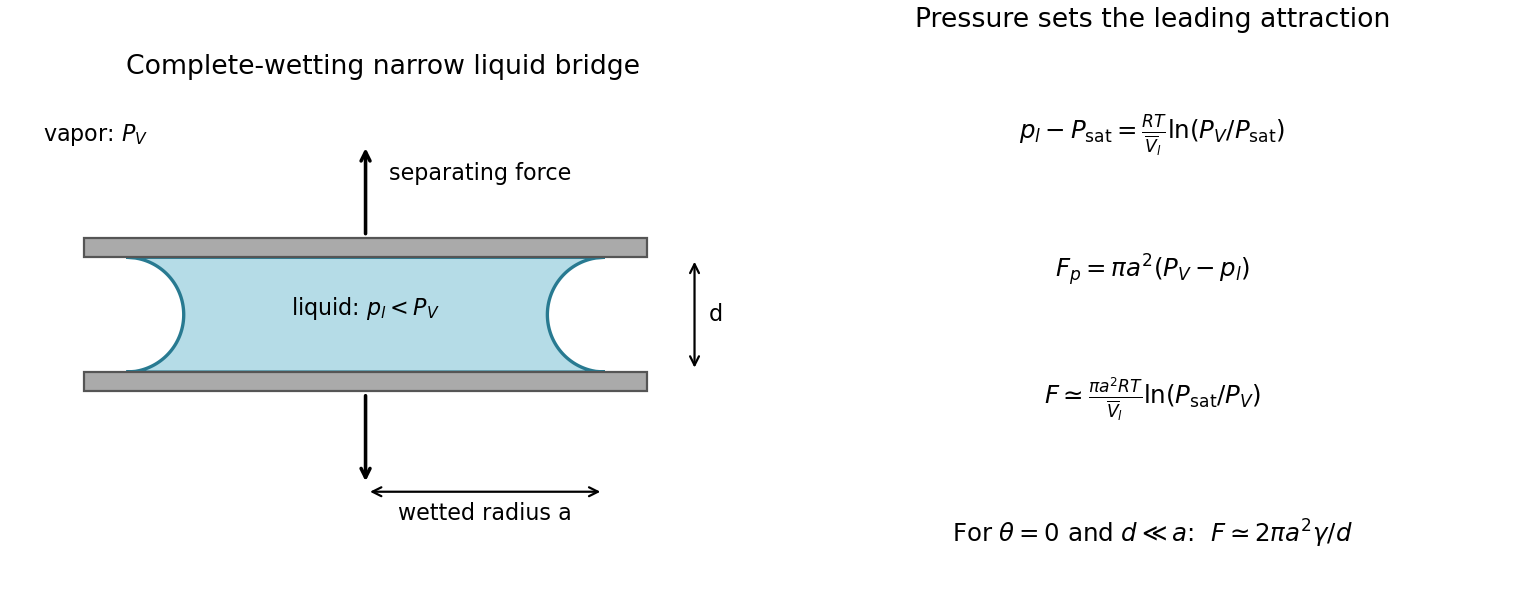


Let denote the flat-interface saturation pressure at the same temperature, the surrounding equilibrium vapor pressure, and the incompressible liquid molar volume. Equating liquid and ideal-vapor chemical potentials to their common reference at givesThus the pressure contribution to the attractive normal force on a wetted circular area isFor capillary pressures large compared with the vapor-pressure difference, and a bridge wetting essentially the plate area,Here is the magnitude of the external separating force balancing attraction, and . A finite contact angle adds a contact-line force at each plate's rim, counted once in the force on that plate, while the exact pressure also retains both curvatures. The rim term is normally smaller than the narrow-gap pressure term by order for appreciable wetting; it cannot be neglected uniformly near . For complete wetting the leading equivalent expression is . The corresponding equilibrium humidity is .
These are quasistatic, equilibrium expressions for an existing bridge, neglecting viscous suction, contact-angle hysteresis, disjoining forces and deformation of the plates. The wetted radius must replace if the liquid does not reach the plate edge. During actual separation a bridge can shrink, depin or break, so this local force balance is not a promise of a constant force for arbitrary travel.
Articles by others on the same topic
There are currently no matching articles.