Brownian motion is the fluctuating motion of a suspended particle produced by thermal molecular collisions. Using the standard Brownian displacement conventions, in a uniform fluid without external drift, mean displacement is zero but mean-square displacement grows with time. For overdamped diffusion, in one coordinate and in three dimensions, with and Stokes friction for a no-slip sphere.
Brownian transport brings nanoparticles into encounters and allows them to explore configurations during self-assembly. Reversible interactions permit rearrangement toward low-free-energy structures; interactions that are too strong can instead trap disordered aggregates. Thermal fluctuations also oppose localization in shallow traps. The symbol avoids confusing friction with an unrelated chemical potential.
For radius and gold density , . The supplied Stokes model gives and at . Therefore the standard one-second diffusive rms distances are in one coordinate and in three dimensions.
Using the source's supplied shorthand literally with instead gives . That shorthand lacks the factor two in the standard long-time mean-square displacement; it should not be identified with either of the preceding standard rms conventions. None of these rms values is a cumulative path length.
An ideal drag-free fall from rest gives . Actual gravitational settling in the assumed viscous model is much smaller: , , and displacement in one second is approximately . Thus diffusion overwhelms settling, even though ideal vacuum fall exceeds the rms diffusion distance. For rarefied-gas nanoparticle drag, at a 20-nm size in argon, continuum no-slip drag may require a rarefaction/slip correction; pressure and gas mean-free-path data are absent, so these numerical transport estimates are conditional on the supplied Stokes model.
For fluid density , speed and characteristic length , inertial kinetic energy scales as while viscous work over distance scales as . Their ratio is the Reynolds number,Smaller particles at a fixed speed have smaller Re, so viscous stresses dominate fluid inertia when . Increasing speed increases Re and eventually makes inertia more important, rather than making viscous dominance stronger.
Particle inertia is a separate issue. Its particle velocity-relaxation time is ; comparing it with a travel time gives a Stokes number . This uses particle density , whereas the fluid Reynolds number uses fluid density .
Interpreting the nominal size as diameter , fluid viscous dominance requireswith in . The liquid density is not supplied, so the conventional fluid-Reynolds crossover is not numerically fixed. As an explicitly additional illustrative assumption, gives near ; ordinary much slower nanoparticle motion is well within the viscous regime.
If instead the supplied gold density is inserted into the dimensionless ratio , that ratio reaches one at . It is not the fluid Reynolds number. Including the spherical Stokes prefactor, the particle relaxation criterion occurs at . These quantify different inertia comparisons. The wording's speed direction is reversed: viscous dominance is obtained by making speed sufficiently small. If 10 nm denotes radius, the length-based thresholds halve.
A tightly focused laser produces a strong intensity gradient. A small polarizable particle experiences a gradient force toward increasing intensity when the real polarizability has the appropriate positive sign; radiation pressure from scattering and absorption pushes predominantly along the beam. A high-numerical-aperture objective creates lateral confinement and a sufficiently strong opposing axial gradient for a three-dimensional optical trap. Equilibrium is generally shifted from the intensity maximum by radiation pressure.
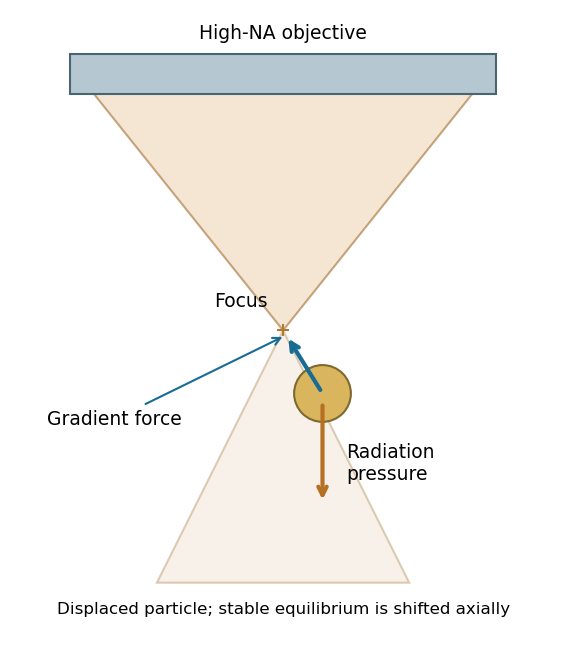

For a Rayleigh sphere, in an absolute-permittivity convention, and for peak complex field amplitude. Near a stable point, ; the trap depth must exceed thermal fluctuations sufficiently to retain the particle. Viscous drag opposes motion, Brownian forcing produces fluctuations, and gravity/buoyancy are normally small at this scale.
For absorbing gold, use its complex wavelength-dependent permittivity: scattering, absorption and heating can frustrate trapping. The existence of an ideal dielectric gradient-force trap does not guarantee stable trapping of every metal nanoparticle at every wavelength or power.[ref]
Observation of a single-beam gradient force optical trap for dielectric particles by Arthur Ashkin and others. General optical trapping principle; gold-specific absorption qualification is separate
Articles by others on the same topic
There are currently no matching articles.