Only the magnetic-response physics is addressed here; biological and clinical application is user-deferred.
A single-domain particle has an approximately coherent magnetic dipole moment, but single-domain does not by itself imply rapid thermal reversal. If moments equilibrate within the measurement time, a dilute, noninteracting ensemble is superparamagnetic: its quasistatic magnetization is reversible, odd in field and approaches saturation with negligible remanence or magnetic coercivity.
For freely orientable classical moments,At small field, ; at large field moments align. This Langevin form is an ideal limit, not a universal exact curve for anisotropic fixed-axis particles.
The missing timescale/magnetic anisotropy information must be stated: blocked single-domain particles can already show hysteresis. Also, a reversible quasistatic curve does not preclude a finite-frequency loss loop when relaxation lags an alternating field. The original curves illustrate an equilibrated dilute limit and possible blocked/interacting alternatives, not measured treatment performance.
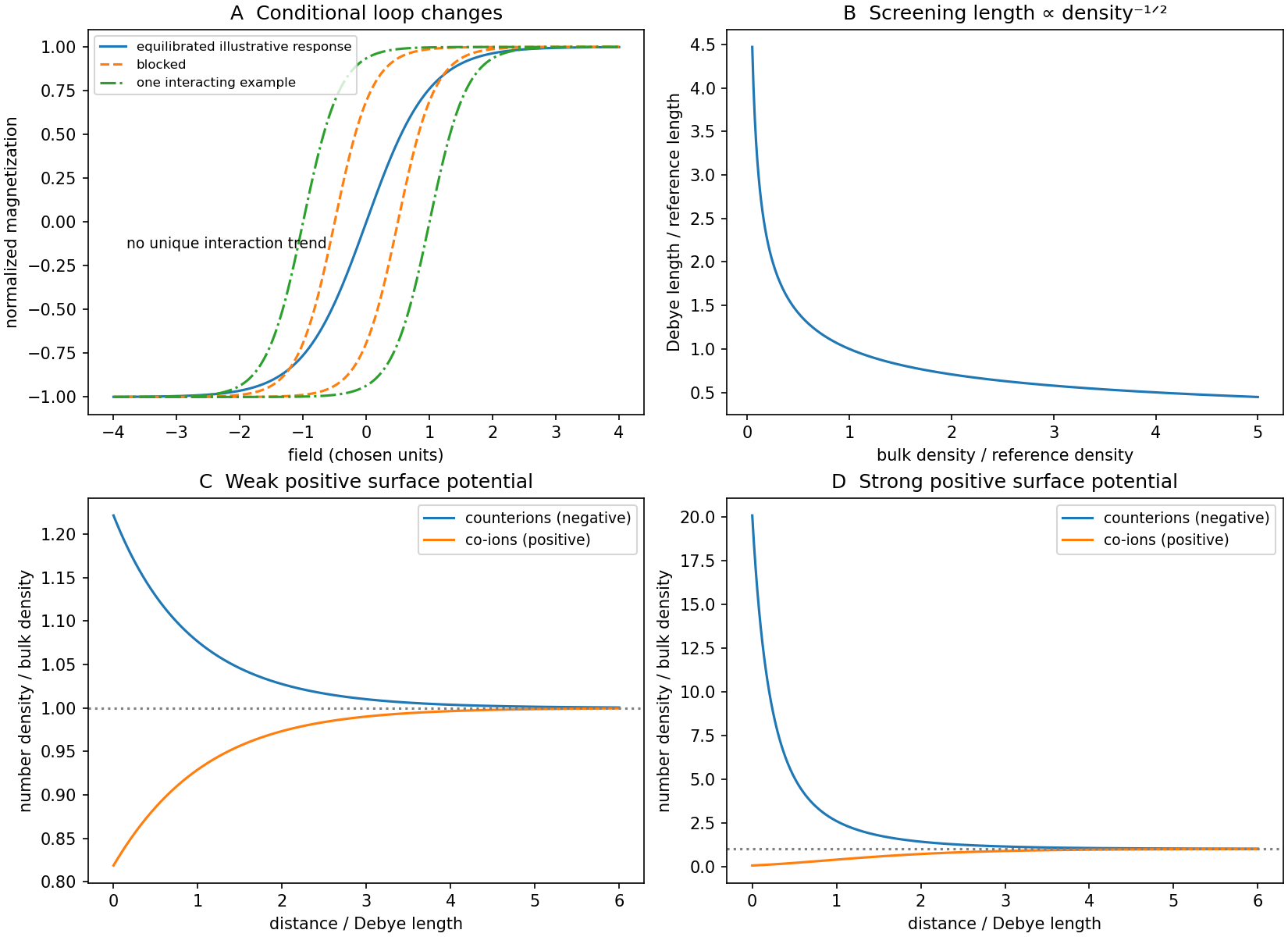
Conditional magnetic loops and electrostatic screening profiles
. Original illustrative magnetic curves and calculated planar mean-field ion profiles. Magnetic-loop broadening is one possible interaction outcome, not a concentration-dependent experimental fit or a clinical prediction. Details.
Thermally activated moment reversal, or Néel relaxation, often has an activated timescaleLowering temperature increases . When it becomes comparable to the observation time , the ensemble crosses an operational magnetic blocking temperature,Above this blocking crossover, an equilibrated ensemble remains reversible; its low-field susceptibility can increase as temperature falls. Below it, moments cannot fully relax during the field sweep, so magnetic coercivity and remanence can emerge and the loop opens. A distribution of particle volumes/anisotropies broadens the crossover.
This is a timescale-dependent blocking effect, not necessarily a thermodynamic phase transition. Rotation of whole particles in a fluid can supply an additional relaxation channel, and the particle orientation distribution affects the observed loop. Compare sweep rates and temperatures before interpreting one curve as an intrinsic static material law.
At greater concentration, the mean separation falls and the independent-moment approximation can fail. The magnetic dipole interaction has characteristic scalewith sign and angular dependence set by moment orientation. Correlated clusters, chains or frustrated arrangements change local fields and relaxation barriers.
A plausible example is a progressively less reversible loop with larger remanence/magnetic coercivity when interactions slow collective relaxation; the figure illustrates that case. The trend is not universal: some arrangements reduce susceptibility or suppress remanence, and aggregation can introduce a different response from a uniform concentrated dispersion. Neither loop area nor magnetic coercivity must vary monotonically with concentration.
At the actual drive frequency, the dissipated energy per cycle per unit volume is proportional to . Measure this dynamic loop rather than inferring dissipation from an unrelated slow sweep. Compare equal magnetic-material amounts, inspect dispersion state, and vary frequency to separate concentration-driven interactions from simple signal scaling. No biological efficacy is inferred.
For the nonbiology fabrication objective, reduce unwanted dipolar coupling while preserving a useful single-particle dynamic response. Lithographically reduce magnetic volume or adjust aspect ratio to control and magnetic anisotropy. Reducing reduces the characteristic pair interaction approximately as , but also changes and relaxation time.
A nonmagnetic spacer coating or stable surface layer can maintain minimum center-to-center separation after release and reduce aggregation. At a fixed magnetic volume fraction this geometric constraint has a real packing cost; separation cannot be increased without limit while claiming unchanged loading.
Tune particle volume, magnetic anisotropy and spacing together, then measure dynamic susceptibility/loop area at the specified temperature and frequency. In a simple single-relaxation model, useful phase lag occurs near ; making particles so small that reversal is essentially instantaneous can reduce dissipative response. Clinical treatment optimization remains user-deferred; these are materials/fabrication controls, not a treatment recommendation.
For a nonrelativistic electron,Using the supplied constants givesThis is comparable with atomic lattice spacings. A suitable crystalline surface or sufficiently thin crystal can therefore diffract the electron beam; the reciprocal-lattice geometry and scattering conditions determine the actual angles. A grating or slit can also diffract matter waves if its scale and coherence conditions are suitable. The kinetic energy is tiny compared with the electron rest energy, so relativistic corrections are negligible at the stated precision.
The printed rounded coefficients have normThus the expected rounded answer is . If the decimal coefficients are treated as literal exact inputs and the state normalized, the exact probability for that input is . This distinction avoids treating rounding error as a physical departure from wavefunction normalization.
Orthonormal energy eigenstates contribute incoherently to the expectation of energy:Therefore for the normalized literal decimals. Ignoring the small rounding-induced norm error gives , conventionally reported at this precision as about . The mean need not equal an individual energy eigenvalue.
Each energy component acquires its own phase:The factor normalizes the printed rounded input; it can be omitted if the coefficients are regarded as an already normalized rounded representation.
The energy probabilities and remain constant under this time-independent hamiltonian because phase factors have unit modulus. position probabilities can nevertheless vary: interference between different energy components generally changes with their relative phases. A stationary energy distribution is not the same thing as a stationary spatial probability distribution.
The result projects the state onto the corresponding nondegenerate energy eigenstate. Immediately after an ideal measurement,for an unobservable overall phase . Subsequent isolated evolution adds but does not mix in other energy eigenstates. A repeat ideal energy measurement gives with probability one, provided the hamiltonian is unchanged and no intervening disturbance occurs.
Articles by others on the same topic
There are currently no matching articles.