For a positive photoresist, let be the largest exposure preserving the initial film thickness and the clearing dose. The photoresist contrast is . An aerial image can clear its maxima while retaining its minima only ifThus and for the lower- and higher-contrast materials. Reading those levels on the supplied modulation transfer function gives maximum normalized spatial frequencies approximately and , respectively. The stated partial coherence is already represented by that curve; do not multiply the read frequencies by another coherence factor.
The unambiguous pattern dimensions are full pitch and equal line/space width , where is the read normalized frequency. To convert the paper's Rayleigh-frequency label into lengths, explicitly use the circular-pupil Rayleigh criterion and . With the ArF vacuum wavelength and the stated numerical aperture, , givingThe higher-contrast material resolves a line/space feature about two-thirds as wide. The pitch and half-pitch distinction matters: the point-separation Rayleigh criterion is not itself an equal-line/space width. If a course defines as an optical cutoff rather than , use that specified frequency in ; the normalized graph readings and their ratio are unchanged. No absolute clearing dose is provided.
On a graph of normalized remaining thickness against , both positive photoresist curves remain near unity below and fall to zero by . Their transition widths are : decades for the lower-contrast material and decades for the higher-contrast material. The latter therefore has a much steeper transition. The curves can be aligned at a common illustrative clearing dose; their absolute horizontal placement cannot be inferred from photoresist contrast alone.
The higher-contrast material distinguishes bright and dark regions even when diffraction has reduced their intensity modulation. The lower-contrast material requires a much stronger aerial-image modulation and loses small features earlier. Finite resist thickness, standing waves, acid diffusion, development conditions and photon statistics can limit actual performance beyond this threshold model.
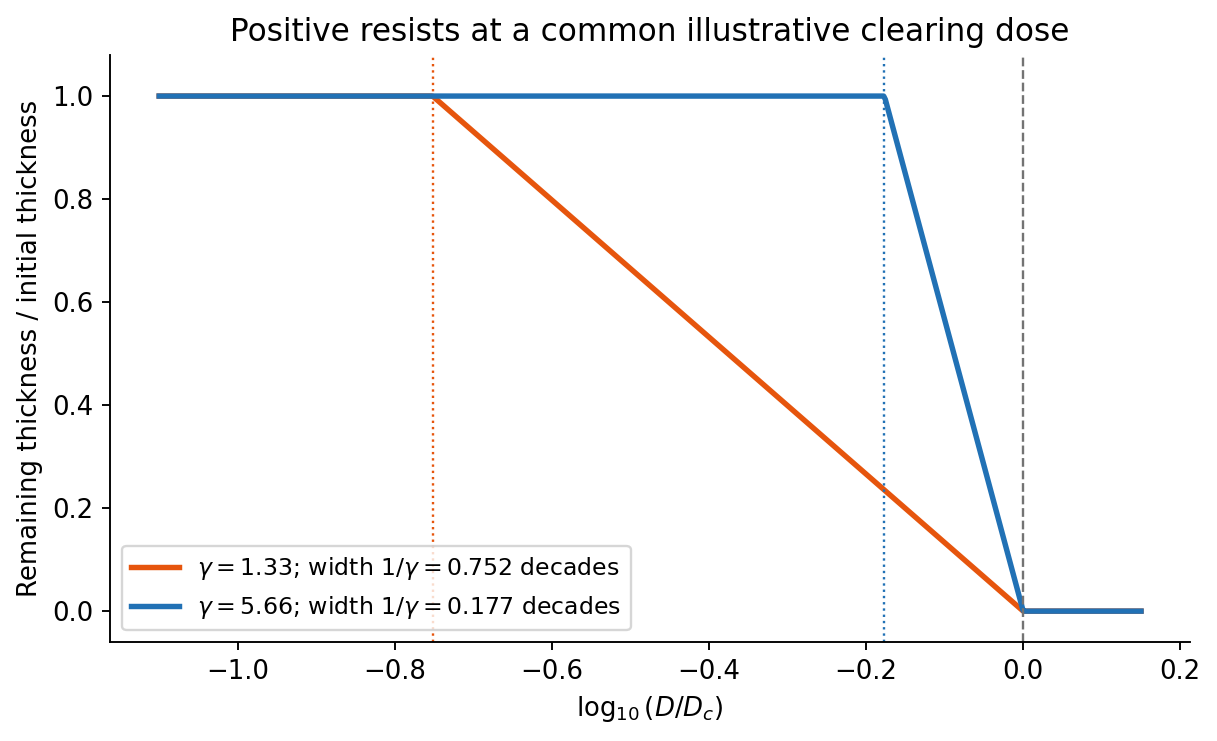
Original normalized positive-resist contrast curves illustrating transition widths, with no assumed absolute sensitivity
. Details. 
Solve the stated depth of focus relation before substituting into the resolution expression:This uses the supplied empirical and unchanged and interprets as the minimum line or space width of an equal-line/space square grating. Under that convention its pitch is . Other pattern shapes or a different definition of the quoted depth of focus would require different process factors.
An immersion liquid increases numerical aperture through , if the optics can use the same ray angle inside a transparent, chemically compatible liquid of refractive index . With unchanged and vacuum wavelength, the width scales as at fixed angle. If the two empirical formulae printed in the question are used literally with fixed , they give .
For a physical axial displacement inside the medium, however, the familiar paraxial defocus range contains an additional index factor: . That convention gives at fixed ray angle, or an approximately -fold larger depth of focus at fixed and resolution. Thus immersion can improve lateral resolution, while its focus benefit depends on what is held fixed and on the axial-focus convention. It cannot improve resolution merely by inserting into while ignoring optical redesign, absorption or resist compatibility. No liquid index is supplied for a numerical prediction.
First, use a phase-shift mask: neighbouring openings transmit appropriately phased light, increasing the intensity slope and improving separation of neighbouring bright regions. The benefit is pattern dependent and phase conflicts or mask defects must be controlled. Second, use off-axis illumination matched to the grating orientation, so useful diffracted orders fall inside the projection pupil and contribute interference contrast at smaller pitch. Check orientation dependence and the reduced process window; it does not enlarge the geometrical pupil.
Third, use optical proximity correction and subresolution assist features to compensate the pattern-dependent aerial-image distortion at edges and corners. Verify the printed critical dimensions using a focus–exposure matrix and scanning electron microscopy. These are three adaptations of the existing exposure process that lower effective ; none promises arbitrary subwavelength structure. A thinner, higher-contrast photoresist and an antireflection underlayer can further improve pattern transfer, but do not change the wavelength.
Articles by others on the same topic
There are currently no matching articles.