The change from a positive surface potential to a negative potential outside the compact layer is consistent with specific phosphate adsorption that overcompensates the positive oxide charge. The negative compact-layer charge then has a diffuse excess of positive counterions. This charge reversal is an interfacial-chemistry interpretation, not something a single monotone double-layer profile with an unchanged positive boundary charge could generate by screening alone. Surface potential and zeta potential at a slip plane are distinct observables.
The Stern model separates the specifically adsorbed compact layer from a diffuse layer. In a spherical diffuse layer, a Poisson-Boltzmann equation description isAt sufficiently small , the Debye–Hückel approximation gives . If is the outer compact-layer radius, its decaying solution isFor a locally flat surface, the geometric factor tends to unity. Thus the far-field negative potential approaches zero from below over the Debye–Hückel screening length. Neither nor is safely in the low-potential linear regime at room temperature, so the simple exponential is a far-field approximation, not a globally valid fit. The phosphate layer requires adsorption chemistry or an equivalent specified boundary model.
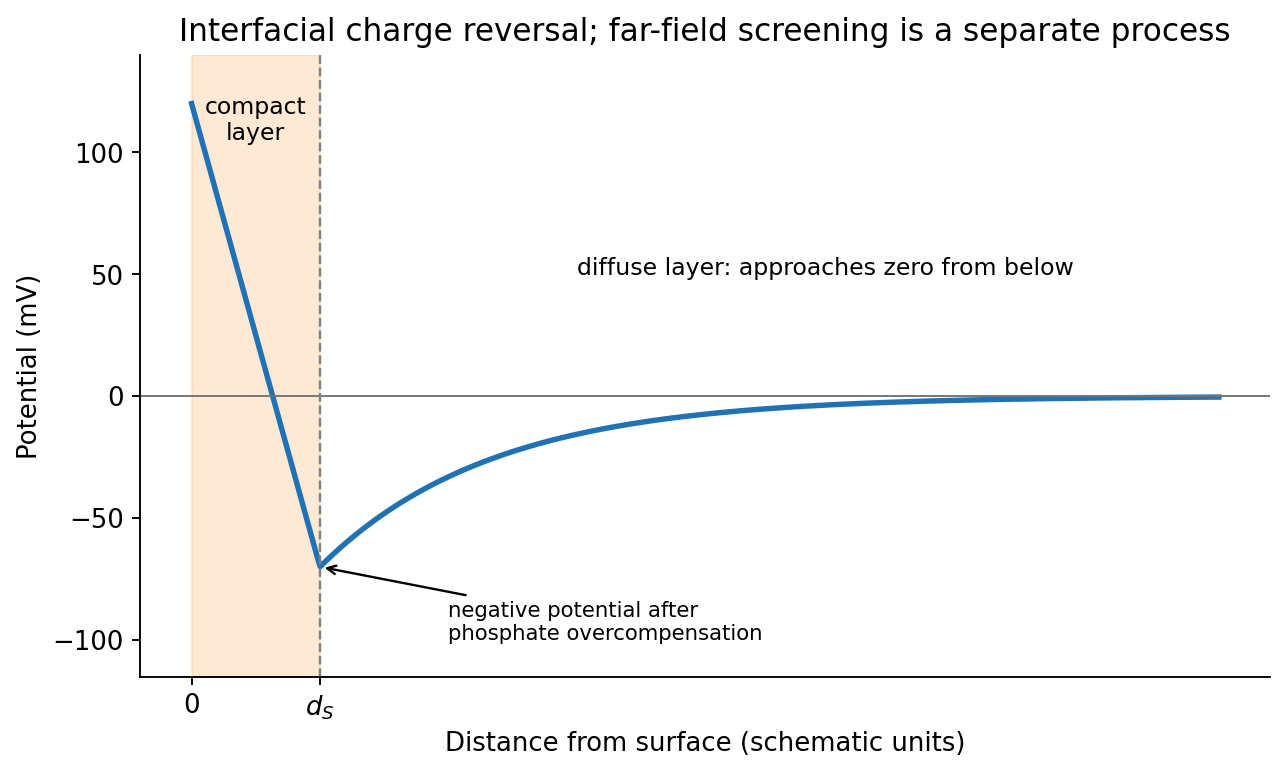
Original illustrative compact-layer charge reversal followed by a negative screened far-field potential
. Details. 
For an ideal dilute electrolyte with molar ionic strength , measured in , the Debye–Hückel screening length isTaking water's relative permittivity as approximately at , for NaCl. Therefore . This is an exponential screening length, not a hard outer edge of the diffuse layer. The factor of converts molarity into .
A formula-unit concentration of fully dissociated gives trivalent cations and chloride:At unchanged temperature and permittivity, the Debye–Hückel screening length scales as , giving . It falls by a factor , not by three. This is a formal screening estimate: at this ionic strength, trivalent-ion activity, finite ion size, hydrolysis and specific adsorption make the ideal dilute model quantitatively limited.
Articles by others on the same topic
There are currently no matching articles.