DLVO theory adds short-range attractive Van der Waals forces to repulsive overlap of the electric double layer. Increasing salt concentration raises the ionic strength and shortens the Debye length, screening the repulsion. The repulsive barrier falls, so thermal collisions can carry particles into the primary attractive minimum and cause colloidal coagulation. An intermediate shallow secondary minimum can instead produce weak, potentially reversible association.
The figure's assignments are a: low salt; b: intermediate salt; c: high salt. Curve a has the largest protective barrier, b a lower barrier and secondary minimum, and c no effective repulsive barrier. This explanation assumes the surface charging chemistry does not independently reverse or radically change the surface potential.
The critical coagulation concentration is the electrolyte concentration at which rapid, approximately diffusion-limited colloidal coagulation begins: the electrostatic barrier has become ineffective and nearly every sufficiently close encounter sticks. It is an operational threshold for the specified colloid and electrolyte, not a universal concentration or a guarantee of a mathematically exact zero barrier in every system.
In the usual high-surface-potential Schulze-Hardy rule approximation, , where is the magnitude of the counterion valence. Consequently,Multivalent counterions screen surface charge much more effectively and strongly lower the electrostatic barrier. The sixth-power estimate includes the way the critical ionic strength and screening condition change with valence; merely scaling the ordinary Debye length at fixed salt concentration would not derive it. Specific adsorption, charge regulation or ion correlations can produce substantial deviations.[ref]
Schulze-Hardy rule in the IUPAC Gold Book. Counterion-valence sensitivity of the critical coagulation concentration
Use steric stabilization: attach or strongly adsorb a dense layer of polymer chains or compatible ligands, with tails well solvated by the nonpolar liquid. Overlap of these layers costs osmotic and conformational free energy and prevents particle cores reaching the strongly attractive contact region. The anchoring groups must bind the particle while the exposed chains prefer the solvent; sufficient coverage and a good solvent are essential. Nonpolar media do not make charging impossible, but electrostatic stabilization there requires an appropriate ion-generation and charge-stabilization mechanism, rather than assuming aqueous dissociation behaviour.
Adsorbed or grafted polymers stabilize a colloid through steric stabilization when coverage is high and the solvent keeps the chains extended. Charged chains can add electrostatic repulsion, giving electrosteric stabilization.
They can destabilize it through polymer bridging flocculation when a chain adsorbs onto two particles, especially at incomplete coverage; through depletion force when nonadsorbing polymer is excluded from the gap and the surrounding solution's osmotic pressure pushes particles together; or through collapse of an adsorbed layer in a poor solvent. Polymer identity, molecular size, solvent quality, adsorption and concentration determine which mechanism dominates.
The discharge reaction is . It transfers two electrons and has per reaction as written. The reversible open-circuit voltage isThe supplied free energy is already at approximately the requested temperature, so an additional temperature factor is unnecessary. Actual activities or discharge polarization could alter the terminal voltage.
The stored energy is , and the load draws . HenceThis is an ideal energy-budget estimate using 365.25 days per year. It assumes the stated energy is usable at this load, constant current and voltage, and negligible self-discharge, ageing and reserve capacity. No biological operating model is required.
The Seebeck effect produces an open-circuit voltage when a material has a temperature gradient: for the stated sign convention. A circuit containing dissimilar thermoelectric legs converts this into useful voltage and current. The intrinsic thermoelectric figure of merit isHere is electrical conductivity and total thermal conductivity. has units ; is dimensionless. A large Seebeck coefficient and electrical conductivity, together with low thermal conductivity, favour efficient conversion.
At low carrier concentration, can be large but electrical conductivity is too small. Increasing the carrier concentration usually increases , while decreases. Electronic thermal conductivity rises approximately as by the Wiedemann-Franz law; lattice conduction supplies an additional background. Thus neither an insulator nor an ordinary metal usually maximizes .
Heavily doped semiconductors and semimetals often give the useful compromise, near a maximum of as doping is varied. The optimum is material- and temperature-dependent; there is no universal optimal concentration.
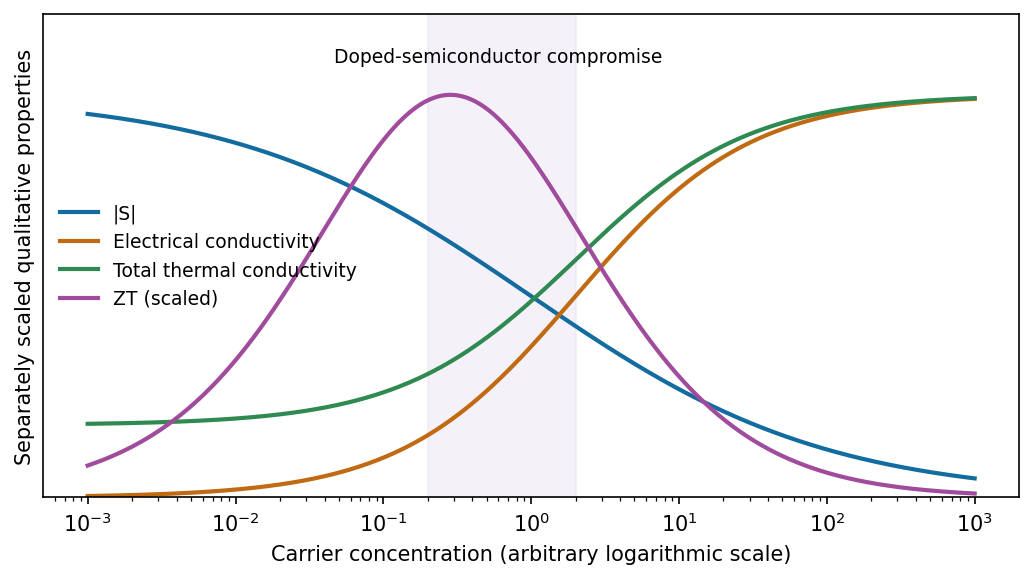

[ref]
Complex thermoelectric materials by G. Jeffrey Snyder and Eric S. Toberer. Carrier-concentration trade-off and thermoelectric optimization
Tune doping to the optimum carrier concentration; a rise in conductivity is useful only if it outweighs the accompanying loss of thermopower and extra electronic heat conduction. Band convergence, favourable density of states and energy-dependent transport can improve the power factor , provided mobility is retained.
Reduce lattice thermal conductivity through alloy disorder, heavy or complex unit cells, grain boundaries and nanoscale inclusions that scatter phonons. Aim to scatter heat-carrying phonons much more strongly than charge carriers; indiscriminate disorder can reduce both thermal and electrical conductivity. Nanostructuring and interfaces can therefore help, but an improvement must be demonstrated in total at the operating temperature, not inferred from lower alone.[ref]
Complex thermoelectric materials by G. Jeffrey Snyder and Eric S. Toberer. Strategies for improving electronic transport and reducing lattice heat conduction
Articles by others on the same topic
There are currently no matching articles.